
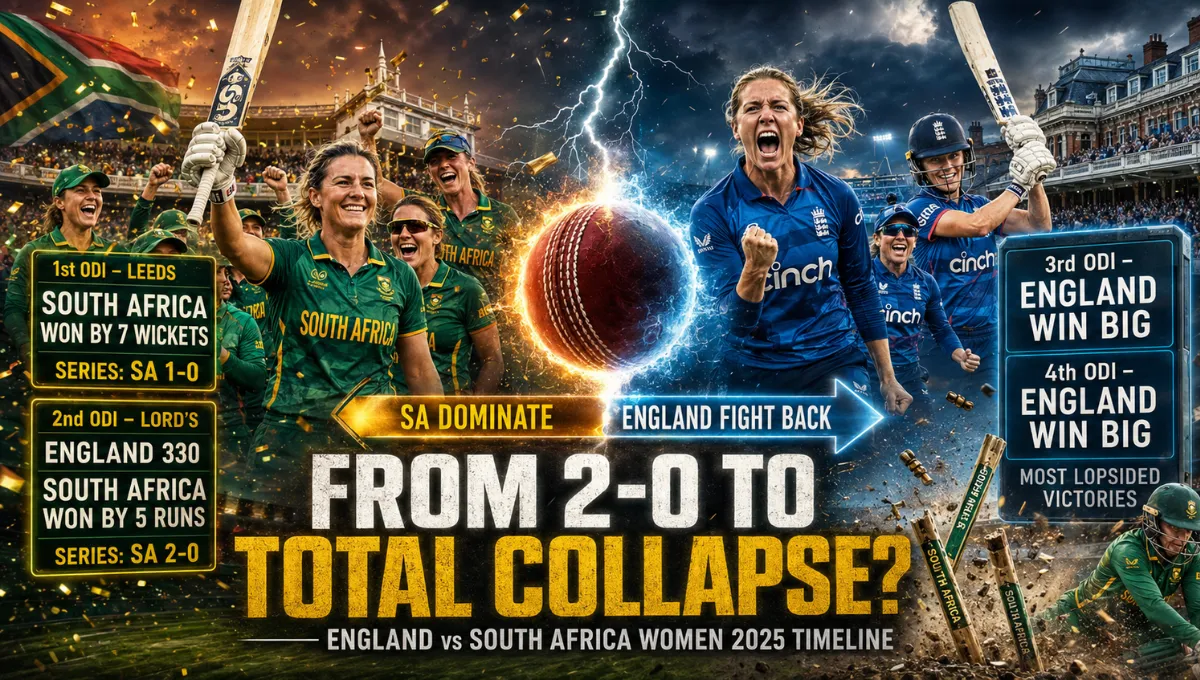
South Africa win the toss, chase down a target with seven wickets in hand, and take a 1-0 lead in Leeds. Two days later, they do it again, edging out a 330-run tally by just five runs at Lord’s. South Africa look unstoppable. But here’s the real problem nobody explains what happened next, because England responded with the two most lopsided wins of the entire series.
This article lays out the complete 2025 timeline, breaks down exactly where the momentum flipped, and explains what the series result actually reveals about both teams.
Head-to-Head Record Across History
What most people miss is that England’s dominance over South Africa is almost entirely a Test cricket phenomenon. Away from the red ball, this rivalry is far closer than most fans assume.
| Format | Matches | England Won | South Africa Won | Draw/NR/Tied |
|---|---|---|---|---|
| Test | 156 | 66 | 35 | 55 |
| ODI | ~90 | ~40 | ~44 | ~6 |
| T20I | ~20 | ~11 | ~9 | 0 |
| Overall | 258 | 110 | 86 | 62 |
What people think vs reality: fans assume England’s clear overall lead (110 wins to 86) means England dominates every format. Test cricket is genuinely where England pulls ahead 66 wins to 35, almost double. In white-ball formats, that gap nearly disappears, and recent results show South Africa is often the more competitive side in ODIs specifically.
Why the Format Split Matters More Than the Overall Number
A single combined head-to-head number hides more than it reveals here. Anyone using “England leads 110-86” to predict a white-ball series is reading the wrong stat entirely. The Test record is built on 130-plus years of history, much of it from eras when South Africa was isolated from international cricket. The white-ball numbers are a far better guide to current form.
The ODI Leg: South Africa’s Fast Start
South Africa toured England in September 2025 for a three-match ODI series followed by three T20Is. The ODI leg started as a near-total statement from the visitors.
| Match | Venue | Result |
|---|---|---|
| 1st ODI | Headingley, Leeds | South Africa won by 7 wickets |
| 2nd ODI | Lord’s, London | South Africa won by 5 runs |
| 3rd ODI | The Rose Bowl, Southampton | England won by 342 runs |
Read Also:- Australian Men’s Cricket Team Vs England Cricket Team Timeline
England were bowled out for just 131 in the first ODI, and South Africa chased it down with 175 balls to spare, powered by Keshav Maharaj’s Player of the Match performance. The second ODI at Lord’s was tighter South Africa posted 330/8, and England fell agonizingly short at 325/9, with Matthew Breetzke earning Player of the Match honors for South Africa.
The 342-Run Response Nobody Saw Coming
Everyone’s recap notes England’s win in the third ODI. Almost nobody explains how completely the momentum reversed. England posted 414/5, their highest total of the series by a huge margin, then bowled South Africa out for just 72 a collapse of historic proportions that handed England a 342-run win, one of the largest ODI victory margins in the format’s history.
This is where things go wrong for readers checking a bare results list: a 2-1 series score suggests a closely contested series. It wasn’t. South Africa’s first two wins were narrow, hard-fought contests. England’s one win was a near-total demolition that erased any momentum South Africa had built.
My honest take: a team that goes from 330/8 one match to 72 all out the next isn’t just having a bad day. It points to a genuine fragility in South Africa’s batting depth once conditions or bowling pressure shift even slightly. That collapse should worry South Africa’s team management far more than the 2-1 scoreline suggests, because it shows their batting confidence has almost no buffer once things start going wrong.
Why the 131 All Out Opener Mattered Too
It’s worth noting the series didn’t start as a batting contest at all England collapsing to 131 in the opener was arguably as extreme a result as South Africa’s later 72 all out. Both teams showed they could implode completely under the right bowling pressure. That’s the real throughline of this ODI series: neither batting lineup was reliably solid across all three matches.
The T20I Leg: England’s Statement Win
The T20I leg opened with more late drama. South Africa won the first T20I at Cardiff by 14 runs under the DLS method, with Donovan Ferreira picking up Player of the Match.
England answered immediately in Manchester, posting 304/2 a near-unbeatable total before restricting South Africa to just 158, winning by 146 runs. Phil Salt was named Player of the Match for the innings that set up the total.
| Match | Venue | Result |
|---|---|---|
| 1st T20I | Sophia Gardens, Cardiff | South Africa won by 14 runs (DLS) |
| 2nd T20I | Old Trafford, Manchester | England won by 146 runs |
| 3rd T20I | Trent Bridge, Nottingham | Match abandoned, no toss |
What people think vs reality: fans watching South Africa’s DLS win at Cardiff assumed the format suited them well after their ODI form. England’s response at Old Trafford proved that assumption wrong within 48 hours 304/2 is the kind of total that erases any tactical advantage a shortened, rain-affected format might offer.
The Pattern Across Both Formats
Look closely and both legs of this tour follow the same shape: South Africa starts strong, England responds with a genuinely dominant performance, and the series never fully resolves. That’s not a coincidence specific to one format it’s a pattern that shows up in both the ODI and T20I legs independently.
Why the Series Ended Without a Winner
The third T20I at Trent Bridge was abandoned due to rain before a toss even took place, leaving the T20I series tied 1-1 and the tour without a clean overall winner across formats.
This is a genuinely underappreciated detail. A series with this many momentum swings three separate results decided by under 15 runs or via DLS, alongside two blowouts over 140 runs deserved a deciding match. Instead, weather denied both sides a clear resolution.
What people think vs reality: fans often assume rain-abandoned matches are minor footnotes. In a series this evenly split on paper (South Africa won the ODI leg 2-1, the T20I leg finished 1-1 with one no result), the missing third T20I genuinely changes how this tour should be remembered — as unresolved rather than decisively won by either side.
What a Completed Decider Might Have Shown
Based on the pattern across the tour, a completed third T20I likely would have been closer to the Cardiff result than the Old Trafford blowout, given how the series alternated between tight finishes and lopsided wins. That’s speculation, but it’s grounded in the actual rhythm of results across six matches not a random guess.
Full Series Summary Table
| Format | Series Result | Standout Performer |
|---|---|---|
| ODI (3 matches) | South Africa won 2-1 | Matthew Breetzke |
| T20I (3 matches, 1 abandoned) | Tied 1-1 | Phil Salt |
| Overall tour | No outright winner | Multiple, split across teams |
Read Also:- Pakistan National Cricket Team Vs New Zealand National Cricket Team Timeline
What People Get Wrong About This Rivalry
A common mistake is assuming South Africa’s recent white-ball competitiveness means they’ve closed the gap with England across all formats. They haven’t. England’s 66-35 Test record is one of the most one-sided major head-to-heads in the sport, built over 130-plus years of contests.
Another mistake: reading the 2025 ODI series (South Africa won 2-1) as a sign South Africa now has the batting edge in 50-over cricket. The 342-run margin in the third ODI tells a different story South Africa’s batting can collapse just as dramatically as it can chase brilliantly, sometimes in the very next match.
A third, counterintuitive point worth stating directly: this 2025 tour, despite its lopsided individual results, was actually one of the more competitive white-ball series between these two sides in years. Three matches decided by 14 runs, 5 runs, or DLS math is a genuinely close series on paper it’s the two outlier blowouts that make it look one-sided in hindsight.
What Both Teams Should Actually Take From This Tour
For South Africa, the priority is batting consistency under sustained bowling pressure the 72 all out and 158 all out results both came in matches where England’s bowlers found early rhythm. For England, the lesson is the opposite: their batting lineup showed it can collapse to 131 just as easily as it can post 414, meaning their recent white-ball form remains genuinely inconsistent despite the two big wins.
Frequently Asked Questions (FAQs)
Q1. What was the result of the South Africa tour of England 2025?
Ans. South Africa won the ODI series 2-1, and the T20I series finished 1-1 with the decider abandoned due to rain.
Q2. What is the all-time Test head-to-head between England and South Africa?
Ans. England leads significantly with 66 wins from 156 Tests, compared to South Africa’s 35 wins, with 55 draws.
Q3. Who won the most one-sided match in the 2025 South Africa vs England series?
Ans. England won the 3rd ODI at Southampton by 342 runs, one of the largest margins in ODI history.
Q4. Did England and South Africa play a decisive final match in the 2025 series?
Ans. No. The 3rd T20I at Trent Bridge was abandoned due to rain before a toss took place.
Q5. Who won Player of the Match most often in the 2025 series?
Ans. South African players won three of the five completed matches’ awards: Keshav Maharaj, Matthew Breetzke, and Donovan Ferreira.
Q6. Does England or South Africa lead the overall head-to-head across all formats?
Ans. England leads overall with 110 wins from 258 matches, but the margin is far closer in ODIs and T20Is than in Tests.



Leave a Reply