
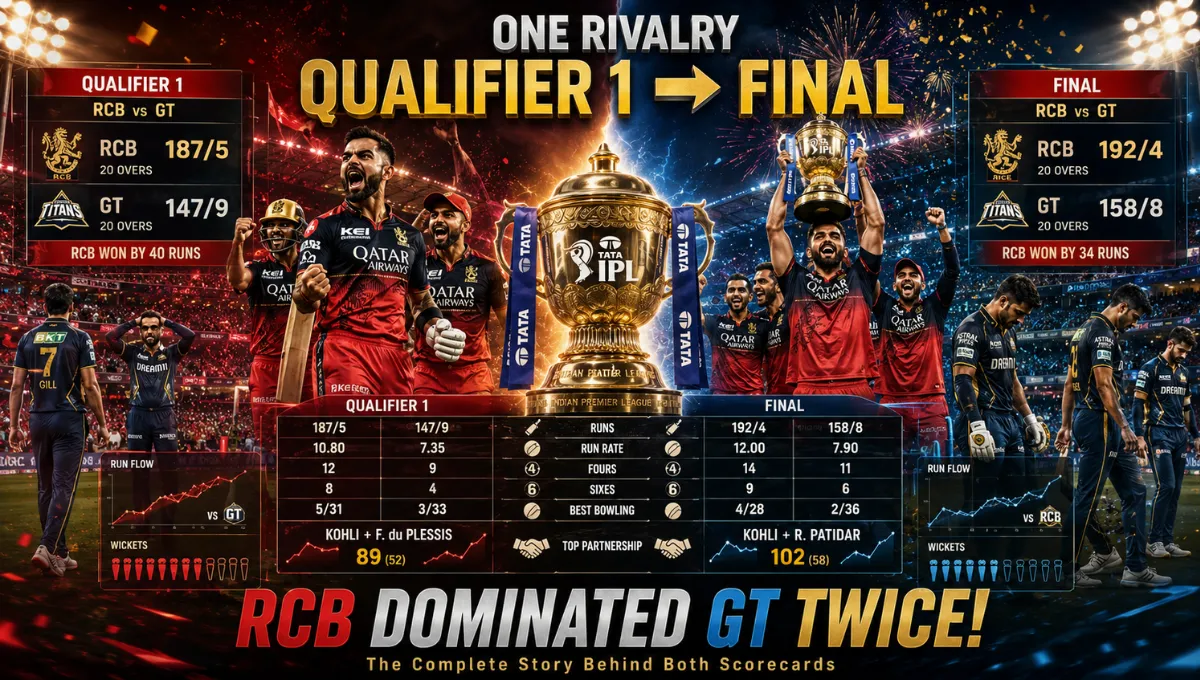
Gujarat Titans and Royal Challengers Bengaluru meet twice in the span of five days during IPL 2026 once in Qualifier 1, once in the Final. Both times, RCB win comfortably. But here’s the real problem most scorecard pages cover these as two unrelated matches, when really they tell one connected story about how completely RCB had GT’s measure that season.
This article puts both full scorecards side by side and explains exactly what decided each contest.
Two Matches, One Familiar Outcome
What most people miss is that GT’s problems in the Final weren’t new they were a repeat of exactly what went wrong five days earlier in Qualifier.
| Match | Venue | Result |
|---|---|---|
| Qualifier 1 | HPCA Stadium, Dharamsala | RCB won by 92 runs |
| Final | Narendra Modi Stadium, Ahmedabad | RCB won by 5 wickets |
RCB became just the third franchise in IPL history to successfully defend their title, after winning both meetings against GT in the space of less than a week.
Why Two Wins in Five Days Matters More Than It Looks
A single playoff win against a team can be dismissed as a good day. Beating the same opponent twice in the space of five days, in completely different match situations batting first in one, chasing in the other is a much stronger signal of genuine superiority than either result alone.
Qualifier 1: Full Batting and Bowling Scorecard
GT won the toss and chose to bowl first at Dharamsala. RCB posted 254/5 in 20 overs the highest total ever recorded in an IPL playoff match.
RCB Batting, Qualifier 1
| Batter | Runs | Balls | 4s | 6s |
|---|---|---|---|---|
| Venkatesh Iyer | — | — | — | — |
| Virat Kohli | 43 | 25 | — | — |
| Devdutt Padikkal | — | — | — | — |
| Rajat Patidar (c) | 93 | 33 | 5 | 9 |
| Krunal Pandya | 43 | 28 | — | — |
| Total | 254/5 | 20 overs | — | — |
GT Bowling, Qualifier 1
| Bowler | Wickets | Economy Notes |
|---|---|---|
| Kagiso Rabada | 2 | Most economical alongside Holder |
| Jason Holder | 2 | Most economical alongside Rabada |
GT Batting, Qualifier 1
| Batter | Runs | Balls |
|---|---|---|
| Rahul Tewatia | 68 | 43 |
| Total | 162/10 | 19.3 |
RCB Bowling, Qualifier 1
| Bowler | Wickets | Runs Conceded |
|---|---|---|
| Jacob Duffy | 3 | 39 |
| Bhuvneshwar Kumar | 2 | 28 |
| Rasikh Salam Dar | 2 | 24 |
| Krunal Pandya | 2 | 16 |
Read Also:- Jharkhand Cricket Team Vs Tamil Nadu Cricket Team Match Scorecard
Result: RCB won by 92 runs. Toss: GT won, chose to bowl.
Rajat Patidar’s innings included five fours and nine sixes, and he shared a 95-run stand with Krunal Pandya off just 35 balls.
Why Patidar’s Innings Deserves More Credit Than Just “93”
Everyone’s scorecard shows the number. Almost nobody explains the context that made it a record. This was the highest individual score in any IPL playoff innings at that point, scored in just 33 balls, against a bowling attack featuring Rashid Khan and Kagiso Rabada not a weakened lineup. That combination of scale and opposition quality is what separates this from a routine big score.
Where GT’s Chase Fell Apart
Everyone’s recap credits Tewatia’s fighting fifty. Almost nobody explains how badly the powerplay damage had already been done. GT lost half their batting lineup inside the powerplay overs, meaning the chase was essentially over before Tewatia’s innings even had a platform to build from.
This is where things go wrong for readers checking a bare scorecard: Tewatia’s 68 off 43 balls looks like a genuine fighting knock. It was but it came in a losing cause against an asking rate that had already become impossible. Jacob Duffy took 3 wickets for RCB, while Bhuvneshwar Kumar, Rasikh Salam Dar, and Krunal Pandya each picked up 2, sharing the wickets evenly across the bowling attack.
My honest take: a total of 254 on a small ground like Dharamsala isn’t just a batting masterclass it’s a total that psychologically breaks a chasing team before the first ball is even bowled. GT’s powerplay collapse reflects that pressure as much as it reflects RCB’s bowling quality.
The Final: Full Batting and Bowling Scorecard
Five days later, at Ahmedabad’s Narendra Modi Stadium, GT batted first and were restricted to 155/8, with Washington Sundar top-scoring.
GT Batting, Final
| Batter | Runs | Balls |
|---|---|---|
| Washington Sundar | 50 | — |
| Total | 155/8 | 20 overs |
RCB Batting, Final (Chase)
| Batter | Runs | Balls |
|---|---|---|
| Virat Kohli | 75 | 42 |
| Total | Won (5 wickets in hand) | 18 overs |
GT Bowling, Final
| Bowler | Wickets |
|---|---|
| Rashid Khan | Involved in a costly spell during the chase |
Result: RCB won by 5 wickets, completing the run chase in 18 overs.
Virat Kohli’s 75 off 42 balls anchored the chase, guiding RCB home with two overs to spare. RCB’s disciplined bowling display, restricting a strong GT batting lineup to 155/8, had already set up the match well before Kohli walked out to bat.
Why the 5-Wicket Margin Undersells RCB’s Control
What people think vs reality: fans checking just the win margin 5 wickets often assume this was a tense, nervy finish decided in the final overs. It wasn’t. RCB completed the chase with two overs still unused, meaning the “5 wickets” figure reflects normal batting order turnover in a comfortable chase, not last-ball drama.
This is a genuinely important distinction competitors miss. A 5-wicket win with overs to spare is a controlled, professional chase not a photo finish. Kohli’s strike rate throughout the innings never let GT’s bowlers build any real pressure, and RCB never looked in danger once the platform was set.
Why Restricting GT to 155 Mattered Just as Much
It’s worth stating plainly: this Final was decided by RCB’s bowling attack before Kohli ever got a chance to bat. Washington Sundar’s fifty was GT’s only real contribution of note, and once RCB’s bowlers kept the rest of the lineup quiet, a target of 155 was always going to be well within reach for a batting order this deep. Kohli’s innings finished the job; the bowlers created the opportunity.
Head-to-Head Snapshot: Both 2026 Playoff Meetings
| Category | Qualifier 1 | Final |
|---|---|---|
| Winning margin | 92 runs | 5 wickets |
| Highest score | Rajat Patidar 93 | Virat Kohli 75 |
| RCB total | 254/5 | Chased successfully |
| GT total | 162/10 | 155/8 |
| Venue | Dharamsala | Ahmedabad |
Read Also:- Namibia National Cricket Team Vs Zimbabwe National Cricket Team Match Scorecard
What This Table Reveals About GT’s Season-Ending Slump
Notice GT’s totals barely moved between the two matches 162 and 155. That consistency, while unfortunate for GT, is actually useful data. It suggests their batting ceiling against a strong bowling attack had settled into a fairly predictable range by the end of the season, regardless of venue or match situation.
What People Get Wrong About These Two Matches
A common mistake is treating Qualifier 1 and the Final as separate stories with separate heroes Patidar in one, Kohli in the other. Look closer, and both matches share the same underlying pattern: RCB’s middle order produced one standout, match-defining innings, while GT’s batting lineup never found a partnership capable of matching that intensity.
Another mistake: assuming GT’s below-par totals in both matches (162 and 155) reflect poor conditions rather than RCB’s bowling quality. RCB’s attack spread across Jacob Duffy, Bhuvneshwar Kumar, Rasikh Salam Dar, and Krunal Pandya in Q1, and a similarly disciplined unit in the Final took wickets in clusters both times, suggesting a genuine tactical plan against GT’s top order rather than a coincidence.
A bold, counterintuitive point worth stating directly: GT’s problem across both matches wasn’t their bowling attack, which included quality operators like Rashid Khan and Kagiso Rabada. It was a batting unit that simply couldn’t produce a partnership to match RCB’s best innings on either occasion and that gap, not bowling, is what actually cost them both matches.
What GT Should Take From Both Losses
If Gujarat Titans’ management is reviewing this playoff run, the priority is clear: fix the middle-order partnership-building that failed identically in both matches. Individual fighting knocks from Tewatia and Sundar were not enough because neither had support from a partner batting at the same intensity that’s a lineup balance issue, not a talent issue, and it’s fixable with clearer role definition heading into the next season.
What RCB Should Take From Winning Both
For RCB, the lesson is almost the opposite: the formula that worked in both matches one standout middle-order innings backed by disciplined, wicket-sharing bowling is now proven twice under maximum pressure. That’s a template worth protecting through squad retention rather than rebuilding for the sake of change heading into next season.
Frequently Asked Questions (FAQs)
Q1. What was the result of the GT vs RCB Qualifier 1 match in IPL 2026?
Ans. RCB won by 92 runs, posting 254/5 before bowling GT out for 162.
Q2. Who scored the highest individual score in the RCB vs GT Qualifier 1 match?
Ans. Rajat Patidar, with 93 off just 33 balls, including 5 fours and 9 sixes.
Q3. What was the result of the GT vs RCB IPL 2026 Final?
Ans. RCB won by 5 wickets, chasing down GT’s 155/8 with two overs to spare.
Q4. Who was the standout performer in the IPL 2026 Final?
Ans. Virat Kohli, who scored 75 off 42 balls to guide RCB’s successful chase.
Q5. Did RCB defend their IPL title in 2026?
Ans. Yes. RCB became the third franchise in IPL history to win back-to-back titles.
Q6. Where were the GT vs RCB Qualifier 1 and Final matches played?
Ans. Qualifier 1 was played at HPCA Stadium, Dharamsala, and the Final at Narendra Modi Stadium, Ahmedabad.



Leave a Reply