
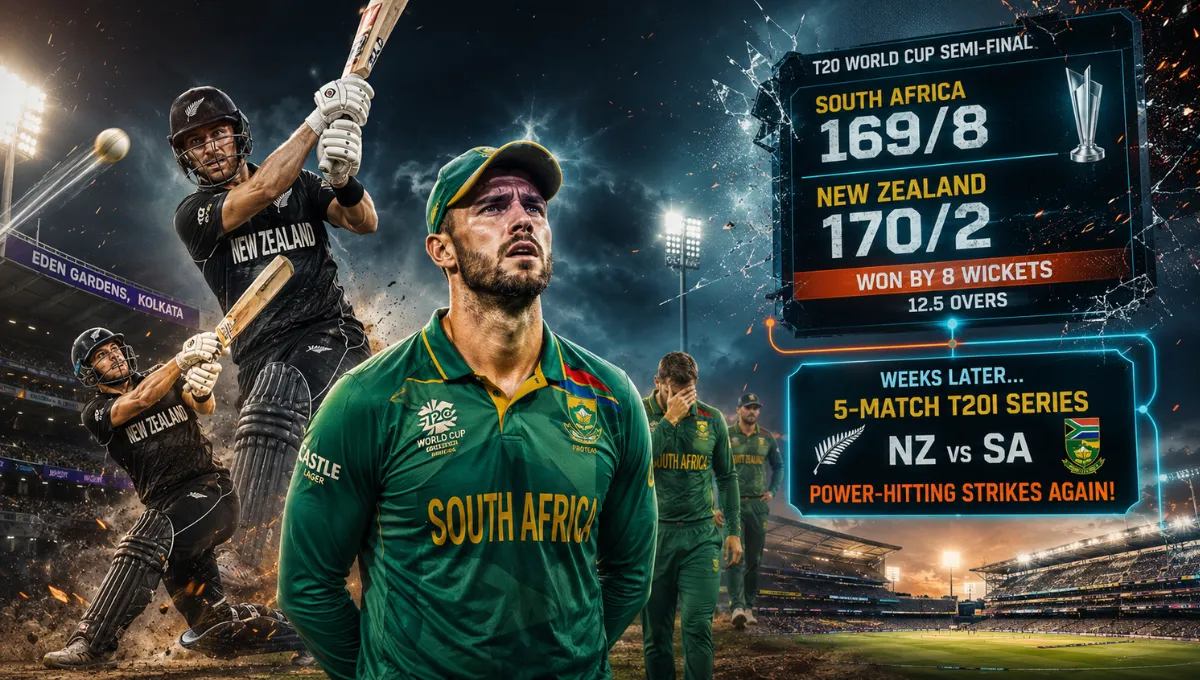
South Africa walk into Eden Gardens for a T20 World Cup semi-final, post a defendable 169, and watch New Zealand chase it down in just 12.5 overs. But here’s the real problem most coverage treats that demolition as a one-off shock, when really it was the first sign of a batting vulnerability that resurfaced just weeks later in a five-match bilateral series.
This article lays out both full scorecards, breaks down exactly how New Zealand’s power-hitting broke South Africa twice, and explains how South Africa still salvaged pride in the bilateral series that followed.
Two Contests, One Recurring Pattern
What most people miss is that these two fixtures, separated by less than two weeks, tell one connected story about South Africa’s struggles against explosive top-order batting.
| Fixture | Venue | Result |
|---|---|---|
| T20 World Cup Semi-Final | Eden Gardens, Kolkata | New Zealand won by 9 wickets |
| Bilateral series (5 T20Is) | New Zealand | South Africa won 3-2 |
Why Connecting Both Events Matters
A single semi-final loss can be dismissed as a bad day on a big stage. When the same opponent chases down a similar total with similar ease in the very next series opener, that’s a pattern worth investigating, not an isolated incident.
The Semi-Final: Full Batting and Bowling Scorecard
South Africa batted first at Eden Gardens and posted 169/8, with Marco Jansen top-scoring with an unbeaten 55.
South Africa Batting, Semi-Final
| Batter | Runs | Balls | Notes |
|---|---|---|---|
| Marco Jansen | 55* | — | Top scorer, unbeaten |
| Dewald Brevis | 34 | — | Second-highest score |
| Total | 169/8 | 20 overs | — |
New Zealand Bowling, Semi-Final
| Bowler | Wickets | Runs Conceded |
|---|---|---|
| Cole McConchie | 2 | 9 |
| Rachin Ravindra | 2 | 29 |
New Zealand Batting, Semi-Final (Chase)
| Batter | Runs | Balls |
|---|---|---|
| Finn Allen | 100 | 33 |
| Tim Seifert | 58 | 30 |
| Rachin Ravindra | 13* | 11 |
| Total | 173/1 | 12.5 overs |
South Africa Bowling, Semi-Final
| Bowler | Wickets | Runs Conceded |
|---|---|---|
| Kagiso Rabada | 1 | 28 |
Read Also:- Gujarat Titans Vs Royal Challengers Bengaluru Match Scorecard
Result: New Zealand won by 9 wickets. Player of the Match: Finn Allen.
Why South Africa’s 169 Wasn’t Really the Problem
Everyone’s headline focuses on Allen’s century. Almost nobody explains that 169 was actually a reasonable total at Eden Gardens that day, given a slower-than-usual pitch. The issue wasn’t South Africa’s batting, It was that Finn Allen’s innings made the total irrelevant within the first six overs.
Allen reached fifty off just 19 balls and hit 10 sixes in an innings that included a 100-run stand with Tim Seifert inside just 47 balls. This is where things go wrong for readers checking a bare scorecard: a “9-wicket loss” sounds like a one-sided mismatch throughout. It wasn’t. South Africa’s total was competitive by any normal standard New Zealand’s chase was simply extraordinary, not a reflection of South African incompetence.
My honest take: no reasonable bowling attack defends against an innings like Allen’s on a given day. The real lesson for South Africa isn’t about their total, It’s about death-over containment plans when facing genuinely destructive top-order hitters, a problem that would resurface soon after.
The Fastest Century in T20 World Cup History
Allen’s century came off just 33 balls, the fastest hundred in men’s T20 World Cup history. What people think vs reality: fans assume record-breaking innings like this happen against weak bowling attacks. Kagiso Rabada, one of the format’s best death bowlers, was on the receiving end here proof that even elite bowling can be completely dismantled by an innings operating at that level.
The Bilateral Series: Full Results Table
Weeks after the semi-final heartbreak, South Africa toured New Zealand for a five-match T20I series. The tone was set immediately when New Zealand’s top order struggled and South Africa opened with a win.
| Match | Venue | Result |
|---|---|---|
| 1st T20I | Mount Maunganui | South Africa won by 7 wickets |
| 2nd T20I | Hamilton | New Zealand won by 68 runs |
| 3rd T20I | Auckland | New Zealand won by 8 wickets |
| 4th T20I | Wellington | South Africa won by 19 runs |
| 5th T20I | (Deciding match) | South Africa won by 33 runs |
Series result: South Africa won 3-2.
4th T20I Batting Highlights, Wellington
| Batter | Team | Runs |
|---|---|---|
| Connor Esterhuizen | South Africa | 57 |
South Africa’s bowling unit backed up Esterhuizen’s innings with what reports described as an “all-star” collective effort, restricting New Zealand’s under-strength lineup after posting a below-par total of 164.
The 68-Run Loss That Nearly Buried the Series
Everyone’s recap of this series jumps straight to the exciting decider. Almost nobody explains how close South Africa came to falling out of contention entirely. After winning the opener, South Africa collapsed to just 107 in the second T20I, losing by 68 runs, before slumping to a second straight defeat in Auckland.
This is where things go wrong for readers checking just the final scoreline: “South Africa won the series 3-2” sounds like a comfortable finish. It wasn’t. South Africa trailed 2-1 heading into the fourth match, with an under-strength squad missing several first-choice players, and needed to win both remaining matches just to salvage the series.
The Comeback Nobody Expected
What people think vs reality: fans assumed South Africa’s semi-final trauma against New Zealand’s power-hitting would carry over into the bilateral series, especially after the 68-run defeat in Hamilton. Instead, Connor Esterhuizen’s 57 in the fourth T20I sparked a genuine turnaround, backed by an inspired bowling display that leveled the series at 2-2 before the decider.
My honest take: this comeback deserves far more credit than it gets. South Africa went from being embarrassed by Finn Allen’s century in the World Cup to fighting back from a 2-1 series deficit against the same opponent, missing key players throughout. That’s not a lucky result it’s a squad that responded to real adversity.
Why the Middle Two Matches Deserve Closer Attention
It’s worth pausing on matches two and three specifically. A 68-run defeat followed immediately by an 8-wicket loss is exactly the kind of pattern that ends series campaigns, not revives them. The fact that South Africa reversed this trend twice in a row, in matches four and five, says more about squad resilience than any single scoreline can capture on its own.
Head-to-Head Snapshot: Full Record
| Category | Total | Detail |
|---|---|---|
| All-time T20I matches | 25 | Since first meeting |
| South Africa wins | 15 | Includes 3-2 series win in 2026 |
| New Zealand wins | 10 | Includes 2026 semi-final |
| NZ in bilateral T20I series (2+ matches) | Never won | Prior to 2026 series |
Read Also:- Namibia National Cricket Team Vs Zimbabwe National Cricket Team Match Scorecard
What This Table Actually Tells You
A 15-10 head-to-head split sounds close on paper, but the context matters more than the raw number. South Africa’s historical dominance has mostly come in bilateral cricket, while New Zealand’s biggest win the semi-final came on the sport’s biggest stage. Both facts are true at once, and neither cancels the other out.
What People Get Wrong About This Rivalry
A common mistake is assuming New Zealand’s semi-final demolition means they now hold psychological edge over South Africa in this fixture. The all-time head-to-head tells a different story South Africa leads 15 wins to 10 across 25 T20I meetings, a clear historical advantage that the semi-final result alone doesn’t erase.
Another mistake: reading South Africa’s slow start in the bilateral series (losing games two and three) as proof the semi-final trauma carried over. It’s more accurate to say South Africa was missing key personnel during that stretch, and their comeback from 2-1 down actually shows resilience rather than a lingering psychological problem.
A bold, counterintuitive point worth stating directly: New Zealand’s win in the semi-final and their 68-run and 8-wicket wins in the bilateral series all shared one common thread explosive top-order batting when conditions favored stroke play. South Africa’s actual weakness isn’t broad-based; it’s specifically about containing New Zealand’s power hitters in the first ten overs.
What South Africa Should Fix Before Their Next Meeting
If South Africa’s team management is reviewing this stretch, the priority is clear: build a specific powerplay bowling plan against New Zealand’s top three, since every heavy defeat in this window came down to fast starts from the top order. Esterhuizen’s fourth T20I innings proves the batting depth already exists the fix needs to come from the bowling attack’s opening spells.
What New Zealand Should Take From the Series Loss
For New Zealand, losing a series they led 2-1 is the real story here, not the semi-final win weeks earlier. Their batting depth beyond the top order looked thin once Esterhuizen and South Africa’s bowlers found rhythm in matches four and five a gap worth addressing before facing stronger middle-order attacks in future series.
Frequently Asked Questions (FAQs)
Q1. What was the result of the New Zealand vs South Africa T20 World Cup 2026 semi-final?
Ans. New Zealand won by 9 wickets, chasing down South Africa’s 169/8 in just 12.5 overs.
Q2. Who scored the fastest century in T20 World Cup history?
Ans. Finn Allen, who reached his century off just 33 balls during the 2026 semi-final chase.
Q3. What was the final result of the South Africa vs New Zealand 2026 bilateral T20I series?
Ans. South Africa won the five-match series 3-2, coming back from a 2-1 deficit.
Q4. Who was the standout performer in South Africa’s series comeback?
Ans. Connor Esterhuizen, whose 57 in the fourth T20I sparked the turnaround.
Q5. What is the all-time head-to-head record between New Zealand and South Africa in T20Is?
Ans. South Africa leads 15 wins to 10 from 25 matches played.
Q6. Where was the New Zealand vs South Africa T20 World Cup semi-final played?
Ans. The semi-final was played at Eden Gardens, Kolkata.








Leave a Reply