
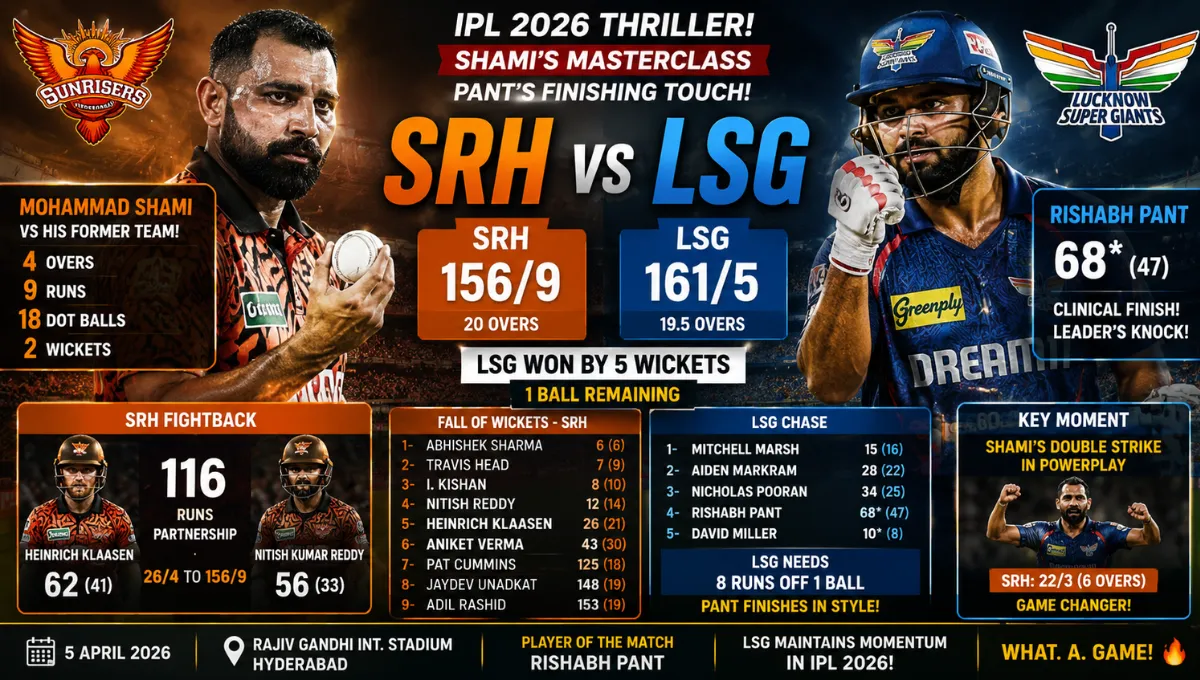
Sunrisers Hyderabad were 26 for 4 after nine overs. Lucknow Super Giants were still searching for their first win of the season. One of those problems got solved that afternoon. The other very nearly didn’t.
If you’re here for the scorecard, it’s below. But the number that actually explains this match isn’t 156 or 160 it’s 26/4, the moment SRH’s innings should have collapsed completely, and the two contrasting recoveries that followed on both sides of the innings break.
Match Result and Full Scorecard
Played 5 April 2026 at Rajiv Gandhi International Stadium, Hyderabad. Lucknow Super Giants won the toss and chose to field first.
Final result: Lucknow Super Giants won by 5 wickets with 1 ball remaining.
Sunrisers Hyderabad innings: 156/9 (20 overs)
| Batter | Dismissal | Runs | Balls | 4s | 6s | SR |
|---|---|---|---|---|---|---|
| Abhishek Sharma | c Manimaran Siddharth b Mohammed Shami | 0 | 2 | 0 | 0 | 0.00 |
| Travis Head | c Aiden Markram b Mohammed Shami | 7 | 8 | 1 | 0 | 87.50 |
| Ishan Kishan (c, wk) | b Prince Yadav | 1 | 4 | 0 | 0 | 25.00 |
| Liam Livingstone | c Rishabh Pant b Digvesh Singh | 14 | 20 | 0 | 1 | 70.00 |
| Heinrich Klaasen | c Rishabh Pant b Avesh Khan | 62 | 41 | 5 | 2 | 151.21 |
| Nitish Kumar Reddy | c Prince Yadav b Manimaran Siddharth | 56 | 33 | 3 | 5 | 169.69 |
| Aniket Verma | not out | 2 | 5 | 0 | 0 | 40.00 |
| Harsh Dubey | b Avesh Khan | 0 | 1 | 0 | 0 | 0.00 |
| Shivang Kumar | b Prince Yadav | 5 | 4 | 1 | 0 | 125.00 |
| Harshal Patel | run out (Rishabh Pant) | 4 | 2 | 1 | 0 | 200.00 |
Read Also:- Gujarat Titans vs Rajasthan Royals Match Scorecard
Extras: 5. Fall of wickets: 1-1 (Abhishek, 1.0 ov), 8-2 (Head, 2.1 ov), 11-3 (Kishan, 3.3 ov), 26-4 (Livingstone, 7.1 ov), 142-5 (Nitish Reddy, 17.4 ov), 144-6 (Klaasen, 18.1 ov), 144-7 (Dubey, 18.2 ov), 151-8 (Shivang, 19.3 ov), 156-9 (Patel, 20.0 ov).
LSG bowling: Mohammed Shami 4-0-9-2 (Player of the Match), Digvesh Singh 4-0-46-1, Prince Yadav 4-0-34-2, Manimaran Siddharth 4-0-29-1, Avesh Khan 4-0-36-2.
Lucknow Super Giants innings: 160/5 (19.5 overs)
| Batter | Dismissal | Runs | Balls | 4s | 6s | SR |
|---|---|---|---|---|---|---|
| Aiden Markram | c Liam Livingstone b Shivang Kumar | 45 | 27 | 6 | 2 | 166.66 |
| Mitchell Marsh | c Nitish Kumar Reddy b Eshan Malinga | 14 | 12 | 2 | 0 | 116.66 |
| Rishabh Pant (c, wk) | not out | 68 | 50 | 9 | 0 | 136.00 |
| Ayush Badoni | st Ishan Kishan b Harsh Dubey | 12 | 9 | 1 | 0 | 133.33 |
| Nicholas Pooran | run out (Ishan Kishan) | 1 | 4 | 0 | 0 | 25.00 |
| Abdul Samad | c Liam Livingstone b Harsh Dubey | 16 | 12 | 2 | 0 | 133.33 |
| Mukul Choudhary | not out | 2 | 5 | 0 | 0 | 40.00 |
Extras: 2. Fall of wickets: 37-1 (Marsh, 4.4 ov), 77-2 (Markram, 9.2 ov), 102-3 (Badoni, 12.1 ov), 105-4 (Pooran, 13.1 ov), 139-5 (Samad, 17.4 ov).
SRH bowling: Harsh Dubey 4-0-18-2, Nitish Kumar Reddy 1-0-14-0, Jaydev Unadkat 3.5-0-50-0, Eshan Malinga 4-0-30-1, Harshal Patel 3-0-16-0, Shivang Kumar 4-0-30-1.
Phase-by-Phase: How Both Innings Actually Unfolded
Reading a final score in isolation hides the shape of a T20 innings. Breaking both innings into phases shows exactly where this match was won and lost.
| Phase | SRH Runs | SRH Wickets | LSG Runs | LSG Wickets |
|---|---|---|---|---|
| Powerplay (1-6) | 26 | 4 | 40 | 1 |
| Middle overs (7-15) | 78 | 0 | 62 | 2 |
| Death overs (16-20) | 52 | 5 | 58 | 2 |
SRH’s middle overs look like a strength on paper 78 runs without losing a wicket but that phase was almost entirely Klaasen and Reddy rebuilding from the wreckage of the powerplay, not a platform-to-acceleration sequence a team can rely on repeatedly.
LSG’s shape was the opposite and, frankly, healthier: a solid powerplay, a couple of wickets in the middle overs that never became a crisis, and a death-overs finish built around one set batter rather than a scramble.
The Turning Point: Shami’s Slower-Ball Reinvention
Here’s what most recaps get wrong. They say Mohammed Shami’s 2/9 in four overs was simply “excellent bowling” and move on. But here’s the real problem with leaving it there Shami has spent most of his career as a swing-and-seam specialist, and this spell was built almost entirely on slower balls, a deliberate shift he explained himself after the match: “I was here last year and used a lot of slower ones. Opponents use it a lot, I thought why not us too.”
What most people miss is exactly how early this spell decided the match. Shami removed Abhishek Sharma and Travis Head inside his first two overs, reducing SRH to 8 for 2 before the powerplay had even finished. Combined with tight bowling from the rest of the attack, SRH slumped to 26 for 4 by the ninth over a position from which most T20 innings simply do not recover to a competitive total.
Counterintuitive idea worth stating plainly: conventional cricket wisdom says a fast bowler in his mid-thirties should be leaning more on experience and variation as raw pace declines which sounds obvious, but very few bowlers actually execute the shift successfully at the international level. Shami didn’t just adapt in theory; he adapted in a way that directly produced his best figures of the season, on a pitch that was expected to reward pace, not deception.
Bowling Comparison: Who Actually Controlled the Middle Overs
| Bowler | Team | Overs | Runs | Wickets | Economy |
|---|---|---|---|---|---|
| Mohammed Shami | LSG | 4 | 9 | 2 | 2.25 |
| Harsh Dubey | SRH | 4 | 18 | 2 | 4.50 |
| Manimaran Siddharth | LSG | 4 | 29 | 1 | 7.25 |
| Shivang Kumar | SRH | 4 | 30 | 1 | 7.50 |
| Eshan Malinga | SRH | 4 | 30 | 1 | 7.50 |
| Prince Yadav | LSG | 4 | 34 | 2 | 8.50 |
| Avesh Khan | LSG | 4 | 36 | 2 | 9.00 |
| Digvesh Singh | LSG | 4 | 46 | 1 | 11.50 |
Shami and Harsh Dubey were, by a clear distance, the most disciplined bowlers on either side.
Common mistake in post-match analysis: crediting a bowling unit’s overall performance to the total wickets column, when the real story is that two individual spells did almost all of the containment work while the rest of both attacks leaked at 7.25 runs per over or worse.
Player Performance Breakdown
- Mohammed Shami (2/9 in 4 overs, Player of the Match): His economy rate of 2.25 in a 156-run match is the difference between SRH posting a defendable total and SRH being blown away entirely.
- Practical takeaway for any bowler managing a career transition: Shami didn’t abandon his strengths he added a new primary weapon on top of them, rather than trying to out-bowl younger, faster attacks on pure pace.
- Heinrich Klaasen (62 off 41) and Nitish Kumar Reddy (56 off 33): Their 100-run stand off 56 balls for the fifth wicket is the entire reason SRH’s innings survived the early collapse.
- What people think vs reality: fans often assume a recovery from 26/4 to 156 means the damage was fully repaired; in reality, SRH still lost their last five wickets for just 14 runs, which is why 156 felt short rather than genuinely competitive.
- Rishabh Pant (68* off 50, unbeaten): This is where things go wrong for analysis that only looks at strike rate Pant’s knock, at just 136, was slower than his reputation suggests, and that was exactly the point. His own words afterward “It’s a big plus, staying till the end and finishing the game” reflect a deliberate innings of restraint rather than the high-risk aggression he’s often associated with.
- Aiden Markram (45 off 27): Markram’s quickfire innings at the top gave LSG’s chase real early momentum, striking six fours and two sixes before falling in the ninth over. His own comment “Nice to be back up top… glad to get us to a semi-decent start” reflects a batter comfortable in an unfamiliar role delivering exactly what his team needed.
- Harsh Dubey (2/18 in 4 overs): The most economical bowler on either side by a wide margin.
- Common mistake in post-match analysis: focusing only on the two wickets rather than the control his 4.50 economy kept LSG’s required rate under constant pressure even as Pant anchored the chase.
- Abdul Samad (16 off 12): Often overlooked in match reports focused on Pant and Markram, Samad’s late-innings cameo kept LSG’s required rate manageable during a period when both Badoni and Pooran had fallen cheaply. Without it, Pant would have faced considerably more pressure to accelerate alone in the final overs.
Why This Result Mattered for Both Teams
| Context Before the Match | Why It Mattered |
|---|---|
| LSG had lost their opening game, falling for 141 against Punjab Kings | This win was LSG’s first of IPL 2026, a genuine confidence marker for a team that had started slowly |
| SRH arrived on the back of a high-scoring win in Kolkata | Losing after a strong previous performance highlighted their middle-order dependency once the top order fails |
| Rishabh Pant’s captaincy and batting form were both under early scrutiny | Finishing this chase unbeaten gave him a tangible result to point to, separate from any statement about his overall form |
Read Also:- Kolkata Knight Riders vs Rajasthan Royals Match Scorecard
Bold opinion worth stating plainly: SRH’s real problem in this match wasn’t their top order collapsing to 26/4 good bowling spells happen to every team. The bigger issue was that their last five wickets fell for just 14 runs after Klaasen and Reddy’s recovery, which suggests a batting depth problem that a single recovery innings cannot fix. LSG, by contrast, showed exactly the kind of composure under pressure Markram’s start, Pant’s patience that a team needs to convert a solid platform into their first win of a season.
What Both Teams Should Actually Change Going Forward
For SRH, the practical fix isn’t complicated in theory, even if it’s hard to execute: their middle-to-lower order (Aniket Verma, Harsh Dubey, Shivang Kumar, Harshal Patel) needs a clearer plan for the final three overs rather than relying on one big partnership to carry the entire innings. Losing 5 wickets for 14 runs is not bad luck repeated five times in a row it’s a structural gap in death-overs batting depth.
For LSG, the lesson is more about replication than correction. Markram opening with intent, a couple of manageable middle-overs wickets, and Pant controlling the finish is a template worth trying to repeat rather than a one-off.
The practical decision LSG’s team management should make: give Markram extended time at the top of the order rather than treating this innings as a one-match experiment, since his own comments suggest he was still adjusting to a role that isn’t his most familiar one.
Key Highlights and Records From the Match
- This was Lucknow Super Giants’ first win of IPL 2026, after an opening-match defeat to Punjab Kings.
- Mohammed Shami’s figures of 2/9 in 4 overs were built on a deliberate shift toward slower-ball variations, a tactical adjustment he explained himself after the match.
- Sunrisers Hyderabad recovered from 26/4 to 156/9, but lost their last five wickets for just 14 runs in the closing overs.
- Heinrich Klaasen and Nitish Kumar Reddy added exactly 100 runs off 56 balls for SRH’s fifth wicket, with both batters reaching fifties in the process.
- Rishabh Pant finished unbeaten on 68 off 50 balls, sealing the chase with three fours in the final over off Jaydev Unadkat.
Frequently Asked Questions (FAQs)
Q1. Who won the Lucknow Super Giants vs Sunrisers Hyderabad match in IPL 2026?
Ans. Lucknow Super Giants won by 5 wickets, chasing down Sunrisers Hyderabad’s 156/9 with 160/5 in 19.5 overs at Rajiv Gandhi International Stadium, Hyderabad, on 5 April 2026.
Q2. Who was Player of the Match in LSG vs SRH, IPL 2026?
Ans. Mohammed Shami was named Player of the Match after taking 2 wickets for just 9 runs in his four overs, built around a deliberate shift toward slower-ball bowling.
Q3. How did SRH recover from 26/4 to post a competitive total?
Ans. Heinrich Klaasen (62 off 41) and Nitish Kumar Reddy (56 off 33) added exactly 100 runs off 56 balls for the fifth wicket, rebuilding SRH’s innings from 26/4 to a total of 156/9.
Q4. Who finished the chase for Lucknow Super Giants?
Ans. Captain Rishabh Pant finished unbeaten on 68 off 50 balls, sealing the win with three fours in the final over bowled by Jaydev Unadkat.
Q5. Was this Lucknow Super Giants’ first win of IPL 2026?
Ans. Yes. This victory over Sunrisers Hyderabad was LSG’s first win of the season, following an opening defeat to Punjab Kings.




Leave a Reply