


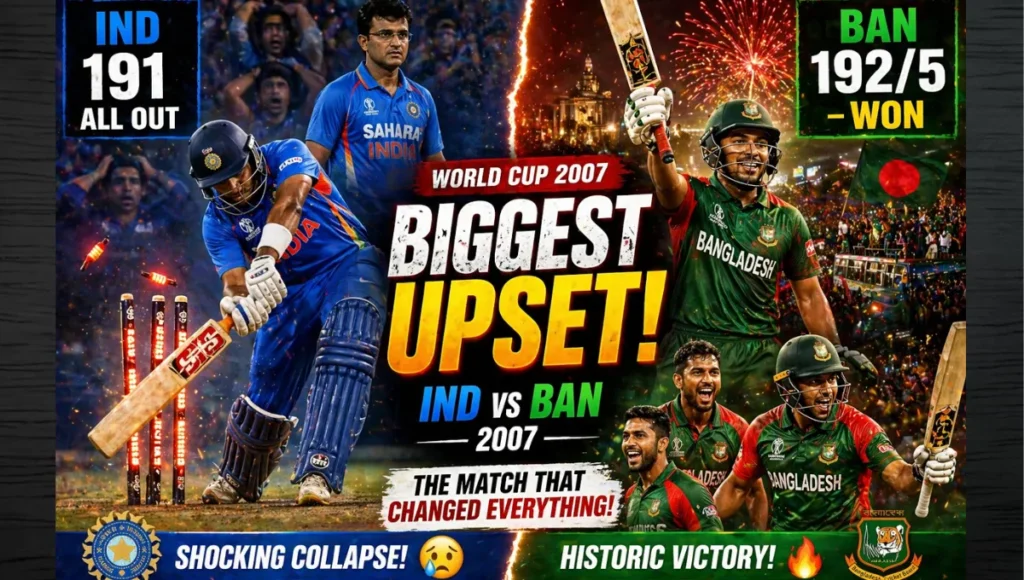
Bangladesh have played India 75 times. They’ve won 9. That single ratio tells you the shape of this rivalry but the story of how it got there, and what’s happening this exact week, is where the real value is.
Which Bangladesh vs India Are You Looking For?
Before the timeline, a clarification most competitor pages skip entirely. Search results for “Bangladesh vs India” frequently mix in fixtures involving completely different teams: a Women’s T20 World Cup 2026 match between the two nations’ women’s sides, and an Asia Cup Rising Stars semi-final between the two nations’ A-teams.
This article covers the senior men’s national teams only, The rivalry with the longest history and the most direct relevance to most searches using this exact keyword.
The Timeline Begins: First Meetings by Format
| Format | First Meeting | Result |
|---|---|---|
| ODI | 27 October 1988 | India won by 9 wickets |
| Test | 10-14 November 2000 | India won by 9 wickets (Bangladesh’s Test debut) |
| T20I | 6 June 2009 | India won by 25 runs |
Bangladesh’s first-ever Test match, in November 2000, came against India meaning this rivalry has been present at foundational moments in Bangladesh’s own cricketing history, not just as a routine fixture added later.
Why the Origin Point of This Rivalry Still Matters
Most timeline pages treat the first meeting in each format as a trivia footnote.
That undersells something important: India was literally the opponent that gave Bangladesh Test status its first real test, in the most literal sense. A newer cricketing nation’s debut match against an established power carries a different kind of significance than a routine early-career fixture it’s the moment a program either survives its first real scrutiny or gets exposed immediately. Bangladesh lost that debut Test, but simply playing it against India rather than a lower-ranked opponent set an early, difficult bar that shaped how seriously the rest of the cricketing world took their arrival into the Test-playing ranks.
Format-by-Format Head-to-Head Record
| Format | Matches | India Wins | Bangladesh Wins | Draws/No Result |
|---|---|---|---|---|
| Test | 15 | 13 | 0 | 2 |
| ODI | 42 | 33 | 8 | 1 |
| T20I | 18 | 17 | 1 | 0 |
| Overall | 75 | 63 | 9 | 3 |
Here’s what most timeline pages get wrong. They present this table and stop, treating every format as equally one-sided. But here’s the real problem with that reading Bangladesh’s ODI record against India (8 wins from 42) is meaningfully better, proportionally, than their T20I record (1 from 18) or their Test record (0 from 15, still winless after 15 attempts).
What most people miss is that this isn’t random variance; it reflects Bangladesh’s genuine historical strength in 50-over cricket, where their bowling depth and home conditions have periodically produced upsets that simply haven’t translated into the shorter or longer formats.
Bangladesh’s lone T20I win came in Delhi on 3 November 2019, in the very first match of the first bilateral T20I series the two sides ever played, chasing 149 with three balls and seven wickets to spare. They have not beaten India in a T20I since.
Why Bangladesh’s Format Split Reveals Something Real
Common mistake in reading a lopsided head-to-head table: assuming the underlying skill gap is identical across every format simply because one team dominates the aggregate numbers. In reality, Bangladesh’s specific strength in ODIs against India built around disciplined middle-overs bowling and batting depth suited to the 50-over format’s pacing doesn’t automatically transfer to T20Is, where matches are decided in shorter, higher-variance bursts that favour explosive top-order hitting rather than sustained control.
Practical takeaway for anyone assessing this rivalry format by format: Bangladesh’s genuine chance of an upset against India is meaningfully higher in a 50-over match than in a 20-over one, and any preview of a bilateral series should weight expectations accordingly rather than treating all three formats as equally hopeless for Bangladesh.
The Most Recent Major Clash: Champions Trophy 2025
Played in the 2025 ICC Champions Trophy. Bangladesh recovered from a collapse to 35/5, before India held on to win.
Read Also:- Royal Challengers Bengaluru Vs Gujarat Titans Timeline
What Happened and Why It Mattered
Here’s what most recaps get wrong about this match. They call India’s win “comfortable” because of the final margin. But here’s the real problem with that framing Bangladesh’s recovery from 35/5 through Towhid Hridoy and Jaker Ali’s partnership genuinely threatened to swing the match, and captain Najmul Hossain Shanto specifically pointed to dropped catches and missed run-outs as the difference, saying the result “could have been different” with better fielding execution.
What most people miss is how tight the middle overs actually were. India needed a strong finish from Shubman Gill, who battled through a tougher period against Bangladesh’s spinners specifically Rishad Hossain, who troubled both Virat Kohli and Axar Patel during his spell before accelerating in the closing stages to secure the win.
Player Performance Breakdown
- Shubman Gill (century, Player of the Match): Called it “definitely one of my most satisfying innings” and his first century in an ICC event. His own explanation of his approach deliberately using his feet against the pace bowlers because cutting wasn’t working, then focusing on strike rotation off the back foot against spin reveals a specific, adaptive game plan rather than just natural talent taking over.
- Bold opinion worth stating plainly: an innings built on tactical adjustments mid-match, rather than one dominant method sustained throughout, is a more valuable long-term skill for a top-order batter than raw power alone.
- Towhid Hridoy and Jaker Ali: Their partnership, rebuilding from 35/5, was the most important passage of play for Bangladesh in the entire match.
- Common mistake in reading a collapse-then-recovery innings: crediting the recovery only for preventing embarrassment, when this specific partnership actually put India under genuine pressure in the middle overs.
- Rishad Hossain: His spell troubling both Kohli and Axar Patel is the clearest evidence that Bangladesh’s bowling attack, even in a losing effort, created real problems for India’s middle order a detail that gets lost when a match is filed away simply as “India won.”
- Rohit Sharma (India captain): His post-match reflection credited the team’s collective experience and specifically praised Gill’s composure, while also acknowledging Bangladesh’s Hridoy-Jaker partnership by name a rare instance of a winning captain giving the opposition’s specific players credit rather than speaking only about his own team.
What This Match Revealed About Both Teams’ Trajectories
Beyond the result itself, this Champions Trophy meeting offered a genuine preview of where each program stood heading into the following year. Gill’s composed, tactically adaptive century confirmed his growing status as India’s next long-term batting cornerstone, not just a promising talent still waiting to translate potential into major-tournament performances.
For Bangladesh, the Hridoy-Jaker recovery from 35/5 demonstrated a specific kind of middle-order resilience that had not always been consistent in previous meetings between the two sides evidence that even in defeat, Bangladesh’s batting depth was showing signs of genuine improvement rather than simply relying on a single senior player to rescue every difficult situation.
The Series Starting This Week: India Tour of Bangladesh 2026
India tour Bangladesh from 1 September 2026, playing 3 ODIs and 3 T20Is the first-ever bilateral T20I series between the two sides to be held on Bangladeshi soil.
| Match | Date |
|---|---|
| 1st ODI | 1 September 2026 |
| 2nd ODI | 3 September 2026 |
| 3rd ODI | 6 September 2026 |
| 1st T20I | 9 September 2026 |
| 2nd T20I | 12 September 2026 |
| 3rd T20I | 13 September 2026 |
This tour was originally scheduled for August 2025 before being postponed to September 2026, with the Bangladesh Cricket Board confirming the revised fixtures in January 2026. The fact that this is the first bilateral T20I series ever hosted on Bangladeshi soil makes it a genuinely historic addition to this timeline, regardless of the eventual results previous T20I meetings between these two sides have all been played in India, at neutral venues, or as part of multi-team tournaments.
Practical context worth stating plainly: given Bangladesh’s proportionally stronger ODI record against India compared to other formats, the 3-match ODI leg of this tour is the segment most likely to produce a competitive contest, based purely on the historical pattern established across 42 previous meetings in the format.
What to Watch as This Series Unfolds
For Bangladesh, the historical pattern suggests the ODI leg offers their best realistic chance of a genuinely competitive result or even an upset, given their stronger proportional record in the format.
Practical decision for Bangladesh’s team management: prioritising squad continuity and confidence in the ODI matches, rather than treating the entire six-match tour as a uniform challenge, would align team preparation with where history suggests they’re most likely to compete.
For India, the specific storyline worth tracking is whether this tour becomes another data point in an already dominant historical record, or whether Bangladesh’s incremental middle-order improvements visible in the Champions Trophy recovery begin translating into actual results against India specifically, rather than just narrow margins of defeat. A genuinely close ODI, even in a losing effort, would represent real progress in a rivalry that has otherwise been remarkably one-sided since it began in 1988.
Why This Rivalry Rarely Gets the Analytical Attention It Deserves
Lopsided head-to-head records often lead to a rivalry being dismissed as one-sided and therefore uninteresting, and that assumption has shaped how little genuine analysis exists comparing Bangladesh and India match by match rather than just aggregate win column.
That’s a mistake specific to this pairing. Bangladesh’s Test debut against India, their solitary T20I win in the format’s first-ever bilateral series between the two, and their proportionally stronger ODI record all tell a more nuanced story than “India wins almost every time” suggests on its own.
Common mistake in covering asymmetric rivalries: focusing coverage entirely on the dominant side’s periodic big performances, while treating the weaker side’s occasional competitive showings as anomalies rather than genuine signals. Bangladesh’s Champions Trophy 2025 recovery from 35/5, and their historical ODI record specifically, both deserve to be read as real evidence of where their program has developed strength, not just footnotes in an otherwise dominant Indian narrative.
The Historical Weight of Playing India as a Newer Cricketing Nation
For Bangladesh specifically, matches against India have carried a different kind of significance than fixtures against comparably ranked opposition. India’s status as one of the sport’s most powerful boards, combined with its deep pool of world-class players across generations, means every meeting between these two sides doubles as both a competitive match and an implicit measuring stick for how far Bangladesh’s program has progressed since gaining Test status in 2000.
Bold opinion worth stating plainly: judging Bangladesh’s cricketing development purely by their head-to-head record against India risks understating genuine, measurable progress in specific formats and specific match situations progress that a simple 63-9 overall ledger cannot capture on its own.
What a Long Rivalry Like This Teaches About Sustained Dominance
India’s 63-9 record across 75 matches and nearly four decades is a useful case study in what sustained dominance in a bilateral rivalry actually looks like over time. It isn’t built on a single golden generation of players the current squad facing Bangladesh in September 2026 bears little resemblance to the team that played the first ODI in 1988 or even the side that featured in Bangladesh’s Test debut in 2000.
Practical takeaway for any cricket board studying long-term program building: consistent institutional strength across multiple playing generations, rather than reliance on any single era of exceptional talent, is what actually produces a head-to-head record this lopsided sustained over decades rather than just a few standout years.
For Bangladesh, the practical lesson embedded in this same long timeline is different but equally important: progress against a dominant rival doesn’t have to mean overturning the overall head-to-head record immediately.
It can mean incremental format-specific improvements a stronger ODI record than Test or T20I record, a genuine recovery partnership under pressure at a major tournament that compound over time into a program capable of eventually producing more competitive results across all three formats, not just the one where history already shows some promise.
Read Also:- India National Cricket Team Vs Afghanistan National Cricket Team Timeline
Key Highlights and Records Along the Timeline
- India lead the overall head-to-head 63-9 across 75 matches since the teams’ first meeting in 1988.
- India have never lost a Test to Bangladesh in 15 meetings, though 2 have ended in draws.
- Bangladesh’s only T20I win over India came in Delhi in November 2019, in the first-ever bilateral T20I series between the sides.
- Shubman Gill’s Champions Trophy 2025 century against Bangladesh was his first century in an ICC event, delivered after India navigated a tense recovery effort from Bangladesh’s middle order.
- The September 2026 bilateral tour includes the first-ever bilateral T20I series held on Bangladeshi soil.
Frequently Asked Questions (FAQs)
Q1. What is the overall head-to-head record between Bangladesh and India in cricket?
Ans. India lead 63-9 across 75 international matches since 1988, including a perfect 13-0 Test record (with 2 draws), a 33-8 ODI record, and a 17-1 T20I record.
Q2. Has Bangladesh ever beaten India in a Test match?
Ans. No. Bangladesh remain winless against India in Tests after 15 meetings, with 2 matches ending in draws.
Q3. When did Bangladesh last beat India in a T20I?
Ans. Bangladesh’s only T20I win over India came on 3 November 2019 in Delhi, the first match of the first-ever bilateral T20I series between the two sides. They have not beaten India in the format since.
Q4. What happened when Bangladesh and India last met at a major ICC event?
Ans. They met at the 2025 ICC Champions Trophy, where India won after Bangladesh recovered from 35/5 through a Towhid Hridoy and Jaker Ali partnership. Shubman Gill scored a century and was named Player of the Match.
Q5. When does India next play Bangladesh?
Ans. India tour Bangladesh from 1 September 2026 for 3 ODIs and 3 T20Is, including the first-ever bilateral T20I series held on Bangladeshi soil.