


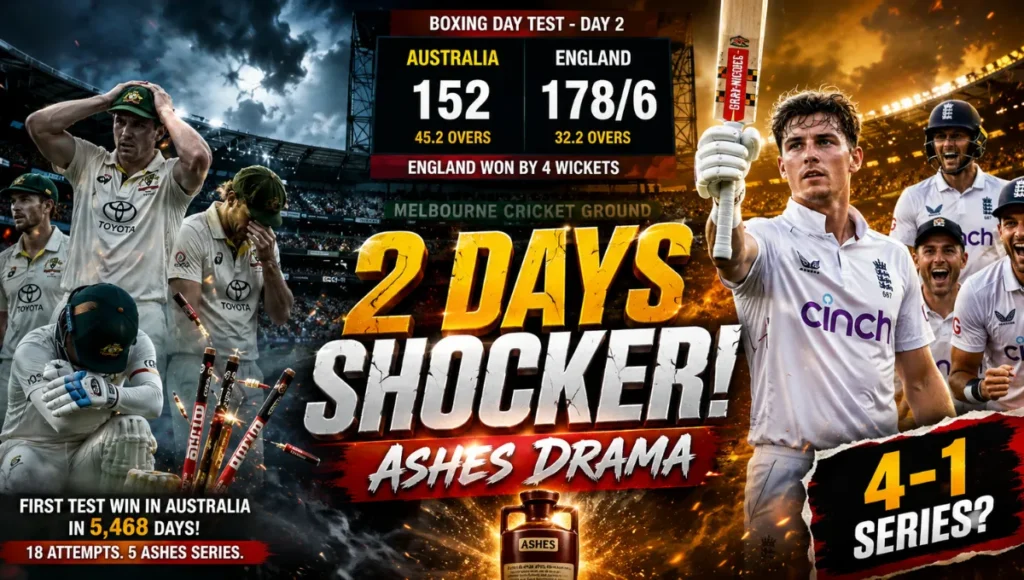
December 26, 2025. Melbourne Cricket Ground. Boxing Day Test. Day 2. Australia bat first and are bowled out for 152 in 45.2 overs. England, in response, reach 178/6 in 32.2 overs.
England win by 4 wickets. In two days.
It was England’s first Test win on Australian soil in 5,468 days. 18 failed attempts across five Ashes series. The MCG Boxing Day crowd, which had arrived expecting four or five days of comfortable Australian dominance, went home on Day 2. Jacob Bethell’s 40 was the top score. Australia had posted 152. And then ten days later Australia won the 5th Test in Sydney by 5 wickets. Series result: Australia 4-1.
England’s first win in Australia since 2011. Followed immediately by Australia retaining the Ashes 4-1. This is the England-Australia cricket rivalry in 2025-26: an 18-Test drought broken in the most lopsided series possible, on the second day of the Boxing Day Test, inside a 4-1 series defeat. No other rivalry in world sport operates at this scale of drama and emotional complexity at the same time.
Head-to-Head Snapshot: England vs Australia Across All Formats (2026)
| Format | Matches | ENG Wins | AUS Wins | Draws/Tied/NR |
|---|---|---|---|---|
| Tests | 370+ | 110 | 147 | 90+ |
| ODIs | 140+ | 55 | 85 | — |
| T20Is | 30+ | 14 | 16 | — |
| Ashes series held | — | — | AUS since 2017 | 1 drawn (2023) |
Australia lead in every format. Australia have held the Ashes urn since 2017.
England’s 110 Test wins against Australia, across 370+ Tests, are not inconsequential no other nation in the history of Test cricket has won as many Tests against Australia. England remains Australia’s most competitive long-term opponent. But the last 15 years of this rivalry specifically in Australia have been almost completely one-sided.
How the Ashes Was Born: The 1882 Mock Obituary
September 1882. The Oval, London. Australia beat England at home for the first time in history.
The Sporting Times printed a mock obituary: “In Affectionate Remembrance of English Cricket, which died at The Oval on 29th August 1882… The body will be cremated and the Ashes taken to Australia.”
English captain Ivo Bligh led a team to Australia that winter, vowing to “recover the Ashes.” After England won, a Melbourne supporter presented Bligh with a small terracotta urn allegedly containing the ashes of a cricket bail.
The Ashes urn is not a trophy in the conventional sense. It has never been formally contested between the two nations it permanently resides at Lord’s Cricket Ground, in the MCC museum, regardless of which nation “holds the Ashes.” What gets contested is the metaphorical Ashes the right to claim the urn symbolically. England have “won” the Ashes (the right to claim them symbolically) but Australia have “held” the physical object since 1882. The Ashes is, structurally, the world’s longest-running sporting metaphor.
Phase 2: The Defining Eras (1932–1989)
1932-33 Bodyline Series: The Most Controversial Ashes in History
England toured Australia in 1932-33 with a specific strategy: target Australia’s star batsman Don Bradman with short-pitched, fast leg-side bowling “fast leg theory,” or Bodyline. England captain Douglas Jardine, under the guidance of Harold Larwood’s pace, directed the field deliberately on the leg side and bowled short at the body.
England won the series 4-1. Bradman averaged 56.57. His lowest Ashes average.
But the diplomatic fallout was severe enough to almost rupture the Australia-England bilateral cricket relationship. The series triggered ICC law changes restricting bodyline-style field settings.
The Bodyline series is the most important event in cricket’s administrative history not just its playing history. It forced the sport to confront the question of whether tactical brilliance could outweigh physical danger to batters. The rules that govern bouncer restrictions and leg-side field placement in modern cricket all trace their origin to 1932-33. England won the battle and lost the moral argument permanently.
1948: Don Bradman’s Invincibles: Australia’s Greatest Ashes Side
The 1948 Australian touring side Bradman’s last went through the entire English tour unbeaten in all first-class matches (including four Tests won, one drawn). They are called The Invincibles. No Australian touring side since has come close to replicating their 1948 record.
Don Bradman’s Test average of 99.94 is the most famous number in cricket. But his final Test innings 4 runs, bowled second ball at The Oval in 1948, needing just 4 more runs to finish with a 100 average is the most poignant single moment in cricket’s history. England’s Eric Hollies bowled him for a duck. Bradman finished with 99.94. The gap between cricket’s greatest average and the round number of 100 was decided by one single delivery.
1981: Headingley: Ian Botham’s Greatest Ashes Miracle
Third Test, 1981 Ashes, Headingley, Leeds. England follow on. 227 runs behind Australia’s first innings. England are 135/7 in their second innings still 92 runs from making Australia bat again. At 500-1 odds in the betting market, several Australian players had bet on their own win.
Ian Botham hits 149*. His career-defining innings. Bob Willis takes 8/43 as Australia, chasing 130, are dismissed for 111. England win by 18 runs.
Botham’s innings is not celebrated simply because of its statistics. It is celebrated because it occurred at the exact moment England’s series and England cricket’s confidence were both broken. A player who had just resigned the captaincy under pressure from poor form producing the most explosive batting rescue in Test history. The Headingley miracle is the reason Botham became the defining English cricket personality of the 20th century.
Read Also:- Sri Lanka National Cricket Team vs Pakistan National Cricket Team Timeline
Phase 3: Modern Ashes (2005–2023)
2005 Ashes: England Win for the First Time Since 1987
England had not won an Ashes series since 1987.
In 2005, under Michael Vaughan, with Andrew Flintoff, Kevin Pietersen, Steve Harmison, and Simon Jones, England won the series 2-1 with Shane Warne (40 wickets, series) being the series’ best player for Australia in a losing cause.
The 2005 Ashes is remembered in England as a triumphant return. The reality: England won 2-1, but the series was decided by margins of 2 runs (Edgbaston) and 3 wickets (Trent Bridge). Remove either of those results from the series and Australia win 3-1. England won the narrowest possible 2005 Ashes and it has been held up as a golden era ever since, which somewhat overstates what was actually achieved.
2011: England’s Last Series Win in Australia
The 2010-11 Ashes in Australia: England won 3-1 their only series win in Australia since 1986-87.
That was 15 years ago. Since then: 5-0 in 2013-14; 4-0 in 2017-18; 4-0 in 2021-22; 4-1 in 2025-26.
England have won one Test on Australian soil between 2014 and 2026.The Melbourne Boxing Day Test in December 2025. One Test in 12 years. That single fact encapsulates how completely Australia have dominated the home Ashes cycle in the modern era.
2023 Ashes: England’s 2-2 Draw Under Bazball
The 2023 Ashes in England under Brendon McCullum and Ben Stokes: England drew 2-2. Australia retained the Ashes, but England’s “Bazball” aggressive approach won four Tests across the series (with Australia winning two decisive ones).
Australia retained the Ashes with a drawn series the convention being that the challenging side must win the series outright to claim the urn.
Phase 4 – The Ashes 2025-26: Complete Match-by-Match Scorecards
1st Test, Perth (Nov 21-22, 2025): Australia Won by 8 Wickets
- England 1st innings: 144 (49 overs)
- Australia 1st innings: 282/8d
- England 2nd innings: Bowled out under 200
- Australia: Reached target easily
- Australia won by 8 wickets in two days
England’s 144 all out at Perth on one of the world’s fastest pitches in 49 overs was a batting failure of the first order. The short-pitched Perth surface exposed England’s top-order inability to handle sustained pace at bounce angles higher than they face in county cricket. Australia’s 8-wicket win inside two days set the series tone immediately.
2nd Test, Brisbane D/N (Dec 4-7, 2025): Australia Won
- Played at The Gabba under pink ball conditions
- Australia won comfortably
- England’s pink-ball vulnerability evident in their 2021-22 Brisbane defeat recurred
3rd Test, Adelaide (Dec 17-21, 2025): Australia Won
- Australia won the 3rd Test at Adelaide Oval, going 3-0 up in the series
- Australia retained the Ashes mathematically after Adelaide
Australia’s Ashes series wins at home follow a pattern: win at Perth (fast pace), win day/night at Brisbane (pink ball swing), win at Adelaide. By Adelaide in every home Ashes since 2017, the series has been decided. The remaining Tests become context-free. England have never been ahead in a home Ashes series after Adelaide in any series since 2010-11.
4th Test, Melbourne (Dec 26-27, 2025): England Won by 4 Wickets
- Australia 1st innings: 152 all out (45.2 overs)
- England 1st innings: 178/6 (32.2 overs)
- England won by 4 wickets
5,468 days. That is how long England had waited for an Ashes Test win in Australia.
Jacob Bethell top-scored with 40 for England. Australia had posted 132 in their first innings (all out), England chased down the small target in 32.2 overs. The match concluded inside two days.
This is where things go wrong for England’s narrative: England’s MCG win was immediately framed as a “new beginning” and “England showing Bazball can work in Australia.” But the truth is more uncomfortable: Australia were bowled out for 152 on a green Boxing Day pitch that assisted England’s seamers in conditions that had nothing to do with England’s tactical system and everything to do with one poor-batting Australian morning. England won a fluke conditions match and still lost the series 4-1.
5th Test, Sydney (Jan 4-8, 2026): Australia Won by 5 Wickets
- Series result: Australia won 4-1. Australia retain the Ashes.
Australia’s 5-wicket win at the SCG completed the series. England’s only win the MCG was their first Ashes Test win in Australia in 18 years.
The ECB vowed to make “necessary changes” after the series. Brendon McCullum and Ben Stokes both stated their desire to remain.
What’s Next: England’s Tour of Australia 2026-27
England are scheduled to tour Australia in November-December 2026 for white-ball cricket, followed by one historic Test:
ODI Series (Nov 13 – Nov 18, 2026):
- 1st ODI: Perth (Optus Stadium) — Nov 13
- 2nd ODI: Adelaide Oval — Nov 15
- 3rd ODI: Hobart (Bellerive Oval) — Nov 18
T20I Series (Nov 21 – Dec 2, 2026):
- 1st T20I: Melbourne (MCG) — Nov 21
- 2nd T20I: Gold Coast — Nov 24
- 3rd T20I: Brisbane (The Gabba) — Nov 27
- 4th T20I: Sydney (SCG) — Nov 29
- 5th T20I: Canberra (Manuka Oval) — Dec 2
150th Anniversary Test, Melbourne (MCG, Day/Night) March 11-15, 2027:
A one-off Test to commemorate the 150th anniversary of the very first Test match ever played Australia vs England, MCG, March 1877. It will be a day-night Test at the same ground. The next full Ashes series in England is scheduled for summer 2027.
The Ashes All-Time Records (2026 Updated)
Read Also:- Pakistan National Cricket Team vs Bangladesh National Cricket Team Timeline
Three Original Observations
- England’s MCG win on December 26-27, 2025. Their first Ashes Test win in Australia in 18 years came inside a 4-1 series defeat. It is one of the most emotionally contradictory individual wins in Ashes history: historically significant in isolation (5,468 days, 18 attempts) and tactically irrelevant in series context. The ECB and English cricket media chose to celebrate it. The harder, more useful question is: why does England consistently win only once the series is already decided? The pattern (2021-22: 4-0; 2025-26: 4-1) suggests England find their best cricket when the pressure of the Ashes itself is removed.
- Australia’s formula for home Ashes dominance since 2017 is not pace, not conditions, not individual brilliance it is three-match consolidation. Win Perth (pace, bounce, short ball). Win Brisbane day/night (pink ball, swing). Win Adelaide. Series over. The remaining Tests are dead rubber. England have never reversed this pattern. They cannot win in Perth because their top order cannot handle high-bounce sustained pace. That structural vulnerability has not changed under Bazball, under McCullum, under Stokes, or under any of the four captains who have toured Australia since 2013.
- The 150th Anniversary Test at the MCG in March 2027 is the most historically significant single Test match scheduled in the next five years in world cricket. The MCG Test of March 1877 was not just England vs Australia it was the literal beginning of international cricket. A day-night MCG Test 150 years later, between the same two nations, is the closest thing cricket has to a spiritual reunion of its own origin. The scheduling of this as a standalone single Test rather than part of an Ashes series means it carries historical weight without Ashes-series pressure. England may actually win it.
Frequently Asked Questions (FAQs)
Q1: What is England vs Australia head-to-head in Tests all-time?
Ans. Australia lead 147-110 in 370+ Tests with 90+ draws. The Ashes has been contested in 73 series since 1877. Australia currently hold the Ashes (since 2017).
Q2: What was the result of the Ashes 2025-26?
Ans. Australia won the 2025-26 Ashes 4-1. Test results: 1st Test Perth — AUS won by 8 wickets; 2nd Test Brisbane — AUS won; 3rd Test Adelaide — AUS won; 4th Test Melbourne — England won by 4 wickets (England’s first Ashes Test win in Australia in 18 years); 5th Test Sydney — AUS won by 5 wickets. Australia retained the Ashes.
Q3: When did England last win an Ashes Test in Australia?
Ans. England’s previous Ashes Test win in Australia before the 2025-26 series was during the 2010-11 series. The MCG Boxing Day Test win on December 26-27, 2025 was their first in 5,468 days (18 failed attempts).
Q4: When did England last win an Ashes series in Australia?
Ans. England last won an Ashes series in Australia in 2010-11 (3-1). Before that, 1986-87. England have not won an Ashes series in Australia in 15 years.
Q5: What is England’s white-ball tour of Australia in 2026?
Ans. England will tour Australia for 3 ODIs (Nov 13-18, 2026 — Perth, Adelaide, Hobart) and 5 T20Is (Nov 21 – Dec 2, 2026 — Melbourne, Gold Coast, Brisbane, Sydney, Canberra). They will return for a one-off 150th Anniversary Day/Night Test at the MCG on March 11-15, 2027.
Q6: What was the Bodyline series?
Ans. The 1932-33 Ashes in Australia where England used short-pitched fast bowling targeting the body to neutralise Don Bradman. England won 4-1 but the series nearly broke the Australia-England cricket relationship. It led to ICC law changes restricting leg-side field placements and bouncer usage.