


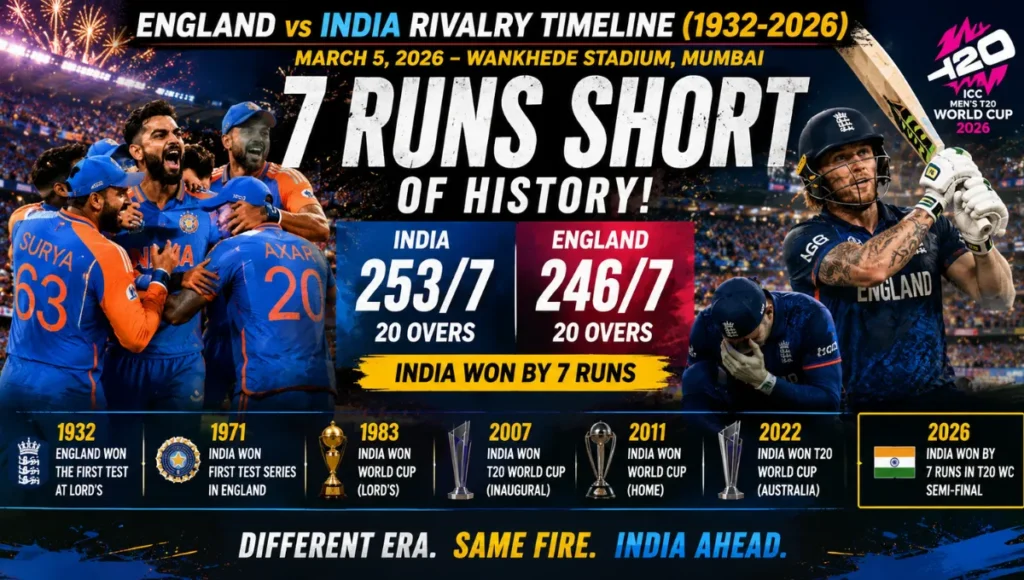
March 5, 2026. Wankhede Stadium, Mumbai.
England needed 254 to win a T20 World Cup semi-final. Against India. In Mumbai. He was not out when the last ball was bowled. England finished on 246/7. Seven runs short of the highest-ever T20 World Cup total by any team.
A player scored 105 off 48 balls in a semi-final and his team still lost by 7 runs because India’s 253/7 was the highest score ever posted in a T20 World Cup match. That is the England vs India rivalry in 2026. You can be extraordinary and still lose. Because the other team was more extraordinary.
Here is the complete timeline from England winning the first Test in 1932 to India beating England by 7 runs in a Wankhede semi-final in 2026.
Head-to-Head Snapshot: All Formats (2026 Updated)
Format-by-Format Records
The Pattern: England Started Every Era, India Reversed Every One
- Tests (1932–1971): England dominated completely India did not win a series in England for 39 years
- Tests (1971–2024): India gradually equalised winning series in England in 1971, 1986, 2007, 2021
- ODIs (1974–1983): England held the balance including the 1979 World Cup Final (West Indies, not India)
- ODIs (1983–2025): India reversed to 61–44 built on the 1983 World Cup win, the 2002 NatWest Final, and home pitches
- T20Is (2007–2026): India leads 18+–12 built entirely on the Yuvraj over and the IPL era
England’s Test lead of 53–37 is, in 2026, a historical artefact rather than a current power statement. England has not won a Test series in India since 2021. India has won the last two bilateral Test encounters (4-1 in 2024, drew 2-2 in England 2025 after being 1-3 down). The Test lead is being eroded. At the current rate, India will level England’s Test lead within the next 10 years.
1932–1970: England’s Early Dominance and India’s Long Learning Curve
First Test (Lord’s, June 25, 1932): England Won by 158 Runs
England vs India. Lord’s Cricket Ground. The first-ever Test between these two nations.
India were captained by C.K. Nayudu a batsman who had dominated the Bombay Quadrangular and was India’s first genuine Test-level cricketer. England were led by Douglas Jardine. The 1932 margin was structural, not merely tactical. India’s cricketing infrastructure domestic tournaments, first-class cricket, conditioning programs lagged 40 years behind England’s. The gap in that first Lord’s Test reflected a gap in development, not just talent.
England won the first 39 years of this rivalry’s Test encounters but India had genuine individual cricketers who competed with England’s best. C.K. Nayudu, Vijay Merchant, Rusi Modi, and Vinoo Mankad were world-class cricketers by any measure. India’s early Test losses were not about individual quality they were about a team structure that hadn’t yet caught up.
1946: India’s Postwar Tour Still Finding Their Feet
India toured England again in 1946. Their first post-war tour. England won the series. But the seeds of Indian cricketing philosophy were being planted Vijay Merchant averaging over 75 in county matches on the same tour showed India’s individual batting quality was approaching parity.
1971: The Seismic Shift. India Win Their First Series in England
Ajit Wadekar, Chandrasekhar, and the Win at The Oval
India’s 1971 series win in England ended a 39-year drought.
Under Ajit Wadekar, India won 1-0 (3-match series, 2 drawn). The decisive Test at The Oval was won largely through Bhagwath Chandrasekhar’s spin taking wickets in English conditions that no Indian spinner had taken before.
England’s 1971 batting order Boycott, Edrich, Illingworth, D’Oliveira was technically equipped to face pace. It was not equipped for Chandrasekhar’s sharp leg-breaks on Oval pitches that offered turn on the fifth day. England’s inability to adapt to world-class Indian spin in England foreshadowed what would become India’s most consistent attacking weapon in bilateral series.
1986: Dilip Vengsarkar’s Lord’s Trilogy and India’s Rising Test Confidence
Dilip Vengsarkar scored three consecutive Test centuries at Lord’s in 1979, 1982, and 1986. Every Lord’s Test he played against England.
Vengsarkar’s Lord’s trilogy is the clearest pre-Tendulkar evidence that India’s batters were developing a technical ability specifically suited to the movement and bounce at Lord’s England’s home fortress. The trilogy was not replicated until Shubman Gill’s twin-century performance at Edgbaston in 2025.
Read Also:- Kolkata Knight Riders vs Punjab Kings Timeline
1990: Tendulkar at 17. Lord’s and the Innings That Redefined the Rivalry
119* at Lord’s What England’s Bowlers Faced for the Next 15 Years
Lord’s, August 1990. England vs India, 2nd Test.
Sachin Tendulkar was 17 years and 112 days old. England’s attack: Angus Fraser, Devon Malcolm, Eddie Hemmings, Derek Pringle.
He arrived when India were under pressure and played back-foot cricket against England’s seamers with a technical maturity that 17-year-olds simply do not possess. The Lord’s crowd gave him standing ovations unusual for opposition batters at the home of cricket.
Cricket historians cite the 119* as “amazing for a teenager.” The actual significance goes deeper. From 1990 onwards, England’s bowling attack spent 15 years designing plans specifically for Tendulkar. Nasser Hussain’s 2001 plans. Michael Vaughan’s 2002 plans. Andrew Flintoff’s 2007 plans. Every England captain after 1990 opened the team meeting with the same question: “How do we get Sachin out?” The Lord’s 119* forced England to think tactically about India in ways they never had before.
2002: NatWest Final India Chased 326 and the White-Ball Tide Turned
Yuvraj Singh + Mohammad Kaif India’s First White-Ball Win on English Soil in a Tournament
July 13, 2002. Lord’s Cricket Ground, London. NatWest Series Final.
England posted 325/5 in 50 overs. India chased it and reached 326/8 off the final ball.
Yuvraj Singh and Mohammad Kaif’s partnership after India collapsed from 170/4 Kaif’s unbeaten 87* being the one that finished the match is the moment India established white-ball credibility in England.
India needed 146 off the last 19 overs with 4 wickets remaining. Yuvraj (69) and Kaif (87*) got them there. Sourav Ganguly famously removed his shirt on the Lord’s balcony at the result.
The 2002 NatWest Final is the specific match where England lost the white-ball psychological advantage against India. Before 2002, India had never chased 300+ to win a bilateral ODI tournament final in England. After 2002, the precedent existed and India’s batters referred to it in every subsequent England bilateral. The Ganguly shirt moment became the visual shorthand for India’s arrival as a white-ball power on English soil.
England’s 325/5 in 2002 was a formidable total. They did everything right and still lost. The 2002 NatWest Final is not the story of England’s failure. It is the story of India’s batting depth (four batters scoring 40+ in a successful 326 chase) becoming sufficient to beat world-class totals. That depth is what has given India the 61–44 ODI lead.
2007: T20 World Cup Yuvraj’s 6 Sixes Off Stuart Broad
The Over That Changed T20 Batting And Built India’s T20I Lead
September 19, 2007. ICC World Twenty20, Durban. Stuart Broad, over 19.
Yuvraj Singh’s single over against Stuart Broad is the most famous single over in T20 cricket history. It happened in an India vs England group match. India won by 18 runs. India won the tournament. Broad was 21 years old. He had 20 international caps. He was bowling to Yuvraj with India needing to accelerate. He was hit for six six times in a row. At the time, no one had done it in a World Cup match.
Broad’s 6-six over against Yuvraj in 2007 is one of two England T20I performances that defined this rivalry’s T20 trajectory. The other is Jacob Bethell’s 105 off 48 in the 2026 semi-final 19 years later, on the other side of the result. In both cases, an England player produced something extraordinary Broad’s extreme suffering, Bethell’s extreme batting in T20 cricket against India, with the match ultimately going India’s way. T20I cricket is India’s format. Both moments prove it.
2021: England’s Last Bilateral Test Series Win in India (3-1)
February–March 2021. England tour of India, 4 Tests.
Joe Root scored 218 in the 1st Test at Chennai his highest ever Test score. England won that match by 227 runs.
England won the 3rd and 4th Tests in Ahmedabad (Tests 3 and 4 played at Narendra Modi Stadium).
England’s 2021 series win planted the direct seed of Bazball. Ben Stokes played in that series watching England succeed with aggressive batting in Indian conditions reinforced his belief that counter-attacking Test cricket could work anywhere. When Stokes became captain in 2022 and developed the Bazball philosophy, the 2021 India series was one of its foundational proof points. India reversed that with Jaiswall in 2024. But England’s 2021 win was Bazball’s Indian dress rehearsal.
Read Also:- India National Cricket Team vs England Cricket Team Timeline
2024: India 4-1. Jaiswall 712 Runs, Bazball Beaten
The Jaiswall Counter India Hit 102 Sixes in One Test Series
January–March 2024. India vs England, 5 Tests in India.
England came to India with Bazball Ben Stokes’ philosophy of batting aggressively regardless of match situation. India responded with a philosophy that was, statistically, more aggressive than Bazball itself.
Yashasvi Jaiswall: 712 runs, 26 sixes the most sixes by a single batter in any Test series in cricket history.
| Test | Venue | Result |
|---|---|---|
| 1st Test | Hyderabad | India won |
| 2nd Test | Visakhapatnam | India won |
| 3rd Test | Rajkot | India won |
| 4th Test | Ranchi | India won |
| 5th Test | Dharamshala | England won (consolation) |
Bazball failed because Indian pitches turn. India’s batting in 2024 was measurably more aggressive than England’s Bazball approach. India hit more sixes, attacked more deliveries, and posted higher first-innings totals. The lesson of 2024 is not that Bazball failed on spinning pitches it is that India developed a counter-philosophy that out-attacked Bazball on every surface they played.
2025 (January–February): England Tour of India 4-1 T20I, 3-0 ODI
England toured India for 5 T20Is and 3 ODIs as preparation for the ICC Champions Trophy.
T20I Series Results (January 22 – February 2, 2025)
India won 4-1. England’s 97 all out in the 5th T20I at Wankhede bowled out in 10.3 overs was England’s lowest T20I total against India.
ODI Series Results (February 6–12, 2025)
India swept 3-0. India’s 356 in the 3rd ODI at Narendra Modi Stadium was their highest ODI score against England.
England’s bowling in India is structurally vulnerable against the combination of left-hand openers (Rohit Sharma angles, Jaiswall front-foot play) and aggressive middle-order hitters (Hardik Pandya, Axar Patel at No. 6–7). The 3rd ODI 142-run margin shows England had no adaptation plan for 50-over cricket on Indian pitches after conceding the T20I series. Their 2025 white-ball India tour was a comprehensive failure.
2025 (June–August): India Tour of England The 2-2 Draw England Should Have Won
Five Tests. Four results. England won two, India won two. But England were 2-1 up with one Test to play and India levelled in the last session of the final day.
England Won Tests 1 and 3
| Test | Venue | Result | Key Performer |
|---|---|---|---|
| 1st Test | Headingley (Jun 20–24) | England won by 5 wickets | Josh Tongue 5-for |
| 3rd Test | Lord’s (Jul 10–14) | England won by 22 runs | Joe Root 99* |
Josh Tongue’s five-for dismantled India’s first innings on a seaming Headingley track. Ben Duckett was Player of the Match for England’s chase. India fought but were underpowered in the opening session.
England’s 22-run win at Lord’s one of the tightest finishes at the home of cricket in recent memory gave England a 2-1 series lead heading into the final two Tests. Joe Root’s first-innings 99* was the platform England needed.
India Won Tests 2 and 5 Gill 336-Run Win and Siraj’s Oval Yorker
Read Also:- India National Cricket Team vs Zimbabwe National Cricket Team Timeline
Shubman Gill’s twin centuries (100+ in both innings) and Akash Deep’s 6/96 in England’s second innings produced India’s biggest Test win in England for decades. England’s second innings of 271 chasing 500+ showed that India’s pace bowling in 2025 was genuinely England-condition-ready.
England went into the 5th Test needing only a draw to win the series. They were bowled out 6 runs short of victory. Mohammed Siraj’s final-over yorker ended England’s innings.
The Paradox: England Were 2-1 Up and Still Drew the Series
England won 2 Tests, India won 2. The series result was equal. But England had a 2-1 advantage with one match to play the statistical favourite to win the series. India’s ability to produce a decisive performance in the 5th Test at The Oval the most hostile venue for visiting batters in the world is the structural explanation for why India’s Test team is genuinely difficult to beat in England even when they are behind in a series.
India’s 2025 performance losing 2 Tests, winning 2, drawing 1 series is the tactical equivalent of a draw-based Test win for India. England produced better cricket across 4 of the 5 Tests (Test 4 was genuinely even). India produced the exact cricket they needed in the exact match that mattered the final Test. That is not luck. That is a culture that India’s Test cricket has built since 2001: finding ways to win when elimination is the alternative. England’s Bazball philosophy is built on volume of attack. India’s philosophy is built on identifying the decisive moment. In the 2025 series, India’s approach won the narrative.
2026: T20 World Cup Semi-Final. India’s Highest T20 WC Total vs Bethell’s 105
March 5, 2026 (Wankhede): India 253/7 vs England 246/7. India Won by 7 Runs
ICC Men’s T20 World Cup 2026. 2nd Semi-Final. Wankhede Stadium, Mumbai.
Sanju Samson 89 + India 253/7: The Highest Score in T20 WC History
India’s 253/7 is the highest score ever posted in an ICC Men’s T20 World Cup match any match, any edition, any venue.
Middle-order contributions from India’s No. 4 through No. 7 kept the total building after Samson’s anchor innings. India posted 80+ in their final 5 overs to reach 253.
Jacob Bethell 105 off 48 Balls: England’s Greatest T20 Innings in a Losing Cause
Jacob Bethell scored 105 off 48 balls the highest score in a T20 World Cup semi-final or final by any batsman from any nation. At the time of his dismissal, England needed 15 off 15 balls with wickets in hand. They finished on 246/7. 7 runs short.
| Statistic | Value |
|---|---|
| Bethell’s score | 105 off 48 balls |
| England’s total | 246/7 |
| India’s winning margin | 7 runs |
| India’s total | 253/7 — highest in T20 WC history |
| Player of the Match | Sanju Samson |
England’s other batters could not match Bethell’s strike rate. When Bethell departed, England still needed 15 off 3 overs achievable with a competent lower order. The middle order couldn’t bridge the gap. Will Jacks (2/40) was England’s most economical bowler against India’s 253/7. 40 runs from 4 overs against India’s batting depth is exceptional, but the total it produced was still insufficient.
The 2026 Wankhede semi-final is the clearest evidence of why India holds the T20I advantage in this rivalry. England produced the highest individual score in a T20 WC knockout match (Bethell 105 off 48) and still lost. India’s collective depth nine different contributors to 253/7, Samson’s 89 anchoring it outweighed England’s individual brilliance. T20 cricket is not won with individual performances alone. India’s structural roster depth means even a Bethell century cannot guarantee a result.
The Pataudi Trophy: Why the Name Carries Cultural Weight
The bilateral Test series between England and India is played for the Pataudi Trophy, named after Mansur Ali Khan Pataudi “Tiger” Pataudi. Who captained India between 1961 and 1975.
Pataudi became India’s youngest-ever Test captain (21 years old) after Nari Contractor was seriously injured. He went on to lead India through some of their most formative Test years including series against England in 1967 and 1971.
The Pataudi Trophy is not named after India’s greatest cricketer. It is named after the man who represented what Indian cricket aspired to a captain who played the game with both technical precision and fearlessness, who led India on English soil, and whose family has spanned two generations of Indian-English cricket cultural connection.
When England and India play Tests, they are playing for Pataudi’s legacy. That context turns a bilateral series into something with genuine historical meaning.
5 Moments That Define the England vs India Rivalry
Read Also:- India Women’s National Cricket Team vs South Africa Women’s National Cricket Team Timeline
Frequently Asked Questions (FAQs)
Q1: What is the head-to-head record between England and India in cricket?
Ans. England leads India in Test cricket 53–37 from 141 Tests (51 draws). India leads in ODIs 61–44 from 110 matches and in T20Is 18+–12 from 30+ matches. India leads the overall combined record.
Q: What was the result of the India vs England T20 World Cup 2026 semi-final?
Ans. India beat England by 7 runs in the 2nd Semi-Final of the ICC Men’s T20 World Cup 2026 on March 5, 2026 at Wankhede Stadium, Mumbai. India posted 253/7 — the highest total ever scored in a T20 World Cup match — led by Sanju Samson’s 89. Jacob Bethell scored 105 off 48 balls for England, but England finished on 246/7.
Q3: What was the result of India’s 2025 tour of England?
Ans. The 2025 India tour of England ended in a 2-2 draw across 5 Tests. England won the 1st Test (Headingley, 5 wickets) and 3rd Test (Lord’s, 22 runs). India won the 2nd Test (Edgbaston, 336 runs — Shubman Gill twin centuries, Akash Deep 6/96) and 5th Test (The Oval, 6 runs — Siraj’s match-winning yorker). The 4th Test (Old Trafford) was drawn.
Q4: What happened in the 2025 England tour of India?
Ans. India won the T20I series 4-1 (Jan 22–Feb 2, 2025) and swept the ODI series 3-0 (Feb 6–12, 2025). Key results: England bowled out for 97 in the 5th T20I at Wankhede (India won by 150 runs); India scored 356 in the 3rd ODI at Ahmedabad (India won by 142 runs).
Q5: When did England last win a bilateral Test series against India?
Ans. England last won a bilateral Test series in India in 2021 (won 3-1 under Joe Root’s captaincy, with Root scoring 218 in the 1st Test at Chennai). England have not won a bilateral Test series against India in any venue since then.
Q6: What is the Pataudi Trophy?
Ans. The Pataudi Trophy is the bilateral Test series trophy contested between England and India. It is named after Mansur Ali Khan “Tiger” Pataudi — India’s former captain who led the team between 1961 and 1975, including series against England. Pataudi became India’s youngest-ever Test captain at age 21.
Q7: Who scored the highest individual score in the 2026 T20 World Cup?
Ans. Jacob Bethell of England scored 105 off 48 balls in the semi-final against India at Wankhede Stadium, Mumbai on March 5, 2026 — the highest individual score in an ICC T20 World Cup knockout match. England still lost by 7 runs as India’s total of 253/7 was the highest team total in T20 WC history.