


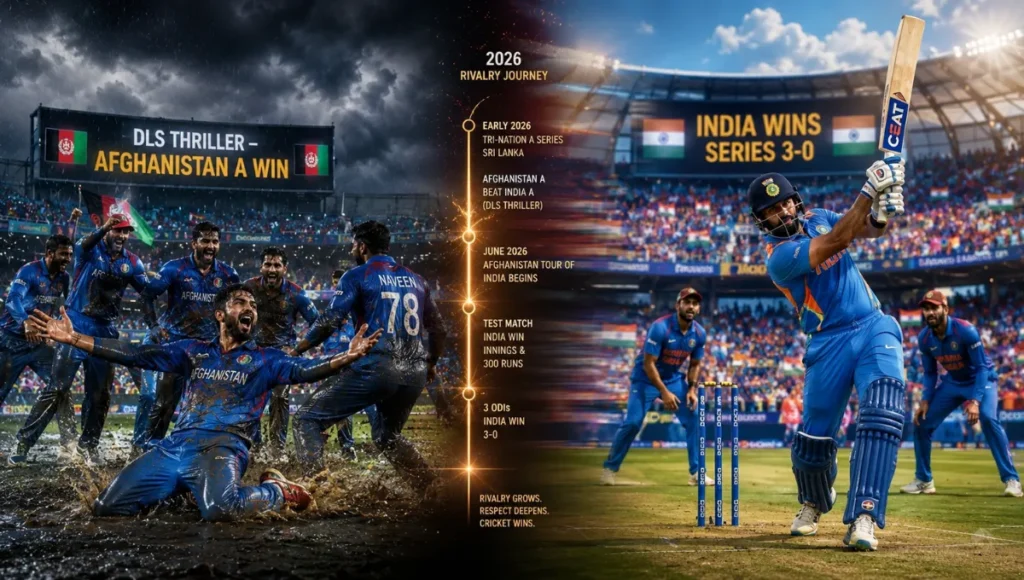
Weeks before India’s senior team completely dismantled Afghanistan across a Test and three ODIs, Afghanistan’s A-team beat India’s A-team in a rain-affected DLS thriller in Sri Lanka. If you only look at the final bilateral scoreline India winning every single match by increasingly brutal margins you’d assume Afghanistan cricket had no real substance at this level. The A-team result months earlier proves that’s simply not true.
Here’s the complete timeline of how this rivalry actually played out in 2026.
The Early Warning: Afghanistan A’s DLS Upset
Before the senior teams even met, India A and Afghanistan A faced off twice in the Tri-Nation Series in Sri Lanka during June 2026. In their first meeting, India A posted a massive 349 for 9, built around a blazing 84 from Prabhsimran Singh and fifties from Tilak Varma and Ruturaj Gaikwad. Rain intervened during Afghanistan A’s chase, and under the DLS method, they were declared winners at 177 for 2 in 25.5 overs, with Imran Mir finishing unbeaten on 75 and Bahir Shah adding 51.
India A vs Afghanistan A: 2nd Match, Tri-Nation Series
| Team | Score | Result |
|---|---|---|
| India A | 349/9 (49 overs) | Lost via DLS |
| Afghanistan A | 177/2 (25.5 overs) | Won by 4 runs (DLS) |
What most people miss when they see India’s eventual 4-0 dominance over Afghanistan’s senior side is that this exact upset happened just weeks earlier at A-team level. India A responded in their second meeting, bowling Afghanistan A out for 218 while chasing 320, winning by 101 runs to seal their spot in the tri-series final. This back-and-forth at A-team level is genuinely important context that no bilateral series report captures on its own.
The Only Test: An Innings Defeat at Mullanpur
Afghanistan’s senior tour of India began with a solitary Test at the Maharaja Yadavindra Singh International Cricket Stadium, Mullanpur. India batted first and posted a massive 564 for 8 declared in 127 overs, built around Shubman Gill’s 126, though Mohammad Saleem’s 6 for 140 showed Afghanistan’s bowling had genuine bite.
1st Innings: India: 564/8 declared (127 overs)
| Batter | Runs | Notes |
|---|---|---|
| Shubman Gill | 126 | Off 177 balls |
Bowling: Afghanistan
| Bowler | Wickets | Runs |
|---|---|---|
| Mohammad Saleem | 6 | 140 |
Read Also:- Ind Vs Eng ODI Squad 2026: Full Team Players List & Updates
Here’s where things go wrong for anyone assuming a 6-wicket haul in reply to 564 signals a competitive match. Afghanistan were bowled out for just 152 in their first innings, with uncapped left-arm spinner Manav Suthar taking 6 for 33 on debut, and Rahmat Shah’s 60 the lone resistance. Forced to follow on, Afghanistan collapsed again to 112 all out, handing India a win by an innings and 300 runs.
Test Result: Mullanpur
| Team | 1st Innings | 2nd Innings | Result |
|---|---|---|---|
| India | 564/8 dec | — | Won by an innings and 300 runs |
| Afghanistan | 152 | 112 (follow-on) | Lost |
What people think happened here is that this was simply a talent gap playing out as expected.
The reality is more specific: Manav Suthar’s 6 for 33 on Test debut is a genuinely rare statistical achievement, and it deserves recognition as one of the standout individual performances of India’s home season, not just a footnote in a lopsided scoreline.
Turning point: Manav Suthar’s six-wicket debut haul in Afghanistan’s first innings ensured India never had to bat again after their declaration, converting a big first-innings total into the most emphatic possible winning margin.
1st ODI (Dharamshala): A Rain-Shortened Statement
The three-match ODI series opened at the Himachal Pradesh Cricket Association Stadium, Dharamshala, reduced to a 25-over contest due to rain. Afghanistan were bowled out for 194 in 24.5 overs, and India chased the target down comfortably, reaching 195 for 3 in 22.5 overs to win by 7 wickets.
1st ODI Result: Dharamshala
| Team | Score | Result |
|---|---|---|
| Afghanistan | 194 (24.5 overs) | Lost |
| India | 195/3 (22.5 overs) | Won by 7 wickets |
A common mistake worth correcting directly: a rain-shortened chase can sometimes flatter the winning team’s dominance, but India’s comfortable position with 3 wickets in hand and overs to spare, even in a reduced format, showed genuine control over Afghanistan’s bowling attack from the very first match of the series.
2nd ODI (Lucknow): India’s Biggest Margin of the Series
The 2nd ODI at Ekana Cricket Stadium, Lucknow, produced the most one-sided result of the entire tour. India posted 402 in 49.5 overs, and restricted Afghanistan to 232 in 44.3 overs, winning by a massive 170 runs.
2nd ODI Result: Lucknow
| Team | Score | Result |
|---|---|---|
| India | 402 (49.5 overs) | Won by 170 runs |
| Afghanistan | 232 (44.3 overs) | Lost |
Here’s a genuinely counterintuitive idea worth stating directly: India’s winning margin actually grew larger as the series progressed, going from 7 wickets to 170 runs to eventually 9 wickets in the decider. This pattern suggests Afghanistan’s fitness, squad depth, or tactical adjustments were deteriorating across the series rather than improving, the opposite of what you’d expect from a touring team settling into conditions.
Turning point: India’s 402-run total at Lucknow set a psychological benchmark that Afghanistan’s bowling attack simply couldn’t recover from for the remainder of the series, visible in how comfortably India completed the whitewash in the very next match.
3rd ODI (Chennai): Completing the Whitewash
The series decider at MA Chidambaram Stadium, Chennai, saw Afghanistan post 218 in 44.2 overs, but India chased it down with ruthless efficiency, reaching 224 for 1 in just 28.4 overs to win by 9 wickets and complete a 3-0 series sweep.
3rd ODI Result: Chennai
| Team | Score | Result |
|---|---|---|
| Afghanistan | 218 (44.2 overs) | Lost |
| India | 224/1 (28.4 overs) | Won by 9 wickets |
What people think happened across this entire ODI series is that Afghanistan simply couldn’t compete with India at senior level.
The reality, when you factor in Afghanistan A’s DLS win over India A just weeks earlier, is more nuanced: Afghanistan’s core issue wasn’t a fundamental talent gap, but rather senior-level execution and depth under sustained pressure across three consecutive matches against a settled Indian squad.
Turning point: India’s completion of the chase in just 28.4 overs, losing only a single wicket, showed a level of batting control that had been building steadily since the Lucknow blowout, cementing the whitewash as India’s most dominant home ODI series of the year.
Player Performance Breakdown
| Player | Team | Standout Performance | Context |
|---|---|---|---|
| Manav Suthar | India | 6/33 on Test debut | Rare six-wicket debut haul in a dominant Test win |
| Shubman Gill | India | 126 in the Test | Set up India’s massive first-innings declaration |
| Mohammad Saleem | Afghanistan | 6/140 in the Test | Afghanistan’s lone bright spot with the ball despite the heavy defeat |
| Imran Mir | Afghanistan A | 75* in Tri-Nation Series | Led Afghanistan A’s genuine DLS upset over India A |
| Rahmat Shah | Afghanistan | 60 in the Test | Afghanistan’s top-scorer in a losing cause |
| India (team) | India | 402 in 2nd ODI, 3-0 series sweep | Complete dominance with escalating margins across the ODI series |
Read Also:- Tri Nation Series 2026: Full Schedule, Teams, Results and Points Table
An original observation worth stating plainly: Manav Suthar’s 6 for 33 on Test debut deserves recognition as one of the most impressive bowling debuts of India’s home season, even though it came against a lineup many would dismiss as significantly weaker. Taking six wickets in your first Test innings, regardless of opposition, is a genuinely rare career milestone that shouldn’t be undervalued just because of a lopsided final scoreline.
What This Timeline Reveals
India’s complete dominance across the Test and ODI series, including a rare innings-and-300-run Test win and an ODI series with escalating margins, shows a squad depth advantage that grew more pronounced as the tour progressed. Afghanistan A’s genuine DLS win over India A just weeks earlier proves the broader talent pool has real competitive substance, meaning senior-level execution, conditioning, and match-tempo management, not raw ability, were the actual differentiators in the bilateral series.
Going forward, Afghanistan’s cricket board should prioritize bridging the specific gap between A-team competitiveness and senior-team execution under sustained series pressure, since that gap, not a talent shortage, is what this timeline most clearly exposes.
Frequently Asked Questions (FAQs)
Q1. Who won the India vs Afghanistan Test in 2026?
Ans. New Zealand won the three-match series 2-1, losing the opener at Lord’s before winning at The Oval and Trent Bridge.
Q2. Who won the India vs Afghanistan ODI series in 2026?
Ans. India won the three-match ODI series 3-0, winning by 7 wickets, 170 runs, and 9 wickets respectively across Dharamshala, Lucknow, and Chennai.
Q3. What was India’s biggest win margin against Afghanistan in 2026?
Ans. India’s biggest margin came in the 2nd ODI at Lucknow, where they won by 170 runs after posting 402.
Q4. Did Afghanistan beat India at any level in 2026?
Ans. Yes, Afghanistan A beat India A by 4 runs via the DLS method in the Tri-Nation Series in Sri Lanka in June 2026, though India’s senior team later swept Afghanistan’s senior team 4-0 across formats.
Q5. Who took a six-wicket haul on Test debut against Afghanistan?
Ans. Manav Suthar took 6 for 33 in Afghanistan’s first innings during his Test debut at Mullanpur.