


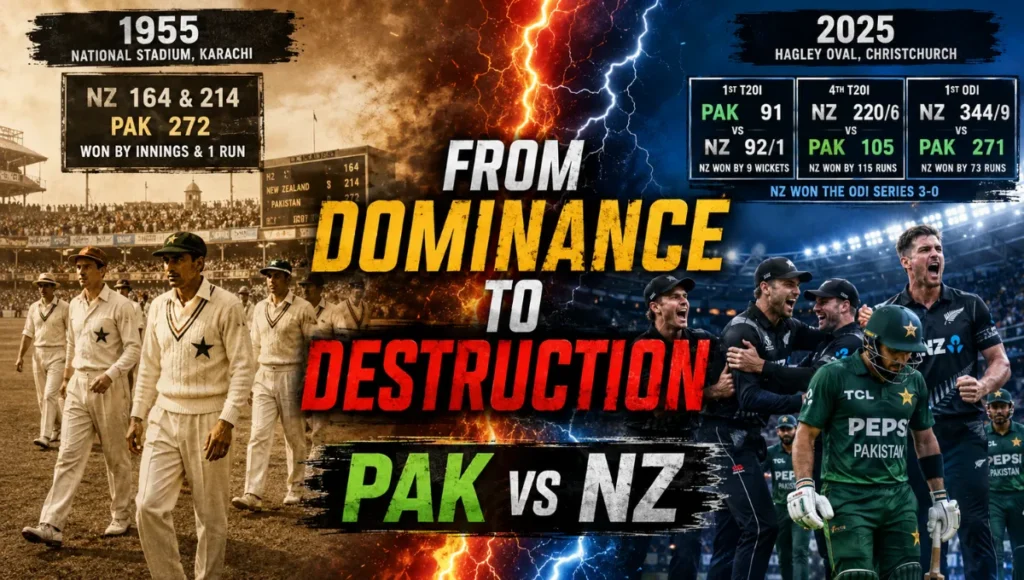
October 13, 1955. National Stadium, Karachi. Pakistan and New Zealand’s very first Test match.
Pakistan bat. New Zealand bowl. New Zealand are dismissed for 164 in their first innings. Pakistan reply with 272. New Zealand, following on, make 214. Pakistan win by an innings and 1 run.
The rivalry begins exactly as it would continue for the next 60 years.
But fast forward to March 16, 2025. Hagley Oval, Christchurch. Pakistan arrive in New Zealand for a bilateral tour. 1st T20I. Pakistan bat first and are dismissed for 91 in 18.4 overs. New Zealand chase 92 and win by 9 wickets with 9.5 overs remaining. Four matches later, the 4th T20I at Bay Oval: New Zealand score 220/6. Pakistan reply with 105. New Zealand win by 115 runs.
Then the ODI series begins. New Zealand score 344/9 in the 1st ODI. Pakistan reply with 271. NZ win by 73 runs. New Zealand sweep all three ODIs. From a 1-run innings defeat in 1955 to two consecutive complete series demolitions in 2025. This rivalry has undergone the most dramatic structural reversal of any bilateral rivalry in cricket’s history. And the precise year it turned? 2014.
Head-to-Head Snapshot: NZ vs Pakistan Across All Formats (2026)
Pakistan lead in Tests, ODIs, and T20 World Cup matches. The overall records still favour Pakistan.
Pakistan’s lead in Tests (25-14) and ODIs (61-57) was built almost entirely before 2014. Since 2014, New Zealand have dominated in Tests, ODIs, and bilateral T20Is winning 7 of 8 Tests and sweeping both bilateral series in 2025 (T20I 4-1, ODI 3-0). The all-time records are a historical relic. The current competitive landscape belongs firmly to New Zealand.
The Two-Phase Rivalry: How 2014 Changed Everything
This rivalry has two distinct phases. Understanding them is more important than any single match result.
| Phase | Period | Dominant Team | Key Format |
|---|---|---|---|
| Phase 1: Pakistan’s Era | 1955–2013 | Pakistan | Tests & ODIs |
| Phase 2: New Zealand’s Reset | 2014–2026 | New Zealand | Tests, ODIs & bilateral T20Is |
The single most important question in this rivalry is: why did 2014 change everything? The answer is more structural than most analysts acknowledge.
Phase 1: Pakistan’s Era of Dominance (1955–2013)
1955: First Test, Karachi: Pakistan Win by an Innings
Pakistan’s first Test win over New Zealand by an innings and 1 run in Karachi in October 1955. Set the template for the next six decades.
New Zealand were a young Test nation, still developing domestic infrastructure. Pakistan had Hanif Mohammad, Fazal Mahmood, and a pace-and-spin combination that was more than capable of dismantling touring sides on home surfaces.
New Zealand’s first Test win against Pakistan came in 1965. Ten years after their first meeting. For a decade, New Zealand simply could not beat Pakistan in any conditions. That 10-year gap explains why Pakistan’s lead in Tests (25-14) was baked in so early the dominance started before New Zealand’s cricket development infrastructure matured.
Tests 1955–2013: Pakistan Win 25 of 39 Matches
Across 58 years of Test cricket, Pakistan won 25 of 39 Tests against New Zealand.
Pakistan’s Test dominance at home was near-total. New Zealand could compete in New Zealand conditions especially with Richard Hadlee bowling in the 1980s. But winning in Pakistan required conditions mastery that New Zealand simply did not possess until the 2010s.
Pakistan’s pace attack from Imran Khan to Wasim Akram, Waqar Younis, and Shoaib Akhtar repeatedly dismantled New Zealand’s top order in subcontinental conditions.
ODIs 1973–2013: Pakistan’s Early Lead Built on Subcontinental Dominance
Pakistan’s 61-57 ODI lead is similarly front-loaded. In their first 50 ODIs (1973–2003), Pakistan dominated particularly in Pakistan, where their record was 22 wins from 28 matches at home.
Pakistan’s ODI lead looks like long-term dominance. in ODIs played in New Zealand, New Zealand lead 17-8. The Pakistan ODI lead exists almost entirely because of home dominance in Lahore, Karachi, and Rawalpindi venues where Pakistan pack the conditions with pace and reverse swing that New Zealand’s batting has historically been underprepared for.
Read Also:- Pakistan National Cricket Team vs India National Cricket Team Timeline
Phase 2: New Zealand’s Structural Reset (2014–Present)
Why 2014 Was the Turning Point: The McCullum Revolution
In December 2014, Brendon McCullum led New Zealand in a Test series against Pakistan.
But 2014 was more than McCullum’s captaincy. It marked the full maturation of New Zealand’s domestic cricket restructuring that had been underway since 2009: the Plunket Shield was producing seam bowlers capable of sustained swing on hard pitches; NZ’s batting depth had expanded through new talent (Williamson, Taylor, Latham, Watling); and the coaching staff had introduced a specific fast bowling development pipeline.
New Zealand’s post-2014 Test dominance over Pakistan is not an accident of scheduling or conditions. It is the result of 10 years of NZC infrastructure investment paying off simultaneously better pace bowling, better batting depth, and crucially, a mental framework under McCullum and Williamson that emphasised attacking cricket over defensive grinding. Pakistan’s Test batting, meanwhile, became increasingly volatile from 2016 onwards with consistent top-order fragility. Those trajectories crossed in 2014 and have not re-crossed since.
Tests 2014 Onwards: NZ Win 7 of 8 Matches
Since 2014, New Zealand have played 8 Tests against Pakistan and won 7.
Pakistan’s one win in this window came in 2018 in the UAE. Every other Test in New Zealand, in neutral venues, and even in the UAE went New Zealand’s way.
The 7-of-8 Test record for New Zealand since 2014 against Pakistan is one of the most sustained single-opponent improvements in modern Test cricket. No other team has gone from a 35% win-rate to an 87% win-rate against the same opponent over a decade. This is not a hot streak it is a structural shift.
Pakistan Tour of New Zealand 2025: Complete Series Breakdown
T20I Series (March 16–26, 2025): New Zealand Win 4-1
Complete match-by-match scorecards:
1st T20I, Christchurch (Mar 16):
- Pakistan: 91 all out (18.4 overs)
- New Zealand: 92/1 in 10.1 overs
- New Zealand won by 9 wickets
2nd T20I, Dunedin (Mar 18, rain-affected, reduced to 15 overs):
- Pakistan: 135/9 (15 overs)
- New Zealand: 137/5 in 13.1 overs (target 136)
- New Zealand won by 5 wickets
3rd T20I, Auckland (Mar 21, D/N):
- New Zealand: 204 all out (19.5 overs)
- Pakistan: 207/1 in 16 overs (target 205)
- Pakistan won by 9 wickets
4th T20I, Mount Maunganui (Mar 23, D/N):
- New Zealand: 220/6 (20 overs)
- Pakistan: 105 all out (16.2 overs)
- New Zealand won by 115 runs
5th T20I, Wellington (Mar 26, D/N):
- Pakistan: 128/9 (20 overs)
- New Zealand: 131/2 in 10 overs (DLS target 129)
- New Zealand won by 8 wickets (Tim Seifert leading the chase)
New Zealand win T20I series 4-1.
Performance breakdown series: Pakistan’s collapse to 91 all out in the 1st T20I at Christchurch set the tone. The 4th T20I at Mount Maunganui (115-run win for NZ) was the single most dominant batting performance 220/6 against a Pakistani attack that had no answer for NZ’s power-hitting depth. Pakistan’s sole win in Auckland (207/1 chasing 205) was the lone bright spot a clinical batting chase that showed what Pakistan could do when their top order fired. They could only sustain that once.
Pakistan’s 207/1 in the 3rd T20I chasing 205 in 16 overs was one of the great individual T20I chasing performances of 2025. But it came sandwiched between a 9-wicket loss and a 115-run loss. Pakistan’s T20 batting can be brilliant and fragile in the same series sometimes in consecutive matches. That volatility is the defining characteristic of Pakistan’s T20 batting identity.
ODI Series (March 29–April 5, 2025): New Zealand Win 3-0: Complete Whitewash
Complete match-by-match scorecards:
1st ODI, Napier (Mar 29):
- New Zealand: 344/9 (50 overs) multiple half-centuries; sustained batting depth
- Pakistan: 271 all out (44.1 overs)
- New Zealand won by 73 runs
2nd ODI, Hamilton (Apr 2):
- New Zealand: 292/8 (50 overs) Mitch Hay 99*
- Pakistan: 208 all out (41.2 overs)
- New Zealand won by 84 runs
3rd ODI, Mount Maunganui (Apr 5, rain-reduced to 42 overs):
- New Zealand: 264/8 (42 overs)
- Pakistan: 221 all out (40 overs)
- New Zealand won by 43 runs
New Zealand win ODI series 3-0.
Unique insight — 2nd ODI, Hamilton: Mitch Hay’s 99* is the hidden gem of this series. New Zealand’s No. 6 or 7 batsman not a headline name globally plays a 99* innings on first team that single-handedly takes a match away from Pakistan. That is what New Zealand’s batting depth looks like in 2025: players deep in the order capable of match-defining performances that flatten touring attacks. Pakistan have no equivalent batting depth in their middle-lower order.
This is where things go wrong — for Pakistan: The ODI series shows Pakistan’s structural ODI vulnerability away from home in stark relief. New Zealand’s 344/9 in the 1st ODI set an immediate statement: Pakistan would need their A-game just to be competitive. Pakistan’s 271 reply while respectable was ultimately a recognition that their chase management under pressure broke down at the back end (from 200/4, losing 6/71 is not coincidental). The same pattern of middle-order batting confidence followed by late-order collapse repeated in all three matches.
T20 World Cup 2026 Super Eights: NZ vs Pakistan Washed Out
February 21, 2026. R. Premadasa Stadium, Colombo. T20 World Cup 2026, Super Eights Group 2.
Rain washout. Match abandoned without a ball bowled. No result one point each.
The opening match of the Super Eights stage at the 2026 T20 World Cup between New Zealand and Pakistan was abandoned after incessant rain in Colombo.
What most people miss the tournament impact: The no-result was not neutral for both teams. Coming off Group A eliminations, Pakistan entered the Super Eights already under pressure on net run-rate having been knocked out of Group A by the USA and needed a positive result against New Zealand more urgently than NZ did. The washout denied Pakistan a chance to reset their tournament momentum. New Zealand took the point and moved on.
T20 World Cup Head-to-Head: Pakistan’s ICC T20 Advantage
Despite New Zealand’s recent bilateral dominance, Pakistan have historically performed better in T20 World Cup matches against New Zealand.
Read Also:- India National Cricket Team vs South Africa National Cricket Team Timeline
Pakistan’s T20 WC record against New Zealand (5-2) is built on: the 2007 semi-final, 2007 final (Pakistan won the tournament), 2010 and 2012 Super Eights, and 2021 Group stage.
New Zealand in bilateral T20Is against Pakistan (21-19) are competitive and roughly equal. Pakistan in T20 World Cups against New Zealand (5-2) have a historically dominant record. The gap between bilateral form and tournament performance is one of the most pronounced format-context gaps in any bilateral T20 rivalry. Whether the 2026 washout changes that dynamic will only become apparent when the two teams next meet in a T20 World Cup match that actually gets played.
Format-by-Format Head-to-Head (2026 Updated)
| Format | Matches | NZ Wins | Pakistan Wins | Draws/Tied/NR |
|---|---|---|---|---|
| Tests | 62 | 14 | 25 | 23 |
| ODIs | 122 | 57 | 61 | 4 |
| T20Is (all) | 49 | 23 | 24 | 2 |
| T20 WC | 7 | 2 | 5 | 0 |
| Tests since 2014 | 8 | 7 | 1 | — |
| ODIs in NZ | 26 | 17 | 8 | 1 |
| 2025 T20I series | 5 | 4 | 1 | — |
| 2025 ODI series | 3 | 3 | 0 | — |
Three Original Observations
- Pakistan’s all-time leads in Tests (25-14) and ODIs (61-57) over New Zealand are the most misleading aggregate numbers in bilateral cricket today. They represent a 60-year dominance that ended in 2014 and has not resumed. Since then, New Zealand have won 7 of 8 Tests and swept both formats in the 2025 bilateral series (T20I 4-1, ODI 3-0). Any article that leads with Pakistan’s all-time advantage without this contextual correction is giving the reader an inaccurate picture of this rivalry in 2026.
- Pakistan’s 9-wicket T20 WC wins and their 9-wicket bilateral loss in the same bilateral series window reveals a split cricketing identity that is unique in world cricket. Pakistan posted 207/1 chasing 205 in Auckland (3rd T20I) 16 overs, 9-wicket win then in the next T20I were bowled out for 105 by the same attack at the same tour. No other team in world cricket fluctuates this dramatically in the same format, against the same opponent, in the same bilateral series.
- The 2025 bilateral series T20I 4-1 and ODI 3-0 for New Zealand is the most complete demolition of Pakistan by any bilateral opponent since Australia’s 2011-12 tour of India. Pakistan were not just outplayed. They were outscored, outbowled, and out-depth-batted in every match except one (3rd T20I). NZ’s 344/9 in the 1st ODI and 220/6 in the 4th T20I represent two of the highest totals New Zealand have posted against Pakistan in their respective formats.
Frequently Asked Questions (FAQs)
Q1: What is New Zealand vs Pakistan head-to-head in Tests?
Ans. Pakistan lead 25-14 in 62 Tests with 23 drawn. Pakistan’s dominance was built from 1955 to 2013. Since 2014, New Zealand have won 7 of 8 Tests against Pakistan — a near-total reversal of the historical pattern.
Q2: What is New Zealand vs Pakistan head-to-head in ODIs?
Ans. Pakistan lead 61-57 in 122 ODIs with 3 no-results and 1 tied. Pakistan’s lead is primarily built on home record (22 wins from 28 at home). In New Zealand, NZ lead 17-8.
Q3: What were the results of the Pakistan tour of New Zealand 2025?
Ans. New Zealand won the T20I series 4-1 (Match results: NZ won 1st by 9 wkts; NZ won 2nd by 5 wkts; PAK won 3rd by 9 wkts; NZ won 4th by 115 runs; NZ won 5th by 8 wkts). New Zealand also won the ODI series 3-0 (73 runs, 84 runs, 43 runs).
Q4: What happened in the NZ vs Pakistan T20 World Cup 2026 Super Eights match?
Ans. The match was abandoned without a ball bowled due to rain at R. Premadasa Stadium, Colombo, on February 21, 2026. Both teams received one point each. It was the opening game of the Super Eights stage.
Q5: What is Pakistan vs New Zealand T20 World Cup head-to-head?
Ans. Pakistan lead 5-2 in 7 T20 World Cup matches. Pakistan have beaten New Zealand in 2007 (semi-final), 2007 (final), 2010, 2012, and 2021. New Zealand’s two T20 WC wins came in 2014 and 2022.