


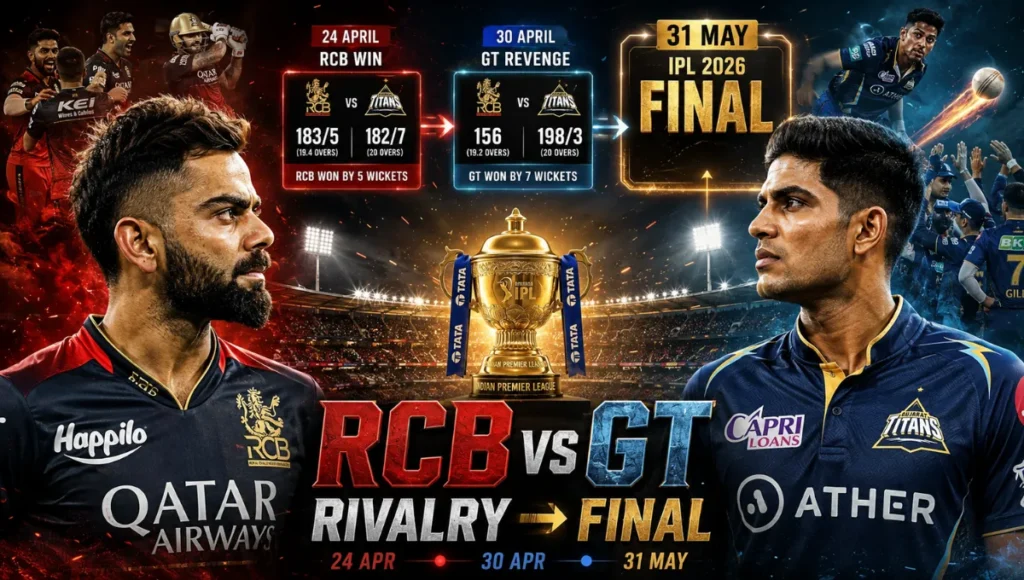
On 24 April, RCB beat Gujarat Titans in a tight chase. Six days later, GT returned the favour just as convincingly. Neither result hinted at what was coming. By 31 May, these two teams were standing on the same ground again this time for the IPL 2026 title itself.
Most “timeline” pages for this rivalry give you four dates and four scorelines. That’s not a timeline it’s a list. A real timeline explains how each match changed what came next, and this one builds toward a genuinely historic finish.
Timeline Overview: All Four Meetings at a Glance
| Date | Match | Result | Significance |
|---|---|---|---|
| 24 April 2026 | Match 34, Bengaluru | RCB won by 5 wickets | Set an early tone of close, chase-driven contests |
| 30 April 2026 | Match 42, Ahmedabad | GT won by 4 wickets | Levelled the season series, exposed RCB’s batting depth |
| 26 May 2026 | Qualifier 1, Dharamsala | RCB won by 92 runs | Broke the season-long pattern; set an IPL playoff scoring record |
| 31 May 2026 | Final, Ahmedabad | RCB won by 5 wickets | RCB became only the third team in IPL history to defend the title |
Final tally: RCB won three of the four meetings, including the two that decided the season.
Why Reading This as a Timeline Changes the Story
A single scorecard tells you who won one match. A timeline tells you why the ending happened the way it did. Treating these four matches as separate, disconnected events which is exactly what most competitor coverage does means missing the single most interesting thread running through this entire rivalry: the balance of power flipped completely between the second league match and the playoffs, and it never flipped back.
24 April 2026: Match 34: RCB Draw First Blood
Played at M. Chinnaswamy Stadium, Bengaluru. Gujarat Titans posted 205/3, built on a century from Sai Sudharsan. RCB chased it down, finishing 206/5 in 18.5 overs. Virat Kohli’s 81 off 44 after being dropped in the very first over anchored the innings, before Krunal Pandya sealed the win with a boundary in the final over.
Why it mattered: This was the seventh straight meeting between these two sides won by the team batting second, a pattern that would eventually define the entire rivalry until Qualifier 1 broke it completely. At this point in the timeline, nobody could have predicted how dramatically that pattern would later shatter.
Early signal worth flagging: RCB’s chase, while successful, was not comfortable. Losing 5 wickets in a chase of 206 is not the profile of a batting unit in total control. This is the first data point in a pattern that would resurface at the worst possible time in Match 42, just six days later.
30 April 2026: Match 42: GT Level the Score
Played at Narendra Modi Stadium, Ahmedabad, just six days after Match 34. Royal Challengers Bengaluru were bowled out for 155. Gujarat Titans chased it down comfortably, finishing 158/6 in just 15.5 overs 25 balls to spare, GT’s second-most in any successful chase in IPL history. Shubman Gill attacked from the very first over, while Jason Holder, coming in as an Impact Player substitute, finished the chase and also took a spectacular catch to win Player of the Match.
What changed between matches: Here’s what most timeline recaps get wrong. They treat Match 42 as simply “the away leg” of the same fixture. But here’s the real problem for RCB captain Rajat Patidar’s own admission afterward, “we gave a lot of wickets in the middle and that kept us on the back seat,” reveals a specific batting collapse pattern that GT’s bowlers had clearly targeted after studying RCB’s approach from six days earlier.
The six-day gap matters more than it looks, Common mistake in season analysis: treating back-to-back fixtures against the same opponent as unrelated events. In reality, a six-day turnaround gives both coaching staffs almost no time to make major personnel changes, but plenty of time to review specific tactical patterns from the previous match. GT’s bowling plan against RCB’s middle order in Match 42 looks less like coincidence and more like a direct response to what they’d just seen.
26 May 2026: Qualifier 1: RCB Rewrite the Rivalry
Played nearly a month later at HPCA Stadium, Dharamsala the first time these two teams met with knockout stakes.
Result: RCB won by 92 runs, ending the pattern of every previous meeting being decided by the chasing side.
Royal Challengers Bengaluru innings: 254/5 (20 overs)
| Batter | Runs | Balls | 6s | Note |
|---|---|---|---|---|
| Rajat Patidar (c) | 93 | 33 | 9 | Not out, Player of the Match |
| Virat Kohli | 43 | 25 | 1 | Set the platform |
| Devdutt Padikkal | 30 | 19 | 0 | Rapid supporting innings |
Read Also:- Mumbai Indians vs Sunrisers Hyderabad Match Scorecard
Gujarat Titans innings: 162 all out (19.3 overs)
GT lost half their side inside the powerplay, including Sai Sudharsan, Shubman Gill, and Jos Buttler. Rahul Tewatia’s defiant 68 off 43 was the only real resistance.
The Record-Breaking Turning Point
What most people miss about this specific point in the timeline is exactly how it reset the entire rivalry’s momentum. Patidar’s 93 off just 33 balls, including nine sixes, gave RCB the highest score in IPL playoff history at that point 254/5.
That total didn’t just win the match; it removed any realistic chase from the equation entirely, breaking the eight-match streak of chasing-side victories that had defined every previous meeting between these two teams.
Counterintuitive idea worth stating plainly: in a rivalry where the team batting second had won eight straight times, the correct strategic response wasn’t to bat more cautiously and protect wickets. It was to attack even harder than usual and remove the chase from the equation entirely. RCB did exactly that, and it worked.
Player Performance Breakdown at This Stage
- Rajat Patidar (93* off 33, Player of the Match):
- Counterintuitive idea worth stating plainly: a captain’s innings arriving at exactly this point on the timeline the first genuinely high-stakes meeting of the season is not a coincidence of form. It reflects a batter targeting a total large enough to remove the tactical pattern that had defined the rivalry all year.
- Sai Sudharsan, Shubman Gill, Jos Buttler (all out inside the powerplay): Their collective collapse at this stage of the timeline is the clearest evidence of how RCB’s total psychologically altered GT’s approach a target this size forces batters into risks they wouldn’t normally take so early.
- Rahul Tewatia (68 off 43): Practical lesson buried in a losing effort: even when a match is already lost on the scoreboard, individual application still has value Tewatia’s innings prevented an even heavier margin and gave GT’s batting order something to build confidence from heading into the final, even if it ultimately wasn’t enough.
31 May 2026: The Final: Kohli Completes the Story
Played five days after Qualifier 1, at Narendra Modi Stadium, Ahmedabad the same venue as Match 42. Royal Challengers Bengaluru won the toss and chose to field.
Result: RCB won by 5 wickets with 12 balls remaining, becoming IPL 2026 champions.
Gujarat Titans innings: 155/8 (20 overs)
Fall of wickets: 22-1 (Shubman Gill, 2.2 ov), 26-2 (Sai Sudharsan, 3.4 ov), 55-3 (Nishant Sindhu, 7.6 ov), 73-4 (Jos Buttler, 12.1 ov), 99-5 (Arshad Khan, 14.1 ov). Washington Sundar finished unbeaten on 50, rescuing GT from an early collapse.
Royal Challengers Bengaluru innings: 161/5 (18 overs)
Virat Kohli batted through the entire chase, finishing unbeaten on 75 off 42 balls.
How the Season’s Earlier Chapters Set Up This Result
This is where things go wrong for anyone treating the final as an isolated event. GT’s top-order collapse here 22-1, 26-2, 55-3 inside eight overs mirrors the exact same vulnerability RCB’s bowlers had exposed in Qualifier 1 just five days earlier. Following the full timeline shows this wasn’t a new weakness discovered in the final; it was the same pattern repeating because GT never solved it between matches.
What most people miss about the five-day gap between Qualifier 1 and the final: unlike the six-day turnaround between Match 34 and Match 42 earlier in the season, this time it was RCB’s bowling plan that carried over unchanged and successfully, while GT’s batting order couldn’t find an adjustment in time. The team that made the tactical correction between fixtures earlier in the season lost that same battle when it mattered most.
Player Performance Breakdown at This Stage
- Virat Kohli (75* off 42, Player of the Match): Bold opinion worth stating plainly: an unbeaten knock carried through an entire T20 chase is one of cricket’s most underrated captaincy-adjacent achievements. Looking back across the timeline, Kohli had also top-scored in Match 34 back in April meaning he bookended the entire rivalry with the two most important individual RCB performances of the season.
- Washington Sundar (50 not out): His rescue act reflects the same resilience GT’s middle order occasionally showed across the season, but by the final stage of the timeline, RCB’s bowling unit had simply improved too much for a single recovery innings to be enough.
- Rasikh Salam (3/27): The best bowling figures on either side in the final, and a continuation of the improved RCB bowling standard first shown in Qualifier 1.
- Practical takeaway for tracking a team’s form across a season: a bowler delivering his best figures at the tournament’s most important moment, rather than in a routine league match, is the clearest sign a team is peaking at exactly the right time.
How the Balance of Power Shifted Across the Timeline
| Timeline Stage | Which Team Had the Advantage | Why |
|---|---|---|
| Match 34 (24 April) | RCB, narrowly | Won a tight chase but showed vulnerability under pressure |
| Match 42 (30 April) | GT, clearly | Exploited RCB’s middle-overs batting collapse pattern |
| Qualifier 1 (26 May) | RCB, decisively | Broke the chasing-team pattern with a record total |
| Final (31 May) | RCB, comprehensively | Carried Qualifier 1’s momentum into a title-winning performance |
Read Also:- Royal Challengers Bengaluru Vs Gujarat Titans Stats
Bold opinion worth stating plainly: tracking this rivalry as a timeline rather than four separate results reveals something no single-match recap can show RCB’s bowling attack, not their famous batting order, is what actually turned the season. Between Match 42 and Qualifier 1, RCB’s pace and death-overs bowling improved dramatically, and that improvement, sustained across the final two matches of the timeline, is the real story of how this rivalry ended.
What This Timeline Teaches About Momentum in T20 Cricket
The single most transferable lesson from tracking these four matches in order is this: momentum in T20 cricket is not permanent, but it is also not random. GT’s win in Match 42 looked, at the time, like proof they had solved RCB’s batting order. Five weeks later, that advantage had evaporated completely, replaced by an RCB side that had specifically corrected its bowling weaknesses in the interim period.
For any team or analyst trying to read a season in progress, this timeline is a useful case study in patience. A single result even a convincing one like Match 42 should never be treated as the final word on a rivalry. The real signal is what changes between meetings, not the standalone scoreline of any individual match.
RCB’s coaching staff clearly used the gap between Match 42 and Qualifier 1 productively; GT, by contrast, walked into Qualifier 1 with essentially the same top-order approach that had just been exposed, and it cost them the biggest total in IPL playoff history at the time.
Key Highlights and Records Along the Timeline
- Every meeting between these two sides before Qualifier 1 had been won by the team batting second an eight-match streak broken on 26 May 2026.
- RCB’s 254/5 in Qualifier 1 is the highest team total in IPL playoff history.
- Rajat Patidar’s 93 off 33 balls in Qualifier 1 included nine sixes, the most destructive individual innings across the entire timeline.
- Virat Kohli was the standout individual performer at both ends of the timeline, top-scoring in Match 34 (24 April) and finishing unbeaten in the Final (31 May).
- Royal Challengers Bengaluru became only the third team in IPL history to defend the title successfully, after Chennai Super Kings and Mumbai Indians, completing the timeline on 31 May 2026.
Frequently Asked Questions (FAQs)
Q1. How many times did RCB and GT play each other across the IPL 2026 timeline?
Ans. Four times: Match 34 on 24 April (RCB won), Match 42 on 30 April (GT won), Qualifier 1 on 26 May (RCB won), and the Final on 31 May (RCB won).
Q2. When did RCB break GT’s chasing-team advantage in this rivalry?
Ans. On 26 May 2026, in Qualifier 1, when RCB posted a record 254/5 that removed any realistic chase from the equation, ending an eight-match streak of chasing-side victories in this head-to-head.
Q3. What is the highest team total across the RCB vs GT IPL 2026 timeline?
Ans. Royal Challengers Bengaluru’s 254/5 in Qualifier 1 on 26 May 2026 is the highest total across all four meetings, and the highest total in IPL playoff history at the time.
Q4. How did the final fit into the season’s overall timeline?
Ans. The final, played on 31 May 2026, continued the shift in momentum that began in Qualifier 1 five days earlier — RCB’s improved bowling attack again exposed GT’s top order, and Virat Kohli’s unbeaten 75 sealed RCB’s back-to-back title.
Q5. Did Virat Kohli perform at multiple points across the timeline?
Ans. Yes. Kohli top-scored in Match 34 on 24 April with 81 runs, and later finished unbeaten on 75 in the Final on 31 May, making him the standout individual performer at both ends of the season’s timeline.