


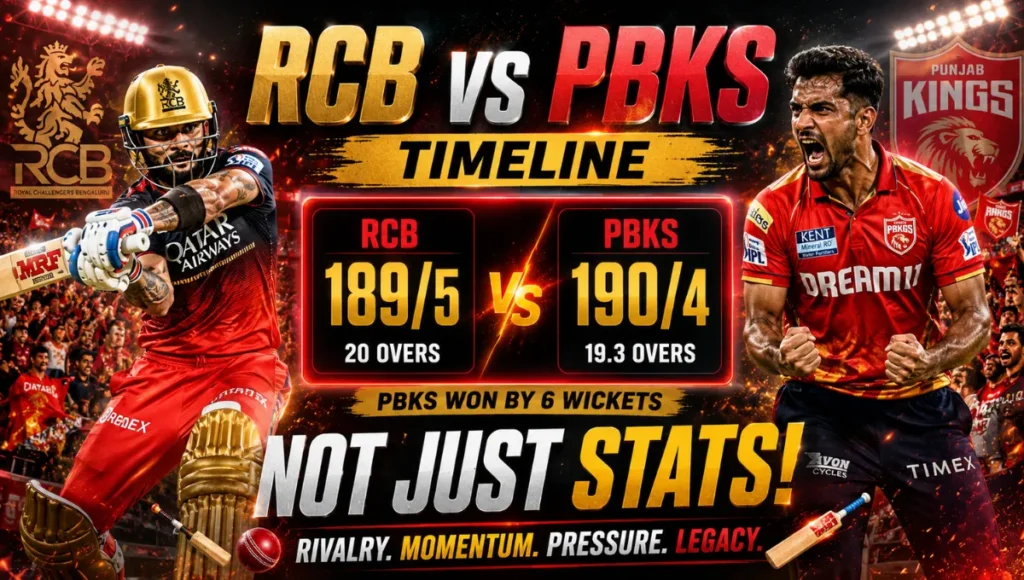
The RCB vs PBKS rivalry looks simple on a stats. But once you follow the timeline, you see a much sharper story: early Punjab control, long stretches of momentum swings, and a 2025 season that pushed this matchup into a new phase.
The rivalry is not just about wins. It is about when one team wins, how they win, and whether the result came under pressure or in control.
What This Rivalry Really Means
This is one of the most balanced IPL rivalries. The latest head-to-head count shows RCB slightly ahead, 19-18, which tells you how close the contest has been over the years. That closeness is the reason this fixture keeps getting attention even when one team enters with better form.
A close head-to-head means random results. That is not true here. The pattern is more specific: the team that controls the powerplay usually controls the match.
| Rivalry detail | Insight |
|---|---|
| Total meetings | 37 IPL matches |
| Head-to-head edge | RCB lead 19-18 |
| Rivalry type | Balanced, high-variance, momentum-driven |
| Biggest story shift | 2025 playoff season changed the perception |
Why The Numbers Alone Are Misleading
A 19-18 split tells you the rivalry is tight, but it does not show the emotional weight of the big matches. RCB’s 2025 Qualifier 1 win was not just another victory; it was a one-sided statement that changed the conversation around both teams. PBKS’s regular-season wins still matter, but playoff performance changes perception faster than season averages.
What Fans Usually Overlook
Fans usually chase the win-loss count and stop there. The better question is:
- Who wins when the pitch is quick?
- Who handles spin better?
- Who wins under playoff pressure?
- Who adapts after losing the first tactical battle?
That is where the real timeline lives.
Royal Challengers Bengaluru vs Punjab Kings timeline by era
2008–2011: PBKS Starts Stronger
The rivalry began in 2008, and PBKS won the first meeting in Bengaluru, then followed that with more early control. In the first phase, Punjab looked more settled in this matchup, while RCB were still searching for a reliable method against them.
The 2011 clash at Dharamsala was a loud reminder of that gap. PBKS piled up 232/2 and beat RCB by 111 runs, one of the biggest statement wins in the rivalry.
if you are using this timeline for content or analysis, treat 2008–2011 as the “Punjab control phase,” not as a random set of old results.
2012–2016: RCB Finds Answers
This is where the rivalry becomes more balanced. RCB started producing bigger match-winning innings and more complete performances. Their wins in this phase showed a shift in execution, especially when RCB got their batting order right and did not let PBKS dictate the game early.
| Era | Trend | What changed |
|---|---|---|
| 2008–2011 | PBKS control | Punjab dominated early matchups |
| 2012–2016 | RCB response | RCB found better batting and bowling balance |
| 2017–2021 | Swing phase | Results went back and forth |
| 2022–2024 | Tactical phase | Smarter matchups, tighter margins |
| 2025 | Turning point | RCB took playoff control |
Read Also:- Mumbai Indians vs Rajasthan Royals Match Scorecard
this phase was just RCB “getting hot.” RCB began matching PBKS’s aggression with better batting depth and more decisive bowling spells.
When writing about this period, highlight not only the result but also the margin. Margin tells the story of control.
2017–2021: Momentum Swings Back and Forth
This is the era of volatility. PBKS won in 2017, RCB answered in 2018 and 2019, and PBKS regained control in 2020 and 2021 in select matches. The rivalry stopped behaving like a one-way street and became more matchup-driven.
One overlooked detail is how much venue and chase pressure started to matter. PBKS often looked more dangerous when their top order fired quickly, while RCB became more dangerous when their batting chase stayed calm and targeted specific bowlers.
That is why the rivalry feels unpredictable even when team form changes. If you are comparing seasons, separate “home away advantage” from “momentum.” They are not the same thing.
2022–2024: Tighter, Smarter, More Tactical
The 2022 and 2023 results show how the fixture kept alternating, but the quality of tactical decisions improved. By 2024, RCB had won both meetings, which helped narrow the long-term gap and gave them more confidence in this matchup.
This phase matters because it shows the rivalry was no longer about raw power alone. Field placements, bowling matchups, and chase planning became more important. That is usually the sign of a matured rivalry. What most articles skip is the psychological layer. Once a team starts winning the “small decisions,” the head-to-head shifts faster than people expect.
2025: The Season That Changed The Story
2025 was the biggest shift in the modern rivalry. RCB beat PBKS in the league phase, then crushed them again in Qualifier 1 to reach the final after nine years. That Qualifier 1 win was especially brutal: PBKS were bowled out for 101, and RCB chased it in 10 overs.
This is where the rivalry stopped being “close and balanced” in the short term and became psychologically tilted toward RCB. Phil Salt’s 56 off 27 and RCB’s bowling masterclass made the match look decided early. The lesson is obvious: in playoff cricket, the first 10 overs can completely erase the balance of the regular-season timeline.
Then came the final, where RCB again beat PBKS, this time by 6 runs after defending 190. That final turned 2025 into a defining chapter, not just a good season.
| 2025 match | Result | Why it mattered |
|---|---|---|
| League stage | RCB beat PBKS | Set up the later psychological edge |
| Qualifier 1 | RCB won convincingly | Changed the rivalry narrative |
| Final | RCB won by 6 runs | Proved the shift was real |
If you want the article to feel non-replaceable, give 2025 its own section with two sub-points: league-phase win and playoff impact. That is the true turning point.
Biggest turning points
Early PBKS Control
PBKS set the tone in the opening years and proved they could hurt RCB badly when batting first. The huge 2011 win was the clearest example of that.
RCB’s Away-Game Control
Later, RCB’s away form became a major factor. That mattered against PBKS too. The sharpest version of RCB is not just star batting, but complete bowling discipline.
Qualifier 1 Demolition
This was the cleanest turning point in the modern timeline. PBKS did not just lose; they were outplayed in every phase. That kind of loss changes future expectations.
The Final and The Pressure Test
The final showed that RCB could repeat the formula under the heaviest pressure. That matters more than a league win because it proves the earlier result was not a one-off.
What The Rivalry Says About Both Teams
RCB’s Bowling Identity
The 2025 playoff run showed RCB’s bowling unit finally behaving like a playoff weapon. That is the sharpest version of RCB: not just star batting, but complete bowling discipline.
PBKS’s Top-Order Aggression
PBKS remain dangerous when their top three get going. But here is the catch: aggression without conversion becomes a trap in knockout cricket.
Why Both Teams Can Dominate in Bursts
This rivalry works because both sides have matchup upside. PBKS can explode early. RCB can control the middle and finish strongly. That creates a fixture where lead changes can happen fast, but only if one side wins the first tactical battle.
| Team | Main strength | Main risk |
|---|---|---|
| RCB | Chase control, bowling discipline, playoff composure | Can be vulnerable if top order fails early |
| PBKS | Fast starts, batting aggression, momentum bursts | Can collapse if powerplay fails |
| Shared pattern | High-pressure swings | Small mistakes become match-defining |
Read Also:- Royal Challengers Bengaluru vs Rajasthan Royals Timeline
Don’t write this rivalry as “RCB strong, PBKS weak” or the reverse. Write it as a rivalry of phases.
Match-up Trends That Matter
| Trend | What it shows | Practical takeaway |
|---|---|---|
| Venue split | Home conditions can flip the result | Mention Bengaluru and Mullanpur separately |
| Chase vs defend | RCB often look calmer in chases | Add result context, not just scoreline |
| Powerplay | PBKS want fast starts | Explain why early wickets matter |
| Death overs | RCB’s bowlers can close games hard | Use 2025 playoff examples |
The strongest insight here is that this rivalry is not about one batting attack versus one bowling attack. It is about which team can force the other into its least comfortable phase.
Full Year-Wise Timeline
| Year | Rivalry note |
|---|---|
| 2008 | PBKS won the first meeting |
| 2009 | RCB began closing the gap |
| 2010 | RCB took control in that phase |
| 2011 | PBKS delivered their biggest win by runs |
| 2012 | Split results kept the rivalry alive |
| 2013 | PBKS held the edge in the season |
| 2014 | PBKS remained strong |
| 2015 | RCB produced major wins |
| 2016 | RCB continued to look stronger in the matchup |
| 2017 | PBKS bounced back |
| 2018 | RCB answered with key wins |
| 2019 | RCB kept pressure on PBKS |
| 2020 | PBKS recovered in the season meetings |
| 2021 | The rivalry remained tight |
| 2022 | PBKS won both meetings |
| 2023 | RCB took an important win |
| 2024 | RCB swept both matches |
| 2025 | RCB beat PBKS in league, Qualifier 1, and the final |
Frequently Asked Questions (FAQs)
Q1. How many times have RCB and PBKS faced each other in the IPL?
Ans. They have met 37 times in the IPL, with RCB leading 19-18 in the latest head-to-head record.
Q2. Who leads the head-to-head?
Ans. RCB currently lead the rivalry by a single match, based on the latest available records.
Q3. What is the biggest win in this rivalry?
Ans. PBKS’s biggest win by runs came in 2011, when they beat RCB by 111 runs after posting 232/2.
Q4. What changed in 2025?
Ans. RCB beat PBKS in the league stage, then dominated Qualifier 1 and later won the final, which made 2025 the most important modern chapter in this rivalry.