
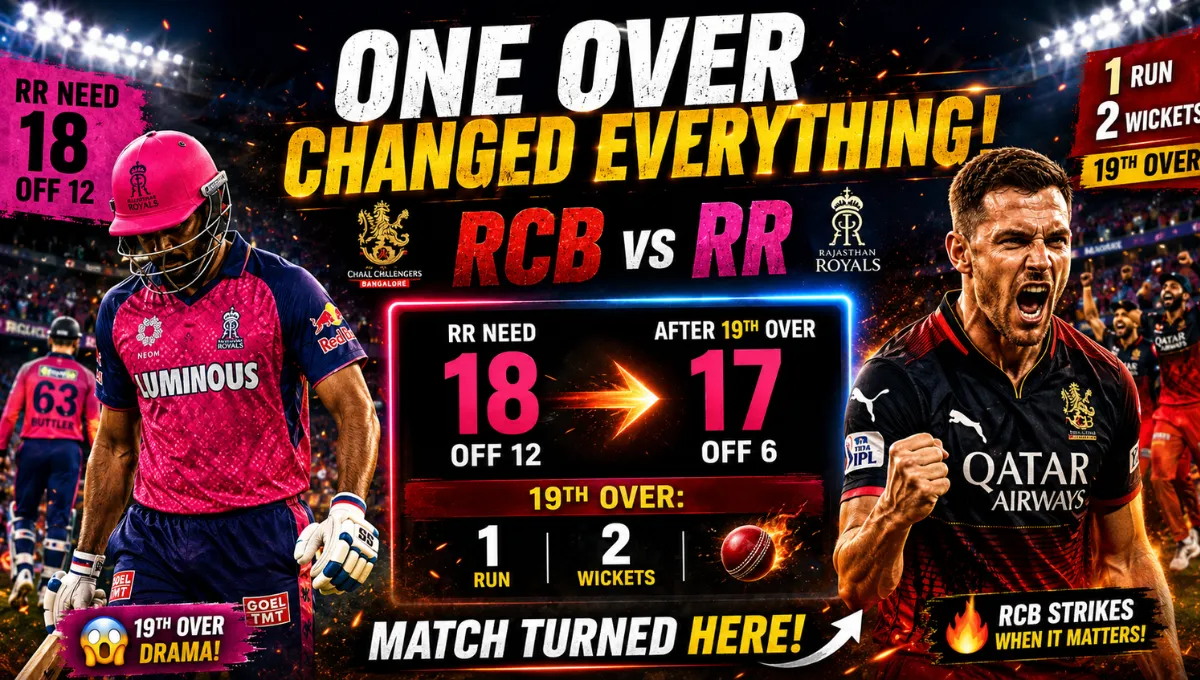
A defending champion walked into Guwahati unbeaten. Two hours later, they walked out having watched a teenager treat their bowling attack like a school net session. The Royal Challengers Bengaluru vs Rajasthan Royals timeline from IPL 2026’s Match 16 is really the story of one 15-ball fifty that changed everything and the story of how RCB’s own middle-overs collapse handed Rajasthan the platform to make it happen.
Played on April 10, 2026, at the ACA Stadium in Guwahati, this match carried real weight beyond just two points. RCB arrived unbeaten in three games; Rajasthan Royals arrived on a four-match winning streak of their own. Only one unbeaten run could survive the night, and this Royal Challengers Bengaluru vs Rajasthan Royals full match report explains exactly how it ended.
Match Overview: Pitch, Toss, and the Setup
Rajasthan Royals won the toss and chose to field first after a brief rain delay, a decision that immediately put RCB’s batters under the lights on a Guwahati surface known for rewarding clean hitting once set. That toss call would prove important not because bowling first was obviously correct, but because it set up a chase RR’s batting depth was perfectly built to exploit.
The ACA Stadium pitch played true and quick throughout, offering little for the bowlers and everything for batters willing to back their power a fact both sides would exploit in contrasting ways across the evening.
Powerplay Analysis (Overs 1-6): RCB’s Collapse Begins
If there’s one phase of this Royal Challengers Bengaluru vs Rajasthan Royals match analysis that deserves scrutiny, it’s RCB’s opening exchanges because the innings never really recovered from what happened here.
- Phil Salt departed for a golden duck in the very first over, an immediate psychological blow to RCB’s chase for early momentum.
- Devdutt Padikkal fell for 14 off 7 balls in the third over, and suddenly RCB had lost two batters before the powerplay was even half done.
- Virat Kohli tried to steady the innings with some fluent strokeplay, striking his way to 32 off just 16 balls, but even his effort ended in the fifth over.
- By the end of the powerplay, RCB were reeling at 58/3 in 4.5 overs pressure was building immediately, and the required recovery had to come from a batting order now facing an uphill climb.
Momentum shifted almost entirely toward Rajasthan Royals in these opening overs, even though they hadn’t yet faced a single ball themselves.
Read Also:- Sri Lanka National Cricket Team vs Bangladesh National Cricket Team Match Scorecard
Middle Overs Breakdown (Overs 7-15): RCB’s Rebuild
RCB’s middle overs told a story of genuine fight, even if the early damage proved difficult to fully erase.
- With three top-order batters gone, RCB needed partnerships, and their middle order responded by gradually rebuilding through calculated boundary-hitting rather than reckless intent.
- Jitesh Sharma’s wicket fell in the 8.4th over, a reminder that Rajasthan’s bowlers were still finding regular breakthroughs even as RCB tried to accelerate.
- Krunal Pandya’s dismissal in the 6.2nd over had already added to the pressure, meaning RCB’s middle overs were less about explosive stroke-play and more about simply surviving long enough to set a platform for the death overs
- By the time this phase ended, RCB had clawed their way back into a defendable position, but the powerplay collapse meant they were building from a deficit rather than compounding a strong start.
This is exactly the kind of middle-overs recovery that looks solid on paper but leaves a team short of a truly imposing total and that’s precisely what happened.
Death Overs Drama (Overs 16-20): A Defendable, Not Dominant, Total
- RCB’s lower order pushed hard in the closing overs, using the depth of their batting to add crucial runs when it mattered most.
- The Bengaluru side eventually posted 201/8 in their 20 overs a total that looked genuinely defendable on a good batting surface, especially given the fast start Rajasthan’s bowlers had forced.
- In hindsight, this total carried a false sense of security. On this particular pitch, against this particular batting line-up, 201 was never going to be enough and the chase would prove it emphatically.
Turning Point of the Match
Every genuine Royal Challengers Bengaluru vs Rajasthan Royals full match report has to identify one specific passage as the moment the game slipped away from RCB completely and it wasn’t anything that happened in their own innings. It was the introduction of Vaibhav Sooryavanshi into Rajasthan’s chase.
The young opener walked out and, within a handful of overs, had rewritten the entire complexion of the match, smashing a 15-ball fifty that turned a competitive 202-run target into a formality. Once Sooryavanshi found his rhythm, RCB’s bowling attack simply had no answer every field adjustment, every change of bowler, was met with the same fearless intent.
Key Performances (Detailed)
Vaibhav Sooryavanshi (RR) Player of the Match
His innings of 78 off just 26 balls, laced with eight fours and seven sixes, wasn’t just fast it was demoralizing. Striking at over 300, he turned RCB’s total from a defendable score into a target that felt almost embarrassing by the time he was done.
Dhruv Jurel (RR)
His unbeaten 81 was the perfect complement to Sooryavanshi’s fireworks calm, calculated, and clinical in sealing the chase without ever needing to force the pace himself.
Virat Kohli (RCB)
His 32 off 16 balls was the one genuine bright spot of RCB’s top order, showing exactly the intent his team needed more of after losing two early wickets.
Jofra Archer (RR)
His early strike removing Phil Salt set the tone for RCB’s powerplay collapse, giving Rajasthan the platform they needed before their batting even came into play.
Tactical Analysis: Captaincy, Bowling, and Match-ups
Riyan Parag’s decision to bowl first after winning the toss reflected confidence in his bowling attack’s ability to exploit early conditions a call fully vindicated once Salt and Padikkal fell inside the powerplay. That early pressure effectively dictated the entire complexion of RCB’s innings, forcing them into recovery mode rather than allowing free-flowing aggression from ball one.
RCB’s tactical issue emerged in their inability to contain Rajasthan’s top order once Sooryavanshi got going. Bhuvneshwar Kumar, despite finishing with the most dot balls in the match, couldn’t find a consistent match-up against the left-handed teenager’s aggressive intent, and no bowling change from Rajat Patidar managed to disrupt the rhythm once it was established. The lack of a clear counter-plan against a batter playing with such freedom proved to be the tactical gap that ultimately decided the match.
What Went Right and What Went Wrong
What went right for Rajasthan Royals:
- Winning the toss and immediately exploiting early conditions with the ball.
- Vaibhav Sooryavanshi’s fearless 78 off 26 balls completely dismantled the chase equation.
- Dhruv Jurel’s composed finishing ensured there was never a hint of late drama.
What went wrong for Royal Challengers Bengaluru:
- Losing Salt and Padikkal inside the powerplay set an immediately negative tone for the innings.
- No bowling change found an answer to Sooryavanshi’s aggression once he settled in.
- The death bowling, already flagged as an area of concern, couldn’t defend a total that needed to be closer to 220 on this surface.
Read Also:- Sri Lanka National Cricket Team vs Zimbabwe National Cricket Team Match Scorecard
Final Moments: How It Ended
Dhruv Jurel’s punch down to long-on for a single sealed the chase in the 18th over, with Rajasthan finishing at 202/4 and 12 balls still unused. What had started as a promising defendable total for RCB ended as their first loss of the season, their unbeaten start snapped in the most emphatic fashion possible.
Rajasthan’s players mobbed Sooryavanshi in celebration not the relief of a tight finish, but the pure joy of watching a teenager announce himself on the biggest stage in Indian cricket.
Conclusion
This Royal Challengers Bengaluru vs Rajasthan Royals timeline ultimately comes down to one uncomfortable truth for the Bengaluru franchise: a powerplay collapse can be survived, but not against a batting line-up with the depth and fearlessness Rajasthan possess this season. RCB fought back well enough to post a defendable score, but “defendable” and “enough” turned out to be very different things once Vaibhav Sooryavanshi walked to the crease.
For Rajasthan Royals, this win extended their remarkable start to a fifth consecutive victory and kept them firmly atop the IPL 2026 points table while RCB now face a pressing question about their death bowling heading into the rest of the season.
Frequently Asked Questions (FAQs)
Q1. What was the final result of the RCB vs Rajasthan Royals IPL 2026 match?
Ans. Rajasthan Royals won by 6 wickets, chasing down RCB’s 201/8 with 12 balls to spare, finishing at 202/4.
Q2. Who was the Player of the Match in the RCB vs Rajasthan Royals clash?
Ans. Vaibhav Sooryavanshi was named Player of the Match for his explosive 78 off 26 balls, which included eight fours and seven sixes.
Q3. Why couldn’t RCB defend a total of 201 against Rajasthan Royals?
Ans. RCB’s bowlers had no effective counter to Vaibhav Sooryavanshi’s aggressive strokeplay, and the Guwahati surface offered little assistance to bowlers once batters settled in, allowing Rajasthan to chase down the target with overs in hand.
Q4. What did this result mean for both teams in the IPL 2026 points table?
Ans. The win kept Rajasthan Royals at the top of the table with a strong net run rate, while the loss dropped Royal Challengers Bengaluru to third place and ended their unbeaten start to the season.
Q5. How did the powerplay collapse affect RCB’s total in this match?
Ans. RCB slipped to 58/3 inside the first five overs after losing Phil Salt, Devdutt Padikkal, and Virat Kohli early, forcing their middle order into recovery mode rather than building on a strong start.












Leave a Reply