


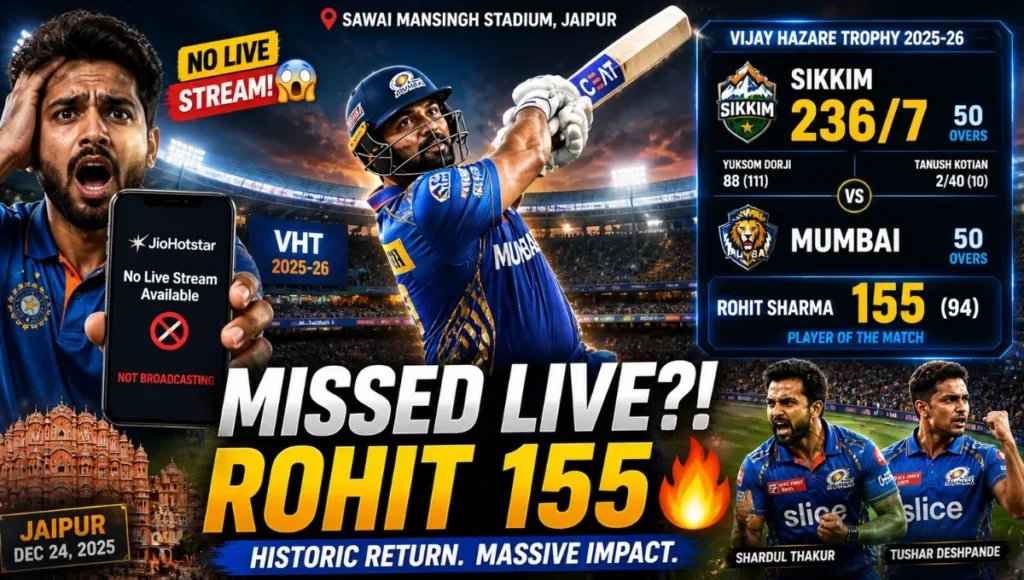
More than 20,000 people packed into the Sawai Mansingh Stadium in Jaipur on a December afternoon for a domestic List A fixture. That number alone tells you something unusual was happening. Sikkim had just posted a genuinely competitive 236 in their 50 overs. Then Rohit Sharma walked out to open the chase and by the time he was done, the entire narrative of the match had changed.
But here’s the real problem with how every report covered this game: they all made it about one man’s innings. What most coverage misses is that Sikkim actually batted well enough to make this a contest, right up until one player made the scoreboard irrelevant.
60-Second Match Summary
| Detail | Info |
|---|---|
| Match | Group C, Vijay Hazare Trophy 2025-26 |
| Venue | Sawai Mansingh Stadium, Jaipur |
| Date | Wednesday, December 24, 2025 |
| Toss | Sikkim won the toss, elected to bat |
| Result | Mumbai won by 8 wickets |
| Sikkim | 236-7 in 50 overs |
| Mumbai | 237-2 in 30.3 overs |
| Player of the Match | Rohit Sharma — 155 off 94 balls |
If you remember one number, remember this: Rohit Sharma’s 155 came off 94 balls, meaning Mumbai’s entire top four combined couldn’t outscore one man’s boundary count 18 fours and 9 sixes from a single innings.
Match Details & Toss
This was a Group C fixture of the Vijay Hazare Trophy 2025-26, played at the Sawai Mansingh Stadium, Jaipur, on December 24. Sikkim won the toss and elected to bat first a reasonable call on a pitch that ultimately played well for batting throughout the day.
What nobody could have predicted was that the same surface would be used to produce a List A innings of 155 in the second innings.
What People Think vs What Actually Happened
What most people assume from a scoreline like “Mumbai won by 8 wickets, chasing 237 in 30.3 overs”: Sikkim must have batted poorly, or bowled even worse.
What actually happened is more nuanced. Sikkim posted 236 for 7 in their 50 overs a genuinely fighting List A total, built around Ashish Thapa’s patient 79 off 87 balls and useful contributions from K Sai Satwik (34) and Kranthi Kumar (34). That’s not a collapse. That’s a competitive first innings from a team many wouldn’t expect to challenge a Mumbai lineup at all.
This is where the story actually turns: Mumbai’s bowlers did concede at nearly 4.72 runs an over, and Sikkim’s lower order added handy runs late through Robin Limboo’s unbeaten 31. The problem for Sikkim wasn’t their batting it was that 236 simply isn’t a defendable total against a top-order batter in career-best form.
This is a common mistake in how these mismatches get reported: pointing at the batting side as the story instead of recognising that some totals just aren’t enough regardless of how competently they were built.
Full Scorecard: Sikkim Innings (236-7, 50 overs)
| Batter | Dismissal | Runs | Balls | 4s | 6s | SR |
|---|---|---|---|---|---|---|
| K Sai Satwik | b Tanush Kotian | 34 | 55 | 4 | 0 | 61.82 |
| Amit Rajera | c Tamore b Deshpande | 0 | 2 | 0 | 0 | 0.00 |
| Ashish Thapa (wk) | c Mulani b Thakur | 79 | 87 | 8 | 0 | 90.80 |
| Kranthi Kumar | lbw b Thakur | 34 | 52 | 2 | 0 | 65.38 |
| Gurinder Singh | lbw b Mulani | 17 | 35 | 0 | 0 | 48.57 |
| Robin Limboo | not out | 31 | 41 | 2 | 1 | 75.61 |
| Palzor Tamang | c Khan b Musheer Khan | 10 | 15 | 1 | 0 | 66.67 |
| Ankur Malik | run out (Deshpande) | 9 | 11 | 0 | 0 | 81.82 |
| Lee Yong Lepcha (c) | not out | 1 | 2 | 0 | 0 | 50.00 |
| Extras | (b 2, lb 4, w 15) | 21 | ||||
| Total | 236-7 | 50 ov | RR: 4.72 |
Did not bat: Md Saptulla, Abishek Kumar.
Sikkim: Fall of Wickets
| Wicket | Batter | Score | Over |
|---|---|---|---|
| 1st | Amit Rajera | 5-1 | 1.2 |
| 2nd | K Sai Satwik | 56-2 | 12.5 |
| 3rd | Ashish Thapa | 162-3 | 31.5 |
| 4th | Kranthi Kumar | 165-4 | 33.4 |
| 5th | Gurinder Singh | 190-5 | 41.5 |
| 6th | Palzor Tamang | 210-6 | 45.4 |
| 7th | Ankur Malik | 232-7 | 49.1 |
Mumbai Bowling Figures
| Bowler | O | M | R | W | Econ |
|---|---|---|---|---|---|
| Shardul Thakur (c) | 6 | 0 | 19 | 2 | 3.17 |
| Tushar Deshpande | 8 | 0 | 32 | 1 | 4.00 |
| Tanush Kotian | 9 | 0 | 63 | 1 | 7.00 |
| Sylvester D’Souza | 7 | 0 | 28 | 0 | 4.00 |
| Shams Mulani | 10 | 0 | 51 | 1 | 5.10 |
| Musheer Khan | 10 | 1 | 37 | 1 | 3.70 |
Read Also:- South Africa National Cricket Team Vs England Cricket Team Timeline
Shardul Thakur’s figures of 2-19 in 6 overs stand out as the most disciplined spell of the innings his early breakthrough of Ashish Thapa’s key partner set the tone even as Sikkim rebuilt around Thapa.
Full Scorecard: Mumbai Innings (237-2, 30.3 overs)
| Batter | Dismissal | Runs | Balls | 4s | 6s | SR |
|---|---|---|---|---|---|---|
| Angkrish Raghuvanshi | lbw b Ankur Malik | 38 | 58 | 4 | 0 | 65.52 |
| Rohit Sharma | c Thapa b Kranthi Kumar | 155 | 94 | 18 | 9 | 164.89 |
| Musheer Khan | not out | 27 | 26 | 2 | 0 | 103.85 |
| Sarfaraz Khan | not out | 8 | 5 | 1 | 0 | 160.00 |
| Extras | (b 1, w 8) | 9 | ||||
| Total | 237-2 | 30.3 ov | RR: 7.77 |
Did not bat: Hardik Tamore, Siddhesh Lad, Shardul Thakur, Tanush Kotian, Shams Mulani, Tushar Deshpande, Sylvester D’Souza.
Mumbai: Fall of Wickets
| Wicket | Batter | Score | Over |
|---|---|---|---|
| 1st | Angkrish Raghuvanshi | 141-1 | 19.4 |
| 2nd | Rohit Sharma | 226-2 | 29.2 |
Sikkim Bowling Figures
| Bowler | O | M | R | W | Econ |
|---|---|---|---|---|---|
| Palzor Tamang | 5 | 2 | 28 | 0 | 5.60 |
| Kranthi Kumar | 6 | 0 | 60 | 1 | 10.00 |
| Gurinder Singh | 5 | 0 | 37 | 0 | 7.40 |
| Abishek Kumar | 4 | 0 | 24 | 0 | 6.00 |
| Ankur Malik | 4 | 0 | 41 | 1 | 10.25 |
| Md Saptulla | 4 | 0 | 26 | 0 | 6.50 |
| Lee Yong Lepcha | 2.3 | 0 | 20 | 0 | 8.00 |
Kranthi Kumar’s figures read 1-60, but that one wicket was Rohit Sharma himself arguably the most valuable single wicket any Sikkim bowler could have picked up all season.
Turning Point of the Match
Every scorecard lists when wickets fell. Almost none tells you which passage of play actually decided the outcome.
Here it is: overs 20 to 29, right after the 141-run opening stand between Raghuvanshi and Rohit was broken. Instead of Sikkim building pressure with fresh momentum, Rohit accelerated from a watchful start into a rampage reaching his century off just 62 balls and 150 off 91, before finally departing having faced only 94 deliveries total.
That nine-over stretch, where Rohit went from set batter to unstoppable, is the actual turning point. Sikkim’s total of 236 would have tested most domestic top orders. It couldn’t survive one batter deciding to play the innings of his comeback.
Player Performance Breakdown
Rohit Sharma: the comeback statement. 155 off 94 balls, with 18 fours and 9 sixes, marking his return to Vijay Hazare Trophy cricket after eight years.
What people miss about this innings is the discipline in the first twenty overs he didn’t attack immediately, he waited for the total to require acceleration, then took over completely. Calling this “just a big domestic score” undersells it; centuries against weaker attacks are common, but a strike rate of 164 while going from fifty to a century in barely 30 balls is a different level of intent.
Ashish Thapa: Sikkim’s real backbone. 79 off 87 balls at a strike rate of 90.8, anchoring an innings that could have collapsed early after Amit Rajera fell for a duck in the second over. Thapa’s innings is the most undervalued performance of the match without it, Sikkim doesn’t reach a total that even looks respectable on paper.
Shardul Thakur: the containment specialist. 2-19 off 6 overs, the most economical spell of the day among bowlers who took wickets. His early strike removed momentum from Sikkim’s middle order before it could build.
Angkrish Raghuvanshi: the underrated support act. 38 off 58 balls in a 141-run opening stand with Rohit. Nobody talks about this innings because of what came after it, but without Raghuvanshi holding one end steady early on, Rohit wouldn’t have had the platform to accelerate the way he did.
Key Moments & Highlights Timeline
- Over 1.2: Amit Rajera dismissed for a duck early setback for Sikkim.
- Overs 12.5–41.5: Sikkim’s middle order rebuilds through Thapa, Sai Satwik, and Kranthi Kumar.
- Over 49.1: Sikkim finish on 236-7 a genuinely competitive total.
- Over 19.4: Raghuvanshi departs after a 141-run opening stand Mumbai already well ahead of the rate.
- Around over 21: Rohit Sharma brings up his century off just 62 balls.
- Around over 27: Rohit reaches 150 off 91 balls.
- Over 29.2: Rohit Sharma departs for 155 the contest is already decided.
- Over 30.3: Musheer Khan and Sarfaraz Khan finish the chase Mumbai win by 8 wickets.
The Real Gap Between Mumbai and Sikkim
This is the part every competitor skips. Mumbai is one of the most decorated teams in Indian domestic cricket, with a squad that includes an ODI World No. 1-ranked batter in Rohit Sharma and Ranji Trophy regulars across the XI. Sikkim, by contrast, is a newer full-member state team still building its List A pedigree.
A counterintuitive point worth making here: the scoreline of “won by 8 wickets” actually flatters Mumbai’s margin less than you’d expect for this gulf in experience. Sikkim’s 236 wasn’t a token effort it was a total that would have made most domestic sides work hard for a chase. The gap between these programs isn’t in effort or basic competence.
It’s in the presence of players who can single-handedly turn a competitive total into an afterthought, and Mumbai has several of those; Sikkim, at this stage of its development, does not yet.
Read Also:- Pakistan National Cricket Team Vs New Zealand National Cricket Team Timeline
What This Result Means Going Forward
For Sikkim, the practical next step isn’t about batting technique their top seven all showed the ability to build an innings. It’s about developing an attack capable of stopping an in-form opposition batter once they’re set, since none of their bowlers could apply real pressure on Rohit once he crossed fifty.
For Mumbai, this match is a reminder that their batting depth is deep enough to make even a competitive opposition total irrelevant inside two-thirds of the overs, which is a significant asset heading into the knockout stage of the tournament.
Frequently Asked Questions (FAQs)
Q1. Who won the Mumbai vs Sikkim match?
Ans. Mumbai won by 8 wickets, chasing down Sikkim’s target of 237 in 30.3 overs.
Q2. Who was the Player of the Match in Mumbai vs Sikkim?
Ans. Rohit Sharma was named Player of the Match for his innings of 155 off 94 balls.
Q3. What was Sikkim’s total?
Ans. Sikkim scored 236 for 7 in their 50 overs.
Q4. How many runs did Rohit Sharma score against Sikkim?
Ans. Rohit Sharma scored 155 off 94 balls, including 18 fours and 9 sixes.
Q5. Who was Sikkim’s top scorer?
Ans. Ashish Thapa top-scored for Sikkim with 79 off 87 balls.