


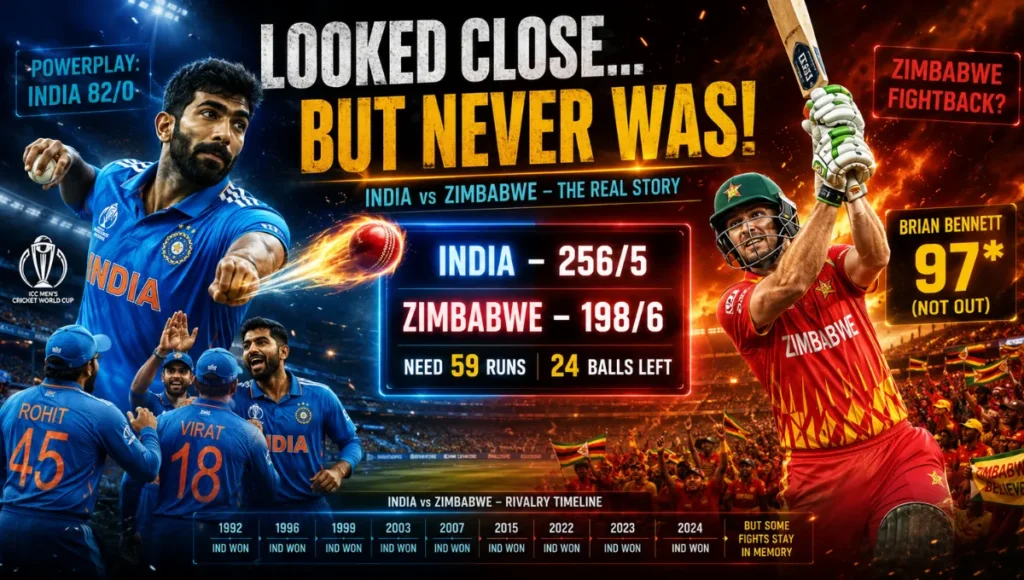
Zimbabwe’s Brian Bennett is unbeaten on 97, having smashed sixes off Jasprit Bumrah in a World Cup Super Eight match. For a few overs, it genuinely looks like Zimbabwe might chase down India’s mammoth 256. But here’s the real problem that innings was always a footnote, not a turning point, because India had already put the game out of reach in the powerplay.
That gap between “looked competitive” and “was never really in it” defines almost every India-Zimbabwe match ever played. Most stats pages just show you the scoreline. This one explains why it always ends the same way and where, occasionally, it doesn’t.
The Real Story Behind This Rivalry
India and Zimbabwe have played 85 matches across all formats, and India has won 67 of them a win rate above 78%. That’s not a close rivalry. It’s closer to a structural mismatch dressed up as a bilateral fixture.
What most people miss is that the gap isn’t really about talent on a given day. It’s about squad depth. India can afford to rest six first-choice players against Zimbabwe and still field a team stronger than Zimbabwe’s best XI. Zimbabwe has no equivalent bench to draw from.
Why India Dominates So Heavily
Three factors explain the imbalance better than any single stat table:
- Resource gap India’s domestic system produces far more high-performance players than Zimbabwe’s, meaning even India’s “B teams” carry more depth
- Conditions familiarity Indian batters train on flat, high-scoring pitches similar to most neutral venues used in ICC events
- Selection freedom India rests stars against Zimbabwe without losing competitiveness; Zimbabwe cannot do the same
My honest take: this rivalry survives mostly because ICC tournament scheduling forces these fixtures, not because of genuine competitive balance. Strip away World Cup group draws, and bilateral India-Zimbabwe series would barely register on the cricket calendar.
Head-to-Head Record Across All Formats
Here’s the complete breakdown something competitor pages usually split across three separate URLs.
| Format | Matches | India Won | Zimbabwe Won | Draw/Tie/NR |
|---|---|---|---|---|
| Test | 11 | 7 | 2 | 2 |
| ODI | 66 | 54 | 10 | 2 |
| T20I | 8 | 6 | 2 | 0 |
| Total | 85 | 67 | 14 | 4 |
India’s ODI win rate against Zimbabwe sits above 81%, the most lopsided of the three formats. In T20Is, Zimbabwe has managed just two wins in eight meetings both at home in Harare.
Reading the Numbers Correctly
A common mistake is treating this table as static. It isn’t. Every fresh bilateral series or World Cup meeting shifts these numbers slightly, and the July 2026 T20I series in Harare is actively updating the T20I row right now.
The 2026 T20 World Cup Clash, Broken Down
India beat Zimbabwe by 72 runs in a Super Eight clash at Chennai on February 26, 2026, posting 256/4 one of India’s highest-ever T20 World Cup totals. Zimbabwe replied with 184/6, with Brian Bennett scoring an unbeaten 97 off a chase that was mathematically dead by the halfway mark.
The Over That Actually Decided the Match
Everyone’s recap mentions the 256. Almost nobody isolates the exact moment the contest ended. India reached 80/1 in the powerplay after Sanju Samson set the tone with a six off the second ball of the innings. That powerplay total not the final score of 256 is what broke Zimbabwe’s bowling plan, because their attack never recovered its discipline for the rest of the innings.
This is where things go wrong for readers relying on standard match reports: they treat Abhishek Sharma’s 55 off 30 as the headline, when the real story is that six Indian batters all struck at 158-plus, meaning Zimbabwe had no bowler to target and no phase of the innings to regroup in. Arshdeep Singh then closed it out with 3/24, ensuring Bennett’s fightback stayed cosmetic rather than threatening.
Performance Snapshot
| Player | Team | Contribution |
|---|---|---|
| Abhishek Sharma | India | 55 off 30 balls |
| Hardik Pandya | India | 50 off 23, plus 0/21 with the ball |
| Sanju Samson | India | Set powerplay tone with early six |
| Arshdeep Singh | India | 3/24, closed out the chase |
| Brian Bennett | Zimbabwe | 97* off a losing effort |
Read Also:- India National Under-19 Cricket Team Schedule
What people think vs reality: fans assume Bennett’s 97 means Zimbabwe “competed well.” The reality is his innings only mattered statistically, not tactically it came after the required run rate had already climbed past 15 an over.
India’s Zimbabwe Tour, July 2026 (Live)
This is the section no static competitor page currently tracks. India is touring Zimbabwe right now for a three-match T20I series their first bilateral meeting since the World Cup clash in February.
| Match | Date | Venue | Status |
|---|---|---|---|
| 1st T20I | July 23, 2026 | Harare Sports Club | Completed |
| 2nd T20I | July 25, 2026 | Harare Sports Club | Upcoming |
| 3rd T20I | July 26, 2026 | Harare Sports Club | Upcoming |
All three matches are being played at the same venue Harare Sports Club where Zimbabwe has historically performed better against India than anywhere else. This tour also marks BCCI’s confirmation of a bilateral T20I series specifically scheduled after the World Cup, signaling India wants to keep testing squad depth even against lower-ranked sides.
Why This Series Matters More Than It Looks
Bilateral tours to Zimbabwe usually get dismissed as low-stakes. That’s a mistake here. India frequently uses these tours to trial fringe players for T20I contention meaning the squad picked for Harare tells you more about India’s bench strength than the scoreline will.
The Four Times Zimbabwe Actually Won
Every other source frames Zimbabwe as perpetually losing. That’s mostly true, but incomplete. Zimbabwe has beaten India four times in bilateral T20Is and ODIs combined, and every single win shares one pattern: it happened in Harare, never on neutral or Indian soil.
| Date | Format | Result | Venue |
|---|---|---|---|
| July 6, 2024 | T20I | Zimbabwe won by 13 runs | Harare |
| June 18, 2016 | T20I | Zimbabwe won by 2 runs | Harare |
| July 19, 2015 | T20I | Zimbabwe won by 10 runs | Harare |
| Various (2000s–2010s) | ODI | Multiple Zimbabwe wins | Harare |
What people think vs reality: fans assume Zimbabwe’s rare wins come against a “weakened” or second-string India squad. Sometimes true, but not always several of these wins came during full-strength bilateral tours where India simply failed to adapt to Harare’s slower, lower-bounce pitch.
The Pattern Nobody Points Out
Look closely at that table and one thing stands out: every Zimbabwean win by margin is single digits or low double digits. None of these are blowouts. That tells you Zimbabwe’s wins aren’t upsets built on brilliance they’re wins built on India making uncharacteristic mistakes under low pressure, low-stakes conditions.
What People Get Wrong About This Rivalry
A common mistake is assuming this fixture is a guaranteed blowout every time. It isn’t. Zimbabwe’s home conditions genuinely level the field more than the overall stats suggest, which is exactly why the current July 2026 series in Harare carries more unpredictability than the head-to-head numbers imply.
Another common mistake: treating T20 World Cup meetings and bilateral series as the same context. World Cup matches involve full-strength India with everything on the line. Bilateral tours often see India rest key players, which skews perceived “competitiveness” in either direction depending on who gets picked.
A third mistake and this one’s counterintuitive is assuming Zimbabwe’s cricket has stagnated. Bennett’s 97 in a World Cup match against India’s full-strength bowling attack suggests otherwise. Zimbabwe’s batting depth has genuinely improved even if results haven’t caught up yet.
Head-to-Head by Decade
Breaking the rivalry down by era shows India’s dominance has actually grown sharper over time, not stayed constant.
| Era | India Win Rate | Notable Trend |
|---|---|---|
| 1990s–2000s | ~65% | Zimbabwe was still a competitive Test nation |
| 2010s | ~75% | Zimbabwe’s Test status declined, gap widened |
| 2020s–2026 | ~85%+ | India fields near full-strength squads even in bilateral series |
Read Also:- Icc men’s T20 World Cup warm-up Matches
This trend line matters for anyone predicting future results: the gap isn’t closing, it’s widening, despite individual talents like Bennett emerging on Zimbabwe’s side.
Frequently Asked Question (FAQs)
Q1. What is India’s head-to-head record against Zimbabwe?
Ans. India has won 67 of 85 matches across all formats, a win rate above 78%.
Q2. Did India win the 2026 T20 World Cup match against Zimbabwe?
Ans. Yes. India won by 72 runs in Chennai on February 26, 2026, posting 256/4.
Q3. When is India’s next match against Zimbabwe?
Ans. India played a three-match T20I series in Harare in July 2026, with matches on July 23, 25, and 26.
Q4. Has Zimbabwe ever beaten India in a major tournament?
Ans. No. Zimbabwe has never beaten India in a 50-over or T20 World Cup match.
Q5. Where does Zimbabwe perform best against India?
Ans. All of Zimbabwe’s wins over India have come at Harare Sports Club, their home ground.
Q6. Who has the better record in T20Is between India and Zimbabwe?
Ans. India leads 6-2 in T20Is, with both Zimbabwean wins coming at home in Harare.