


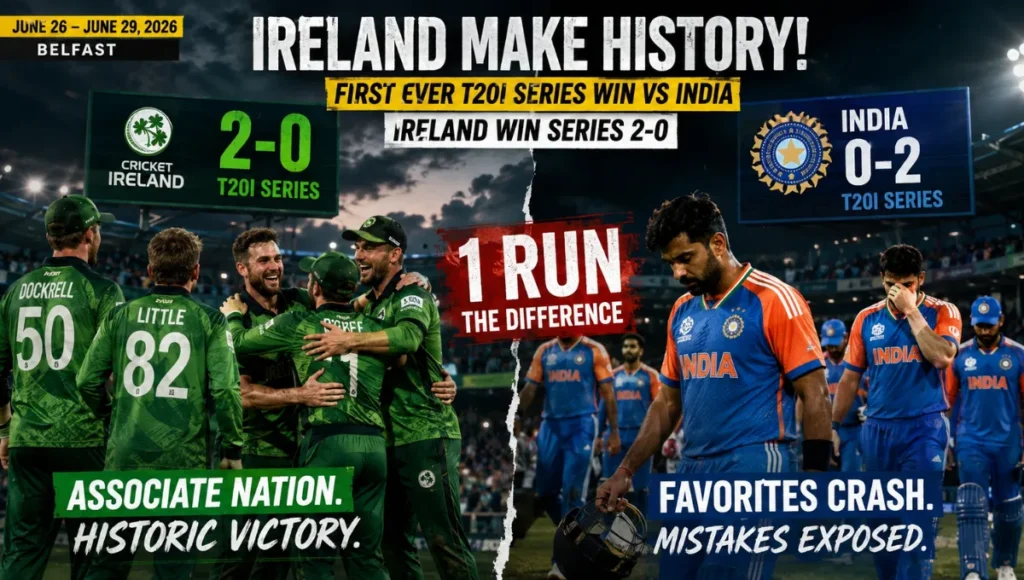
On June 26, 2026, India walked into Belfast holding an 8-0 head-to-head record against Ireland in T20Is. Three days later, they walked out having lost a bilateral series to an associate nation for the first time in the format’s history. Not a fluke. Not a rain-hit fringe result. A clean 2-0 sweep, sealed by a one-run margin so tight that India’s own assistant coach admitted the dressing room was in “disbelief.”
But here’s the real problem: most of the coverage treated this as a shock result and moved on. It wasn’t a shock. It was the end product of specific, repeatable mistakes India made in both matches and that’s what actually deserves attention.
Quick Series Snapshot
- Series result: Ireland won 2-0
- Venue: Civil Service Cricket Club (Stormont), Belfast both matches
- Dates: June 26 and June 28, 2026
- India captain: Shreyas Iyer
- Ireland captain: Lorcan Tucker
- Historic first: Ireland’s first-ever bilateral T20I series win over India
- Streak ended: India’s unbeaten run of 16 consecutive bilateral T20I series, spanning nearly three years
- Closest match: Game 2, decided by a single run
India vs Ireland Head-to-Head: Before and After This Series
| Format | Record Before Series | Record After Series |
|---|---|---|
| T20Is | India led 8-0 | India leads 8-2 |
| All formats combined | India led 11-0 | India leads 11-2 |
What most people miss is the scale hidden inside these numbers. India had never lost a single T20I to Ireland across 17 years and nine previous meetings. Two matches in Belfast changed that completely and did it against a full-strength Indian squad fresh off a T20 World Cup title, not a second-string team.
Full Schedule and Results
| Match | Date | Venue | Result |
|---|---|---|---|
| 1st T20I | June 26, 2026 | Stormont, Belfast | Ireland won by 34 runs |
| 2nd T20I | June 28, 2026 | Stormont, Belfast | Ireland won by 1 run |
Read Also:- India National Cricket Team Vs West Indies Cricket Team Players
Match 1 Analysis: Belfast, June 26: Ireland’s First-Ever Win Over India
Ireland batted first and posted 182/9. Captain Lorcan Tucker anchored the innings with an unbeaten-style 50 off 35 balls, and Gareth Delany added a rapid 49 off 32 to push the total past 180. Harshit Rana, playing his first game in four months after a knee injury, took 3/24 for India proof he can still disrupt an innings even on a good comeback day.
The Batting Collapse After the Powerplay
India’s chase never found rhythm. Abhishek Sharma played the innings of the day, smashing 49 off 20 balls with six of his nine boundaries coming on the off side a pattern Ireland’s bowlers were slow to correct. Once Sharma fell, the innings unraveled. India slipped to 90/5 by the 11th over, and Ireland conceded just two boundaries in the 27 balls immediately after the powerplay. That single stretch of tight bowling won Ireland the match. India were bowled out for 148 in 18.5 overs, losing by 34 runs.
This is where things go wrong for a top-heavy batting lineup: when the powerplay hitters get out, there’s no middle-order plan built for pressure cricket on a seaming pitch. Shreyas Iyer, captaining for the first time in 936 days, front-loaded his best bowlers Rana and Arshdeep Singh through the powerplay. It worked early, but left the death overs to Prasidh Krishna, who returned figures of 0/57, and a costly 16th over from Washington Sundar that went for 19.
Two Debutants Who Changed Everything
Here’s the detail almost every competitor buried: two uncapped Irish pacers won this match. Jai Moondra, a software engineer from Tonk, Rajasthan, made his international debut and dismissed Sanju Samson the Player of the Tournament from the last T20 World Cup for a duck on his very first appearance. Matt Hollard, debuting alongside him, removed Ishan Kishan with the second ball he ever bowled in T20Is and later dismissed Shreyas Iyer for 3. Two players nobody outside Irish cricket had heard of dismantled a title-winning batting order in their first game. That’s not bad luck for India that’s a scouting and preparation gap.
Match 2 Analysis: Belfast, June 28: One Run, One Historic Series
Ireland posted a modest 154/8, built around Harry Tector’s 53. Prince Yadav was India’s best bowler, taking 3/22, but 154 still looked comfortably chaseable on a ground where totals above 180 had been scored two days earlier.
India’s 18-for-3 Start
What people think happened is that India lost a close, well-fought chase.
Reality: India nearly lost the match in the powerplay. Sanju Samson was out first ball, lbw. Abhishek Sharma fell for a duck the very next over. Ishan Kishan was run out for 12. By the time Shreyas Iyer was bowled for 10, India were 18/3 chasing a target that should have been routine, from a position that made it anything but.
Tilak Varma’s Fight and the Final-Over Heartbreak
Tilak Varma played the only substantial Indian innings of the match, scoring 55 and dragging India back into contention almost single-handedly. India needed 18 off the final over. They fell one run short, finishing 153/9. Jai Moondra (3/32) and Matt Hollard (3/26) shared six wickets between them across the two matches the same pair of debutants who broke India’s batting order in Match 1 finished the job in Match 2.
Player Performance Breakdown
India’s Standout Performers
| Player | Best Contribution | Series Note |
|---|---|---|
| Abhishek Sharma | 49 off 20 (Match 1) | India’s most fluent batter across the series, but couldn’t repeat it in Match 2 |
| Tilak Varma | 55 (Match 2) | Series-best individual score, came in a losing cause |
| Harshit Rana | 3/24 (Match 1) | Best bowling return, marked a strong return from injury |
| Prince Yadav | 3/22 (Match 2) | India’s most economical bowler of the series |
| Shreyas Iyer | 10 & 3 | Struggled with bat in first series as captain since his recall |
Ireland’s Standout Performers
| Player | Best Contribution | Series Note |
|---|---|---|
| Jai Moondra | 3/32 combined, debut wicket of Samson | Series-defining debut; software engineer turned India-slayer |
| Matt Hollard | 3/26 combined, debut wicket of Kishan | Shared new-ball destruction with Moondra across both matches |
| Lorcan Tucker | 50 (Match 1) | First player in men’s T20I history to score a fifty in each of his first three games as captain |
| Gareth Delany | 49 (Match 1) | Key partner in building Ireland’s first-innings total |
| Harry Tector | 53 (Match 2) | Set up the total Ireland eventually defended by one run |
Read Also:- India National Cricket Team Vs Netherlands National Cricket Team Matches
The pattern across both games is unmistakable: Ireland’s two debutant pacers, not their established stars, decided the series. India’s response a string of individual fifties that never became a winning partnership shows a batting unit that could produce moments but not match-winning composure.
The Real Turning Point of the Series
Most reports call Match 2’s final over the turning point. It wasn’t it was already too late by then. The real turning point was India’s decision, in both games, to let their top three bat without adapting to a seaming Belfast pitch that clearly favored the bowlers who pitched fuller and straighter. Ireland’s bowlers adjusted their lines mid-innings in Match 1 after Abhishek Sharma punished width. India never made an equivalent adjustment in either innings. That’s a preparation and in-game-thinking gap, not a talent gap.
What People Got Wrong About This Series
The dominant narrative was “India fielded an inexperienced side, so this doesn’t count.” That excuse doesn’t survive contact with the scorecard. Sanju Samson, Shreyas Iyer, Ishan Kishan, Tilak Varma, and Abhishek Sharma are established international batters, several with T20 World Cup medals. The problem wasn’t inexperience it was that India’s batters kept playing the same aggressive game plan against bowlers who were clearly exploiting seam movement, instead of adjusting. Blaming personnel lets the actual issue game-plan rigidity on unfamiliar pitches go unexamined.
Records Broken and Streaks Ended
- Ireland’s first-ever win over India in international cricket, in any format
- Ireland’s first-ever bilateral T20I series win over India
- India’s first defeat to Ireland in nine head-to-head T20I meetings across 17 years
- India’s 16-series unbeaten bilateral T20I streak, spanning nearly three years, ended
- Lorcan Tucker became the first player in men’s T20I history to score a half-century in each of his first three matches as captain
- Two debutant Irish pacers (Moondra and Hollard) combined for 6 wickets across the series
What This Means for India’s T20I Team Going Forward
A series loss to an associate nation, right after a T20 World Cup win, will force selectors to separate short-term reputational damage from actual squad problems. The real fix isn’t dropping players it’s building in-game adaptability against unfamiliar seam-friendly conditions, something India rarely faces at home. Expect India’s think tank to schedule more preparation matches in England-and-Ireland-style conditions before any future assignments there, rather than treating this result as a one-off blip to be forgotten once bigger opponents arrive.
Frequently Asked Questions (FAQs)
Q1. Has Ireland ever beaten India in cricket before 2026?
Ans. No. Before June 26, 2026, India had won all nine previous meetings between the two sides across all formats. Ireland’s win in the first T20I was their first-ever victory over India in international cricket.
Q2. What was the final score of the India vs Ireland T20I series 2026?
Ans. Ireland won the two-match series 2-0, winning the first T20I by 34 runs and the second T20I by 1 run.
Q3. Who was the standout player of the India vs Ireland series 2026?
Ans. Jai Moondra, an Irish debutant pace bowler, was the standout performer, taking key wickets in both matches, including dismissing Sanju Samson on his international debut.
Q4. Why did India lose the T20I series to Ireland?
Ans. India’s top order collapsed in both matches against disciplined Irish seam bowling, and the team failed to adjust its aggressive batting approach to Belfast’s bowler-friendly conditions.
Q5. Did this result end any major India streak?
Ans. Yes. It ended India’s run of 16 consecutive bilateral T20I series without a loss, a streak that had lasted almost three years.