


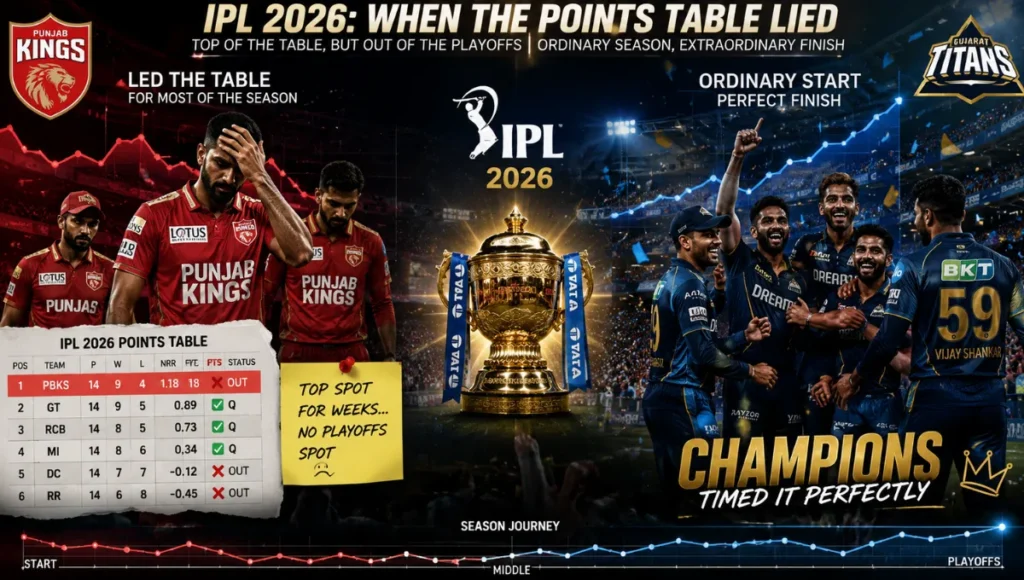
Picture leading the IPL points table for most of the season, sitting comfortably atop the standings with a commanding net run rate, and still finishing outside the playoffs’ top four. That’s exactly what happened to Punjab Kings in IPL 2026. Meanwhile, the eventual champions spent stretches of the season looking distinctly ordinary before timing their peak perfectly for the knockouts.
If you only check the points table once at the end of the season, you miss the genuinely wild ride that got teams there. Here’s the complete breakdown.
Final Points Table 2026: Complete Standings
The IPL 2026 league stage concluded after 70 round-robin matches, with the top four teams advancing to the playoffs. Royal Challengers Bengaluru finished the league phase level on points with Gujarat Titans and Sunrisers Hyderabad, all three teams securing 18 points, with net run rate ultimately separating the top three positions.
IPL 2026 Final League Standings
| Position | Team | Matches | Won | Lost | Points | NRR |
|---|---|---|---|---|---|---|
| 1 | Royal Challengers Bengaluru (Q) | 14 | 9 | 5 | 18 | +0.783 |
| 2 | Gujarat Titans (Q) | 14 | 9 | 5 | 18 | +0.695 |
| 3 | Sunrisers Hyderabad (Q) | 14 | 9 | 5 | 18 | +0.524 |
| 4 | Rajasthan Royals (Q) | 14 | 8 | 6 | 16 | +0.189 |
| 5 | Punjab Kings (E) | 14 | 7 | 6 | 15 | +0.309 |
| 6 | Delhi Capitals (E) | 14 | 7 | 7 | 14 | -0.651 |
| 7 | Kolkata Knight Riders (E) | 14 | 6 | 7 | 13 | -0.147 |
| 8 | Chennai Super Kings (E) | 14 | 6 | 8 | 12 | -0.345 |
| 9 | Mumbai Indians (E) | 14 | 4 | 10 | 8 | -0.584 |
| 10 | Lucknow Super Giants (E) | 14 | 4 | 10 | 8 | -0.740 |
What most people miss when they scan this final table alone is how dramatically different it looked at various points during the season. Three teams finishing level on 18 points is genuinely rare, and it meant the entire playoff seeding came down to fractional net run rate differences accumulated across 14 matches each.
The Punjab Kings Story: Table-Toppers Who Missed the Playoffs
Here’s where things go wrong for anyone assuming points table positions stay stable across a season. After 6 matches, Punjab Kings sat comfortably at the top with 11 points from 5 wins, boasting an excellent net run rate of +1.420, well clear of the chasing pack.
Points Table After Match 33 (Mid-Season Snapshot)
| Position | Team | Matches | Points | NRR |
|---|---|---|---|---|
| 1 | Punjab Kings | 6 | 11 | +1.420 |
| 2 | Rajasthan Royals | 7 | 10 | +0.790 |
| 3 | Royal Challengers Bengaluru | 6 | 8 | +1.171 |
| 4 | Sunrisers Hyderabad | 7 | 8 | +0.820 |
Read Also:- Icc T20 World Cup 2024: Full Schedule, Teams, Venues and Match Details
What people think happened is that Punjab Kings simply faded gradually as the season progressed.
The reality is more specific: they finished the league stage with 15 points and a still-respectable NRR of +0.309, meaning their tally was genuinely competitive, but three other teams overtook them in the run-in to reach 16-18 points. This is a common mistake worth correcting directly Punjab Kings didn’t collapse; they simply got squeezed out by three teams peaking at exactly the right moment while carrying superior net run rates.
Turning point: Punjab Kings’ inability to convert their dominant early-season net run rate advantage into enough additional wins in the back half of the league phase allowed RCB, GT, and SRH to overtake them using superior head-to-head form down the stretch.
How the Playoffs Actually Worked
The IPL 2026 playoffs followed the standard four-team knockout format across four matches.
Here’s a genuinely useful practical explainer that most competitor pages skip entirely: the format isn’t a simple single-elimination bracket, and understanding it changes how you read the table.
IPL 2026 Playoff Results
| Match | Fixture | Result | Venue |
|---|---|---|---|
| Qualifier 1 | RCB vs GT | RCB won by 92 runs | Dharamshala |
| Eliminator | SRH vs RR | RR won by 47 runs | New Chandigarh |
| Qualifier 2 | GT vs RR | GT won by 7 wickets | New Chandigarh |
| Final | RCB vs GT | RCB won by 5 wickets | Ahmedabad |
Here’s the practical step-by-step breakdown: the Qualifier 1 winner goes straight to the final, while the loser gets a second chance in Qualifier 2. The Eliminator is a straight knockout between the 3rd and 4th-placed teams, and its winner then plays the Qualifier 1 loser for the second final spot.
What people think happened here is that finishing 1st or 2nd guarantees a spot in the final. The reality is only the Qualifier 1 winner gets that guarantee the Qualifier 1 loser still has to win one more match, which is exactly what nearly derailed Gujarat Titans’ campaign after their 92-run loss to RCB.britannica+1
Rajat Patidar smashed an unbeaten 93 off just 33 balls in Qualifier 1, propelling RCB to 254 for 5, a total GT never got close to chasing, falling to 162 all out. Gujarat Titans then had to fight through Qualifier 2, beating Rajasthan Royals by 7 wickets to book their final spot.
The Final: RCB’s Back-to-Back Triumph
Royal Challengers Bengaluru beat Gujarat Titans by 5 wickets in the final at Narendra Modi Stadium, Ahmedabad, on May 31, defending their title from the previous season. RCB posted 161 for 5, and restricted GT to 155 for 8, sealing back-to-back titles for the first time in the franchise’s history.
Final Result: Narendra Modi Stadium, Ahmedabad
| Team | Score | Result |
|---|---|---|
| Royal Challengers Bengaluru | 161/5 | Won by 5 wickets |
| Gujarat Titans | 155/8 | Lost |
A genuinely counterintuitive idea worth stating directly: RCB and GT finished the league stage level on 18 points, yet RCB’s superior net run rate meant they never had to play the pressure-cooker Eliminator match, going straight from Qualifier 1 to the final with one less high-stakes game to navigate. That single NRR advantage, built up over 14 matches, arguably mattered as much as any individual playoff performance.
Orange Cap and Purple Cap: The Individual Battles
Vaibhav Sooryavanshi won the Orange Cap with 776 runs in 16 matches for Rajasthan Royals, at a strike rate of 237.30, the highest strike rate ever recorded by an Orange Cap winner across 19 editions of the tournament. Kagiso Rabada claimed the Purple Cap with 29 wickets for Gujarat Titans, edging out Bhuvneshwar Kumar’s 28 wickets in a genuinely tight race that went down to the final matches.bbc+3
Final Orange Cap Standings: Top 5
| Rank | Player | Team | Runs |
|---|---|---|---|
| 1 | Vaibhav Sooryavanshi | Rajasthan Royals | 776 |
| 2 | Shubman Gill | Gujarat Titans | 732 |
| 3 | Sai Sudharsan | Gujarat Titans | 652 |
| 4 | Heinrich Klaasen | Sunrisers Hyderabad | 606 |
| 5 | Virat Kohli | Royal Challengers Bengaluru | 600 |
Final Purple Cap Standings: Top 5
| Rank | Player | Team | Wickets |
|---|---|---|---|
| 1 | Kagiso Rabada | Gujarat Titans | 29 |
| 2 | Bhuvneshwar Kumar | Royal Challengers Bengaluru | 28 |
| 3 | Prasidh Krishna | Gujarat Titans | 25 |
What people think happened is that Sooryavanshi led the run-scoring charts wire-to-wire all season. The reality is the Orange Cap race genuinely swung between multiple players Heinrich Klaasen led early, then Sameer Rizvi briefly topped it, before Sooryavanshi’s Eliminator innings of 97 off 29 balls for Rajasthan Royals pushed him decisively clear near the very end of the tournament.
Player Performance Breakdown
| Player | Team | Season Contribution | Context |
|---|---|---|---|
| Vaibhav Sooryavanshi | Rajasthan Royals | 776 runs, Orange Cap | Highest strike rate ever by an Orange Cap winner |
| Kagiso Rabada | Gujarat Titans | 29 wickets, Purple Cap | Won his second career IPL Purple Cap |
| Rajat Patidar | Royal Challengers Bengaluru | 93* in Qualifier 1 | Captain’s innings that sent RCB straight to the final |
| Bhuvneshwar Kumar | Royal Challengers Bengaluru | 28 wickets | Ran Rabada extremely close for the Purple Cap all season |
| Shubman Gill | Gujarat Titans | 732 runs, century in Qualifier 2 | Kept GT’s campaign alive with a knockout-stage century |
Read Also:- Tri Nation Series 2026: Full Schedule, Teams, Results and Points Table
An original observation worth stating plainly: Vaibhav Sooryavanshi’s 776-run season deserves recognition as one of the most statistically remarkable individual campaigns in IPL history, not just because of the volume, but because a strike rate above 237 across 16 full innings represents a genuinely different tier of aggression compared to every previous Orange Cap winner in the tournament’s 19-year history.
What This Season’s Table Reveals
Punjab Kings’ fall from table-toppers to 5th place proves that early-season net run rate cushions, however commanding, can evaporate if a team doesn’t keep winning at pace through the back half of the league phase. RCB and GT finishing level on points but with RCB avoiding the Eliminator through superior NRR shows that net run rate management deserves genuine strategic attention throughout a season, not just in the final run-in.
Going forward, franchise team managements should treat net run rate as an active in-season metric to optimize, deliberately targeting bigger winning margins in games that are already well in hand, rather than only worrying about it once the playoff race tightens.
Frequently Asked Questions (FAQs)
Q1. Who won IPL 2026?
Ans. Royal Challengers Bengaluru won IPL 2026, beating Gujarat Titans by 5 wickets in the final at Narendra Modi Stadium, Ahmedabad, securing back-to-back titles.
Q2. Who topped the IPL 2026 points table?
Ans. Royal Challengers Bengaluru finished 1st with 18 points, level with Gujarat Titans and Sunrisers Hyderabad, but ahead on net run rate.
Q3. Who won the Orange Cap in IPL 2026?
Ans. Vaibhav Sooryavanshi of Rajasthan Royals won the Orange Cap with 776 runs in 16 matches at a strike rate of 237.30.
Q4. Who won the Purple Cap in IPL 2026?
Ans. Kagiso Rabada of Gujarat Titans won the Purple Cap with 29 wickets, narrowly ahead of Bhuvneshwar Kumar’s 28.
Q5. Why did Punjab Kings miss the IPL 2026 playoffs despite leading the table early?
Ans. Punjab Kings led the table after 6 matches but were overtaken by RCB, GT, and SRH in the back half of the season, finishing 5th with 15 points.