


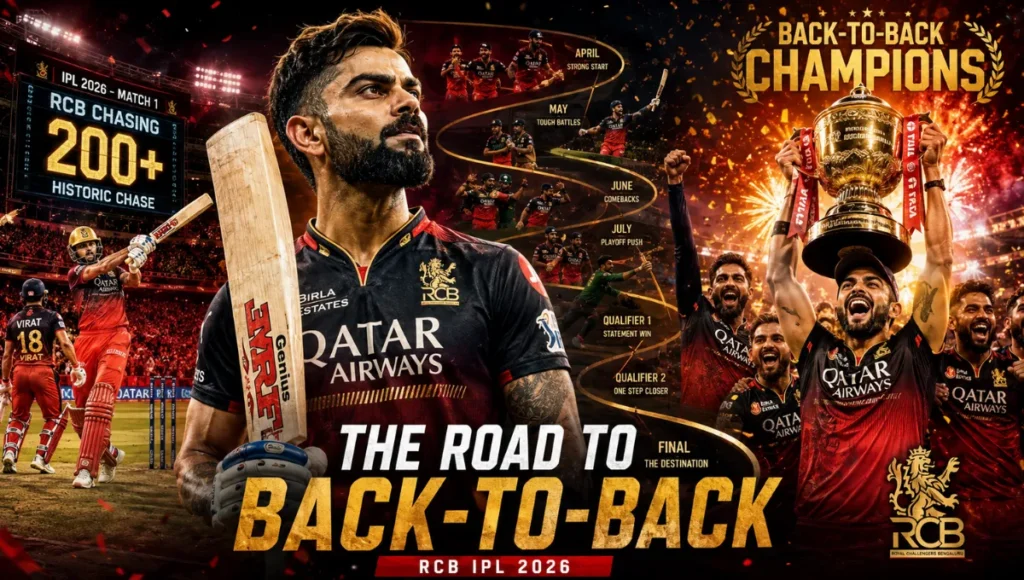
Royal Challengers Bengaluru Schedule lists RCB’s match dates, start times, venues, and opponents, helping fans find fixtures and plan their viewing. Royal Challengers Bengaluru opened their IPL 2026 season with the fastest-ever 200-plus run chase in the competition‘s history. They closed it by lifting the trophy for the second year running. Everything that happened on their schedule in between is the story of how a good team became back-to-back champions.
Quick Overview: How the Schedule Shaped the Season
BCCI announced RCB’s Phase 1 fixtures on 11 March 2026, confirming the defending champions would open the tournament at home against Sunrisers Hyderabad, before a run of matches that included the Southern Derby against Chennai Super Kings and away trips to Guwahati and Mumbai.
That opening stretch of the schedule set the tone for a season that RCB would go on to dominate, on the way to becoming only the third team in IPL history to successfully defend the title.
Full RCB Schedule and Results, IPL 2026
| Match | Date | Venue | Opponent | Result |
|---|---|---|---|---|
| Match 1 | 28 March 2026 | M. Chinnaswamy Stadium, Bengaluru | Sunrisers Hyderabad | RCB won by 6 wickets |
| Match 11 | 5 April 2026 | M. Chinnaswamy Stadium, Bengaluru | Chennai Super Kings | RCB won by 43 runs |
| Match 16 | 10 April 2026 | ACA Stadium, Guwahati | Rajasthan Royals | RCB lost by 6 wickets |
| Match 20 | 12 April 2026 | Wankhede Stadium, Mumbai | Mumbai Indians | RCB won by 18 runs |
| Match 26 | 18 April 2026 | M. Chinnaswamy Stadium, Bengaluru | Delhi Capitals | RCB won by 6 wickets |
| Match 34 | 24 April 2026 | M. Chinnaswamy Stadium, Bengaluru | Gujarat Titans | RCB won by 5 wickets |
| Match 39 | 27 April 2026 | Arun Jaitley Stadium, Delhi | Delhi Capitals | RCB won by 9 wickets |
| Match 42 | 30 April 2026 | Narendra Modi Stadium, Ahmedabad | Gujarat Titans | RCB lost by 4 wickets |
| Match 54 | 10 May 2026 | Shaheed Veer Narayan Singh Stadium, Raipur | Mumbai Indians | RCB won by 2 wickets |
| Qualifier 1 | 26 May 2026 | HPCA Stadium, Dharamsala | Gujarat Titans | RCB won by 92 runs |
| Final | 31 May 2026 | Narendra Modi Stadium, Ahmedabad | Gujarat Titans | RCB won by 5 wickets |
This table reflects RCB’s confirmed key fixtures across the season, from the Phase 1 announcement through to the title decider.
Why Reading a Schedule as a Story Beats Reading It as a Table
A bare fixture list tells you dates and opponents. It doesn’t tell you why RCB’s approach to chasing in Match 1 reappeared in Qualifier 1 two months later, or why a league defeat in April directly explains a final victory in May.
Treating a season schedule as a connected narrative, rather than eleven isolated rows in a table, is the only way to actually understand how a title campaign builds on itself.
The Season Opener: A Record-Breaking Statement
Played 28 March 2026. Sunrisers Hyderabad posted 201/9, with Ishan Kishan blazing 80 off 38 balls. RCB responded with 203/4 in just 15.4 overs, Virat Kohli finishing unbeaten on 69 and Devdutt Padikkal contributing 61, the two adding 101 runs together off just 45 balls. This was the fastest successful chase of 200-plus runs in IPL history.
Here’s what most schedule pages get wrong. They list Match 1 as a routine season opener and move straight to the next fixture. But here’s the real problem with treating it that way RCB’s approach on day one of the season, chasing with total freedom rather than caution, set the tactical identity that would carry through their entire title run.
What most people miss is that this wasn’t a one-off explosive night; it was the first data point in a pattern of RCB’s top order consistently attacking chases throughout the season, most visibly repeated in Qualifier 1 two months later.
Practical decision RCB’s team management made and stuck with: rather than treating the opener’s aggression as a one-match anomaly to be reined in, the coaching staff clearly encouraged the same approach in subsequent chases. That consistency of method, rather than reactive tinkering match to match, is a repeatable lesson for any franchise building a season-long identity.
Royal Challengers Bengaluru Schedule Turning Points of the Season
- Match 16 (10 April, lost to Rajasthan Royals): RCB’s only truly one-sided defeat of the campaign, with Vaibhav Sooryavanshi and Dhruv Jurel chasing down 202 with six wickets in hand.
- Common mistake in reading a schedule: assuming every loss matters equally. This result mattered less for RCB’s title hopes than the head-to-head battle developing with Gujarat Titans over the following weeks.
- Match 42 (30 April, lost to Gujarat Titans): RCB were bowled out for 155, and GT chased it down with 25 balls to spare.
- What most people miss about this schedule entry: it set up the exact rematch dynamic that RCB would need to reverse in Qualifier 1 just under a month later and they did, emphatically.
- Match 54 (10 May, won vs Mumbai Indians): A last-ball, two-wicket thriller in Raipur, with Krunal Pandya scoring 73 while battling cramps.
- Bold opinion worth stating plainly: this result mattered less for the points table and more for squad morale a team that survives a match this dramatic tends to carry real belief into the closing stretch of a season.
Read Alos:- England Cricket Team Vs India National Cricket Team Stats
What the Two Defeats Actually Taught RCB
Losing to Rajasthan Royals and Gujarat Titans in the same month could easily have been read as a warning sign for a title-defending squad. Instead, both defeats produced specific, useful information.
The RR loss confirmed that RCB’s bowling attack still had gaps against genuinely explosive top-order batting, a lesson that fed directly into the personnel and tactical sharpening visible by the time Qualifier 1 arrived. The GT loss, meanwhile, exposed a specific batting collapse pattern in the middle overs that RCB’s own analysts would have flagged and corrected before the two sides met again in the knockout stages.
Counterintuitive idea worth stating plainly: a title-winning season doesn’t require an unbeaten campaign. It requires losing in ways that generate genuinely useful information, then acting on that information before the stakes rise. RCB’s schedule shows exactly that pattern two defeats in April, followed by zero repeats of the same specific weaknesses in the games that actually decided the title.
The Play-Off Run: RCB’s Path to the Title
RCB’s schedule funnelled into two knockout matches against the same opponent, Gujarat Titans, who they had already split with 1-1 during the league phase.
Qualifier 1, 26 May 2026, Dharamsala: RCB posted 254/5, the highest total in IPL playoff history at the time, built on Rajat Patidar’s unbeaten 93 off 33 balls. Gujarat Titans were bowled out for 162, handing RCB a 92-run win and a place in the final.
Final, 31 May 2026, Ahmedabad: Gujarat Titans posted 155/8, rescued from an early collapse by Washington Sundar’s unbeaten 50. RCB chased it down for the loss of 5 wickets, with Virat Kohli batting through the entire innings to finish unbeaten on 75. Royal Challengers Bengaluru became only the third team in IPL history to defend the title successfully, after Chennai Super Kings and Mumbai Indians.
This is where things go wrong for anyone reading the schedule as a simple list: the final’s result is only fully explained by looking back at Match 42 on the schedule five weeks earlier. GT’s top order collapsed in the final in almost the identical pattern RCB’s bowlers had exposed in Qualifier 1 a direct consequence of how the season’s fixtures had already shaped both teams’ tactical tendencies against each other.
Venue-by-Venue Breakdown
| Venue | RCB Record (Confirmed Matches) |
|---|---|
| M. Chinnaswamy Stadium, Bengaluru | 3 wins from 3 confirmed home fixtures |
| Wankhede Stadium, Mumbai | 1 win |
| Arun Jaitley Stadium, Delhi | 1 win |
| Narendra Modi Stadium, Ahmedabad | 1 loss, 1 win (the Final) |
| ACA Stadium, Guwahati | 1 loss |
| Shaheed Veer Narayan Singh Stadium, Raipur | 1 win |
| HPCA Stadium, Dharamsala | 1 win (Qualifier 1) |
Practical takeaway for reading any team’s schedule this way: RCB’s home form at Chinnaswamy was close to flawless across their confirmed fixtures, but their most statistically important win of the season the title-clinching final came away from home at a venue where they had lost earlier in the year. That’s a useful reminder that a team’s overall trajectory matters more than any single venue record.
Why the Narendra Modi Stadium Split Result Matters
Losing at a venue in the league phase and then winning the title at the exact same ground five weeks later is a genuinely rare storyline, and it deserves more attention than a simple “home vs away” breakdown gives it. RCB’s bowling unit that failed to defend 155 in Match 42 was, functionally, the same group of bowlers who dismantled GT’s top order in the final.
Practical lesson for reading venue-specific form: a single bad result at a ground doesn’t establish a pattern the way three or four results might and treating one loss as evidence of a “bad venue” for a team can lead to the wrong conclusions if that same team returns weeks later with sharper execution.
Key Highlights and Player Performance Breakdown
- Virat Kohli: Delivered match-defining innings at both ends of the schedule an unbeaten 69 in the season opener and an unbeaten 75 in the final making him the most consistent standout name across RCB’s entire campaign.
- Rajat Patidar (captain): His unbeaten 93 off 33 balls in Qualifier 1 was the single most destructive individual innings anywhere on RCB’s schedule, directly enabling their playoff breakthrough.
- Devdutt Padikkal: A near-constant presence in RCB’s top order across the season, contributing 61 in the opener and further supporting innings throughout the campaign.
- Tim David: His middle-overs hitting was central to RCB’s 250/3 demolition of Chennai Super Kings in Match 11, one of the most one-sided results on the entire schedule.
- Krunal Pandya: His 73 while battling cramps in the Match 54 thriller against Mumbai Indians stands out as one of the most physically demanding individual performances anywhere on the schedule.
What RCB’s Schedule Teaches About Building a Title-Winning Season
Stepping back from the individual results, RCB’s IPL 2026 campaign offers a genuinely useful template for any franchise planning a title defence. First, an aggressive, consistent batting identity established from Match 1 paid dividends right through to the final the team never abandoned the approach that worked in the opener, even after early-season losses.
Second, both of their significant defeats came against the two teams they would face again at the business end of the season, and both times, RCB corrected the specific weakness that had been exposed rather than making wholesale changes. Third, the same core group of players Kohli, Patidar, Padikkal carried the campaign from the first match to the last, giving the squad a stable identity that made in-season adjustments easier to implement without disrupting the whole unit.
For any reader tracking a franchise’s season going forward, this schedule is proof that the story worth following isn’t just who wins each individual match it’s how a team uses its early results to prepare for the exact opponents it’s likely to meet again when the stakes are highest.
Read Also:- Orange Cap In IPL 2026: Top Run Scorers and Full Rankings
How This Schedule Compares to Other Successful Title Defences
Successfully defending an IPL title is rare only Chennai Super Kings and Mumbai Indians had managed it before RCB.
Looking at RCB’s schedule against that historical backdrop reveals a specific pattern worth noting: both previous successful defences also featured at least one meaningful mid-season defeat against a team they later met in the knockouts, followed by a corrected performance when it mattered most. RCB’s schedule fits that exact template almost perfectly, with the Gujarat Titans defeat in Match 42 playing the same role that similar mid-season stumbles played in prior title-defence campaigns.
This pattern matters for a simple reason: it suggests that a title defence is rarely about avoiding adversity altogether. It’s about how a squad metabolizes a specific defeat into a corrected game plan before the rematch that actually decides the season. Franchises hoping to replicate a title defence in future seasons should study this exact dynamic rather than assuming an unbeaten or near-unbeaten campaign is the only path to back-to-back success.
What to Watch on RCB’s Schedule Going Forward
Heading into the next IPL season, a few specific storylines from this campaign are worth tracking closely. Rajat Patidar’s captaincy, forged under the pressure of a title defence, gives RCB a settled leadership structure heading forward continuity at the top is historically rare for IPL franchises and is itself a competitive advantage.
Virat Kohli’s bookend performances, in the opener and the final, raise a genuine question about squad planning: how much of RCB’s success is built around his individual clutch performances, and does the franchise have a credible succession plan if his role changes in future seasons.
Practical decision RCB’s think tank should prioritise: using the pre-season and early fixtures of the next campaign to test whether their middle order can produce match-winning performances independent of Kohli, the way Patidar did in Qualifier 1 this season. A title defence built on one player peaking at the right moments is impressive once. Relying on the same dynamic for a third consecutive title would be a considerably higher-risk strategy.
Frequently Asked Questions (FAQs)
Q1. When did Royal Challengers Bengaluru start their IPL 2026 campaign?
Ans. RCB opened their IPL 2026 season on 28 March 2026 against Sunrisers Hyderabad at M. Chinnaswamy Stadium, winning by 6 wickets in the fastest-ever 200-plus run chase in IPL history.
Q2. Did Royal Challengers Bengaluru win the IPL 2026 title?
Ans. Yes. RCB beat Gujarat Titans by 5 wickets in the final on 31 May 2026, becoming only the third team in IPL history to successfully defend the title, after Chennai Super Kings and Mumbai Indians.
Q3. How many times did RCB play Gujarat Titans across the IPL 2026 schedule?
Ans. Four times: twice in the league phase (RCB won one, GT won one), then again in Qualifier 1 and the Final, both won by RCB.
Q4. What was RCB’s most dramatic match on the IPL 2026 schedule?
Ans. Their Match 54 fixture against Mumbai Indians in Raipur, won by 2 wickets on the final ball, with Krunal Pandya scoring 73 while battling cramps.
Q5. Where was the IPL 2026 final played?
Ans. The final was played at Narendra Modi Stadium, Ahmedabad, on 31 May 2026, the same venue where RCB had lost to Gujarat Titans in the league phase five weeks earlier.