


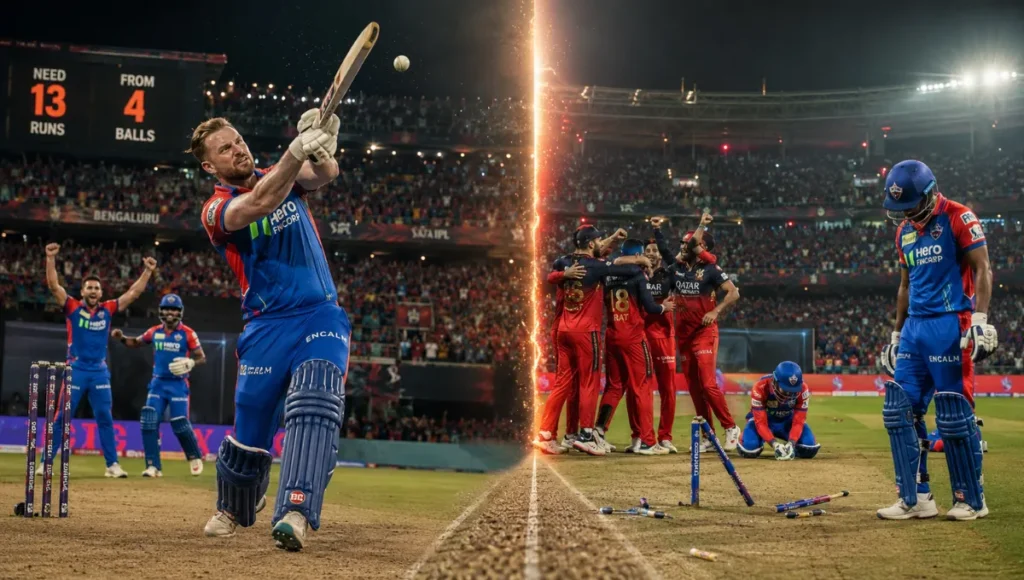
Delhi Capitals needed 13 runs from four balls in Bengaluru. David Miller responded with six, six and four. Nine days later, the same side was 8/6 against the same opponent in Delhi.
That is why a single Delhi Capitals vs Royal Challengers Bengaluru match scorecard does not tell the full IPL 2026 story. DC and RCB did not merely split two fixtures. They produced two opposite lessons in T20 cricket: a finishing masterclass at the M Chinnaswamy Stadium, followed by one of Delhi’s most brutal powerplay collapses at Arun Jaitley Stadium.
If you came for the scorecard, the results are below. But the useful part is understanding the turning points. A scorecard records 179/4 and 75 all out. It does not automatically explain why Tristan Stubbs and David Miller could hold their nerve under final-over pressure, or why six Delhi wickets disappeared for 13 powerplay runs just over a week later.
Quick Result: DC vs RCB IPL 2026 Head-to-Head
| Match | Venue | Result | Decisive Performers |
|---|---|---|---|
| Match 26, 18 April 2026 | M Chinnaswamy Stadium, Bengaluru | Delhi Capitals won by 6 wickets, with 1 ball remaining | Tristan Stubbs 60*, David Miller 22* off 10, KL Rahul 57 |
| Match 39, 27 April 2026 | Arun Jaitley Stadium, Delhi | Royal Challengers Bengaluru won by 9 wickets, with 81 balls remaining | Josh Hazlewood 4/12, Bhuvneshwar Kumar 3/5, Devdutt Padikkal 34* off 13 |
The headline is simple: DC won the first meeting 2-0 on points, but RCB’s reply was not a narrow correction. It was a 9-wicket dismantling that reduced DC to 75 in 16.3 overs and gave RCB one of the quickest successful chases in IPL history.
Match 26 Scorecard: RCB vs DC, Bengaluru
Played on 18 April 2026 at M Chinnaswamy Stadium. Delhi Capitals won the toss, chose to bowl, and won by 6 wickets with one ball remaining.
Royal Challengers Bengaluru innings: 175/8 (20 overs)
| Batter | Runs | Balls | 4s | 6s | Key note |
|---|---|---|---|---|---|
| Phil Salt | 63 | 38 | 4 | 3 | Controlled RCB’s best phase |
| Tim David | 26 | 17 | — | — | Useful late runs |
| Krunal Pandya | 12 | 10 | 0 | 1 | Run out late |
| Other batters | — | — | — | — | RCB lost wickets frequently after the opening lift |
DC’s key bowlers were Axar Patel (2/18 in 3 overs) and Kuldeep Yadav (2/32 in 4). RCB’s 175/8 was competitive at Bengaluru, but it was not a clean 175. The innings had enough scoring power, led by Salt, yet DC repeatedly pulled it back with wickets.
Delhi Capitals innings: 179/4 (19.5 overs)
| Batter | Runs | Balls | 4s | 6s | Key note |
|---|---|---|---|---|---|
| Pathum Nissanka | 1 | 2 | 0 | 0 | Early wicket |
| KL Rahul | 57 | 34 | 6 | 2 | Made the chase possible before the finishers took over |
| Karun Nair | 5 | 5 | 1 | 0 | Fell during an early wobble |
| Sameer Rizvi | 2 | 3 | 0 | 0 | Chase was under pressure at 4 wickets down |
| Tristan Stubbs | 60* | 47 | — | — | Anchored the chase through the middle and death overs |
| David Miller | 22* | 10 | — | — | Finished with 6, 6, 4 when DC needed 13 from 4 balls |
Read Also:- Punjab Kings Vs Delhi Capitals Match Scorecard
RCB’s Bhuvneshwar Kumar took 3/26 in four overs, while Krunal Pandya returned 1/24 in four. Yet those figures did not decide the final over. Stubbs stayed unbeaten through the pressure, then Miller converted a difficult equation into a last-ball win.
Turning Point: Stubbs and Miller’s Final-Over Finish
At the end of 19 overs, DC were 161/4. They needed 15 from the last over, then 13 from four balls. Most teams lose from there because the non-striker cannot get off strike or the batter tries to manufacture a miracle against a yorker.
Miller did not manufacture anything. He attacked the length. Six, six, four. The chase was done with one delivery left.
What people think vs reality: a final-over finish looks like individual power-hitting. The reality is that the finish was created much earlier by Stubbs. His unbeaten 60 off 47 absorbed the collapse around Rahul and gave Miller a realistic target to attack. Without Stubbs protecting his wicket, Miller never faces a chase that is still alive at the death.
This is a practical T20 lesson. When a side loses wickets in a chase, the next batter does not always need to score at 180 strike rate instantly. One player must first keep the equation within reach. Stubbs did that. Miller provided the acceleration at the only moment it mattered.
Player Performance Breakdown: Match 26
- Tristan Stubbs — 60* off 47: Stubbs played the innings that scorecard-only coverage tends to underrate. It was not flashy at every stage, but it was structurally essential. DC were 4 down after Rahul fell. Stubbs made sure that the required rate did not become impossible.
- David Miller — 22* off 10: Miller’s last-over six, six, four was the match’s most visible moment. His value was not just 22 runs; it was decision-making. He attacked the scoring options rather than chasing a pre-planned shot.
- KL Rahul — 57 off 34: Rahul gave DC their base. His strike rate of 167.64 was the correct balance for a 176 chase. He did not over-anchor, and he left enough runs for the finishers to complete.
- Phil Salt — 63 off 38: Salt’s innings was RCB’s platform. But RCB’s bigger mistake was failing to turn 175 into 190-plus after receiving a 63 from 38 at the top.
- Axar Patel and Kuldeep Yadav: Their wickets mattered more than their economy rates. They stopped RCB from building one decisive late partnership, which is why 175 proved chaseable.
Original observation: RCB were not beaten because their total was poor. They were beaten because DC had two different finishing roles. Stubbs was the pressure absorber. Miller was the closer. Most teams have one; championship-level line-ups need both.
Match 39 Scorecard: DC vs RCB, Delhi
Played on 27 April 2026 at Arun Jaitley Stadium. RCB chose to field and won by 9 wickets with 81 balls remaining.
Delhi Capitals innings: 75 all out (16.3 overs)
| Batter | Runs | Balls | Dismissal context |
|---|---|---|---|
| Sahil Parakh | 0 | 2 | Debutant bowled by Bhuvneshwar’s inswinger |
| KL Rahul | 2 | 2 | Pulled Hazlewood and offered a catch |
| Sameer Rizvi | 0 | 1 | Edged Hazlewood |
| Tristan Stubbs | 5 | — | Edged Bhuvneshwar at wide slip |
| Axar Patel | 0 | — | Bottom-edge dismissal during the collapse |
| Nitish Rana | 0 | — | Gloved Hazlewood’s steep bounce |
| David Miller | — | — | Fell before the innings could recover |
| Abishek Porel | 26 | — | Top scorer, dismissed by Hazlewood |
DC were 8/6 after 3.5 overs. Their powerplay score was 13/6. They eventually reached 75, their third-lowest IPL score as the Delhi franchise.
RCB bowling figures
| Bowler | Overs | Runs | Wickets | Economy |
|---|---|---|---|---|
| Bhuvneshwar Kumar | 3 | 5 | 3 | 1.66 |
| Josh Hazlewood | 3.3 | 12 | 4 | 3.42 |
| Rasikh Salam | 2 | 21 | 1 | 10.50 |
| Romario Shepherd | 2 | 21 | 1 | 10.50 |
| Suyash Sharma | 4 | 7 | 1 | 1.75 |
| Krunal Pandya | 2 | 9 | 0 | 4.50 |
Royal Challengers Bengaluru innings: 77/1 (6.3 overs)
| Batter | Runs | Balls | 4s | 6s |
|---|---|---|---|---|
| Jacob Bethell | 20 | 11 | — | — |
| Virat Kohli | 23* | 15 | — | — |
| Devdutt Padikkal | 34* | 13 | — | — |
RCB lost only Bethell, then completed the chase in 6.3 overs. Padikkal’s unbeaten 34 off 13 made a 76-run target look even smaller, while Kohli finished the match with consecutive sixes and crossed 9,000 IPL runs.
Turning Point: The 8/6 Collapse
The result was not decided when DC were bowled out for 75. It was decided at 8/6.
Bhuvneshwar Kumar’s first spell was 3 overs, 5 runs and 3 wickets. Josh Hazlewood followed with 4/12. DC lost their debutant opener for 0, KL Rahul for 2, Sameer Rizvi for 0, Tristan Stubbs for 5, captain Axar Patel for 0 and Nitish Rana for 0.
But here’s the real problem: this was not only a pace-and-swing collapse. It was a decision-making collapse. Several DC batters attempted to drive or pull balls that were still moving and bouncing unpredictably. Hazlewood later explained that he targeted a straight line and a hard length, forcing batters to hit down the ground or deal with steep bounce. DC tried to solve that problem with shots instead of survival.
What people think vs reality: “The pitch was unplayable.” The RCB chase proves it was not. It was difficult during the first six overs when the ball was hard and moving. Once it softened, batting became more consistent. DC needed a 25/2 powerplay, not 13/6. That is the entire match in one contrast.
Player Performance Breakdown: Match 39
- Josh Hazlewood — 4/12: Player of the Match and the chief destroyer. His key strength was not raw pace.
- It was repeatable accuracy: straight seam, hard length, a tempting wider full ball, then a bouncer that climbed at the right height. Hazlewood did not need an extravagant spell. He needed batters to make one mistake at a time.
- Bhuvneshwar Kumar — 3/5: This was the more damaging new-ball spell in terms of game state. A 3/5 spell removed DC’s opening shape before the rest of the lineup had settled. RCB’s success began here, not at the end.
- Devdutt Padikkal — 34* off 13: Padikkal has often been judged by whether he can keep pace in modern T20 batting.
- This innings answered that in the simplest way: he took 21 from Kyle Jamieson’s third over and erased any remaining doubt about the chase.
- Virat Kohli — 23* off 15: Kohli did not need a major score.
- His role was correct for a 76 target: stay present, rotate, then finish. His two final sixes added theatre, while the 9,000-run IPL landmark added historical weight.
- Abishek Porel — 26: Porel was DC’s top scorer, but the number should not hide the team problem. He arrived after the collapse and could only delay the inevitable.
- Axar Patel — captaincy context: Axar’s post-match response was sensible: move on rather than blame individuals. Still, the tactical review must be blunt. A team cannot let six top-order wickets fall in the first six overs and call it one bad day; it must rehearse a clear survival plan for seaming surfaces.
Bold opinion: RCB’s bowling unit, not their famous batting order, is what makes them dangerous in IPL 2026. Rajat Patidar said a good bowling unit is essential to winning a championship on flat T20 surfaces.
The Delhi performance showed the stronger version of that argument: if your new-ball bowlers can exploit even slight help, they can end a match before your batters face pressure.
What Changed in Nine Days?
| Match factor | Match 26: DC win in Bengaluru | Match 39: RCB win in Delhi |
|---|---|---|
| Pitch phase | Batting-friendly, with a chase alive until the last ball | Hard new ball moved and bounced sharply in the first six overs |
| DC top order | Rahul gave a 57-run platform | DC collapsed to 8/6 and 13/6 in the powerplay |
| Key partnership | Stubbs held the chase together; Miller finished | Kohli and Padikkal added an unbeaten 51 after Bethell’s wicket |
| RCB bowling impact | Bhuvneshwar 3/26 was strong but DC recovered | Bhuvneshwar 3/5 and Hazlewood 4/12 ended the contest |
| Death overs | Miller dominated the last over | No RCB death-over test was required |
Read Also:- Kolkata Knight Riders Vs Sunrisers Hyderabad Match Scorecard
The most important change was not form. It was the first six overs.
In Bengaluru, DC survived early losses and still had Rahul and Stubbs to build the chase. In Delhi, every player who might have performed that stabilising role was removed before the powerplay ended. T20 games often look like 20-over contests, but a collapse to 8/6 makes the remaining 14 overs administrative rather than competitive.
Highlights, Records and Key Moments
- Delhi Capitals chased 176 in Match 26 with one ball remaining, after David Miller hit six, six and four in the final over.
- RCB dismissed DC for 75 in Match 39, with DC falling to 8/6 and 13/6 in the powerplay.
- Josh Hazlewood returned 4/12 and Bhuvneshwar Kumar 3/5 in the return game.
- RCB’s chase of 76 with 81 balls remaining was the second-fastest successful IPL chase by balls remaining at the time.
- Virat Kohli passed 9,000 IPL runs during the RCB chase.
- RCB’s Match 39 win was their 21st IPL victory against DC, tying them among the most wins by one side against an opponent in IPL history.
Practical Lessons From Both Scorecards
For players and coaches, these two fixtures offer useful, repeatable lessons.
- Build one stabiliser into every chase. Stubbs showed that a chase can remain alive even after early wickets if one batter owns the middle overs.
- Do not fight moving new-ball conditions with low-percentage shots. DC’s Match 39 top order tried to score before it had earned the right to score.
- Use two contrasting finishers. A holding batter plus an explosive closer is more reliable than asking everyone to attack from ball one.
- Plan the first three overs by surface, not reputation. RCB did not bowl “T20 variations” for the sake of it. Bhuvneshwar and Hazlewood used conventional swing and hard lengths because Delhi’s surface demanded it.
- Never use a result alone to judge a team. DC were good enough to win a last-ball chase in Bengaluru and poor enough to collapse for 75 nine days later. The phase-by-phase scorecard gives the truer diagnosis.
Frequently Asked Questions (FAQs)
Q1. Who won the Delhi Capitals vs Royal Challengers Bengaluru match in IPL 2026?
Ans. The teams split their two IPL 2026 league meetings. Delhi Capitals won Match 26 in Bengaluru by 6 wickets with one ball remaining, while Royal Challengers Bengaluru won Match 39 in Delhi by 9 wickets with 81 balls remaining.
Q2. What was the DC vs RCB score in Match 39 of IPL 2026?
Ans. Delhi Capitals were bowled out for 75 in 16.3 overs. Royal Challengers Bengaluru chased 76 in 6.3 overs, finishing 77/1 to win by 9 wickets.
Q3. Who was Player of the Match in DC vs RCB Match 39?
Ans. Josh Hazlewood was Player of the Match after taking 4 wickets for 12 runs. Bhuvneshwar Kumar also took 3/5 as DC collapsed to 75.
Q4. How did Delhi Capitals beat RCB in Match 26?
Ans. DC chased 176 to win by 6 wickets. KL Rahul scored 57, Tristan Stubbs remained unbeaten on 60, and David Miller sealed the match with six, six and four when DC needed 13 runs from four balls.
Q5. What record did Virat Kohli achieve against DC in Match 39?
Ans. Virat Kohli crossed 9,000 runs in the IPL during RCB’s chase of 76. He finished unbeaten on 23 off 15 balls.