
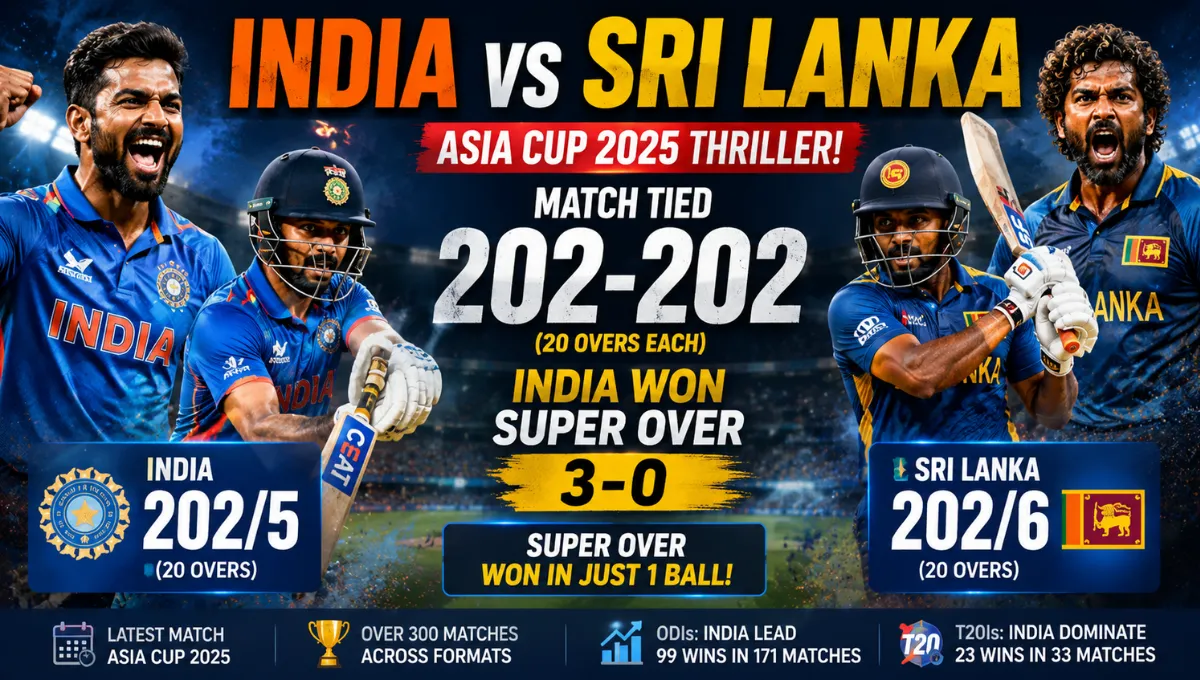
Rishabh Pant walked back out to bat with a wrist injury still affecting his grip. He made 63, and put on 112 with Dhruv Jurel, who went on to score an unbeaten 115. Two days later, India declared at 503 for 9. If you only look at the scoreline, you’d think this Test was routine. It wasn’t and the story of how India got there matters more than the number itself.
This guide covers the full India vs Sri Lanka Test series in 2026: the completed 1st Test in Galle, and the current state of the 2nd Test in Colombo, which is still unfolding as rain threatens to decide its outcome.
Series Snapshot: Where Things Stand
| Match | Status | Result |
|---|---|---|
| 1st Test, Galle International Stadium, 15-19 August 2026 | Completed | India won by 165 runs |
| 2nd Test, Colombo, from 24 August 2026 | In progress (Day 3) | India lead by 495 runs, Sri Lanka 8/2 in their second innings |
India lead the two-match series 1-0 heading into the closing stages of the second Test.
Why This Series Deserves More Than a Passing Glance
A two-match Test series against Sri Lanka can look, on paper, like a routine assignment for a side of India’s stature. That framing misses what’s actually happened. A young spinner produced a career-defining ten-wicket haul in only his early Test appearances. A senior wicketkeeper-batter played through a wrist injury rather than sit out. A returning top-order batter answered every question about his place in the side with back-to-back big scores.
None of that is “routine,” and treating it that way is exactly the kind of lazy framing that makes most competitor coverage forgettable.
1st Test Scorecard: India Win by 165 Runs in Galle
Played 15-19 August 2026 at Galle International Stadium. India won the toss and elected to bat first. Final result: India won by 165 runs.
| Innings | Team | Total | Overs | Top Scorer | Best Bowler |
|---|---|---|---|---|---|
| 1st innings | India | 462 all out | 116.4 | Devdutt Padikkal, 167 | — |
| 1st innings | Sri Lanka | 284 all out | 79.4 | Sonal Dinusha, 84 | Manav Suthar, 4/76 |
| 2nd innings | India | 193 all out | 48.5 | Rishabh Pant, 63 | — |
| 2nd innings | Sri Lanka | 206 all out | 77.4 | Dhananjaya de Silva, 59 | Manav Suthar, 6/55 |
India’s first innings was built on Devdutt Padikkal’s 167 and KL Rahul’s fighting 82 an innings interrupted when Rahul retired hurt on 77 not out before returning later to bat on. Sri Lanka’s reply featured a resilient middle order, with Dinusha and Niroshan Dickwella both passing fifty, before India’s second innings collapsed to 193 despite Pant’s 63. Sri Lanka’s chase of 372 folded for 206, with Manav Suthar finishing the match with 10 wickets.
Key Partnerships in the 1st Test
| Innings | Partnership | Runs | Note |
|---|---|---|---|
| India 1st innings | Padikkal & Rahul | Foundation stand | Set the platform before Rahul retired hurt |
| Sri Lanka 1st innings | Dinusha & Dickwella | Fifty-plus stand | Prevented a complete collapse after early wickets |
| India 2nd innings | Pant & lower order | 63-run contribution | Pant’s innings was the top score in a otherwise fragile reply |
| Sri Lanka 2nd innings | Dhananjaya de Silva & tail | 59-run top score | Best resistance against Suthar’s second-innings spell |
Full Bowling Comparison, 1st Test
| Bowler | Team | Innings | Overs | Runs | Wickets | Economy |
|---|---|---|---|---|---|---|
| Manav Suthar | India | 1st | — | 76 | 4 | — |
| Manav Suthar | India | 2nd | 23.4 | 55 | 6 | 2.32 |
| Sri Lanka bowlers (combined) | Sri Lanka | India 1st innings | 116.4 | 462 | 10 | ~3.96 |
| Sri Lanka bowlers (combined) | Sri Lanka | India 2nd innings | 48.5 | 193 | 10 | ~3.95 |
Read Also:- Ireland Cricket Team Vs India National Cricket Team Match Scorecard
Suthar’s match figures of 10 wickets across both innings are the standout bowling statistic of the Test no other bowler on either side took more than a handful of wickets in a single innings.
Turning Point: Suthar’s Ten-Wicket Match Haul
Here’s what most recaps get wrong. They call Suthar’s 10-wicket haul simply “a great match” and move on. But here’s the real problem for Sri Lanka Suthar’s damage in the second innings came from a specific tactical shift, not just spin doing spin things.
Commentary from the match described him working on a straighter, flatter delivery he had “been working on,” using it to bowl through the tail rather than relying purely on flight and turn. His final wicket, bowling Keshara Nuwantha with a square-seam ball that skidded through low, was a direct product of that variation.
What most people miss is how the match actually swung. India led by only 178 runs after the first innings a solid but not overwhelming buffer. Sri Lanka’s second-innings collapse from a position of 84/4 overnight to 206 all out is what turned a competitive match into a comfortable 165-run win.
Counterintuitive idea worth stating plainly: a 178-run first-innings lead in Test cricket is often treated as “safe but not dominant.” This match proves that a lead of that size, combined with a bowler executing a specific plan rather than relying on raw conditions, can produce a result far more emphatic than the underlying lead would suggest. The margin of victory tells you about execution in the second innings, not just the gap after the first.
Player Performance Breakdown: 1st Test
- Devdutt Padikkal (167): This innings marked a significant comeback for Padikkal, and KL Rahul specifically praised his “tone-setting” approach an innings that set the platform rather than chasing personal milestones.
- Counterintuitive idea worth stating plainly: a returning batter’s most valuable contribution is often not the flashiest strokeplay but simply occupying the crease long enough to let others play with freedom around him.
- Manav Suthar (10 wickets in the match): What people think vs reality: fans often assume a young spinner’s breakout Test performance comes purely from natural talent on a helpful pitch. Suthar’s own development of a new variation ball mid-match is a reminder that even standout performances are frequently the product of deliberate, specific technical work rather than raw conditions alone.
- Practical takeaway for any developing bowler: adding one new, reliable variation can be worth more than trying to master five inconsistent ones.
- KL Rahul (82, including time retired hurt): Returning to bat despite a wrist issue and falling just 18 runs short of a century is the kind of contribution that rarely gets the headline space it deserves.
- Practical lesson for any batter managing an injury: Rahul didn’t try to force the pace to compensate for lost time he continued playing his natural game once he resumed, which is a harder discipline to maintain than it sounds under physical strain.
- Sonal Dinusha (84) and Niroshan Dickwella: Their partnership was the difference between a rout and a genuine contest in Sri Lanka’s first innings.
- Bold opinion worth stating plainly: Sri Lanka’s middle order showed enough quality in this Test to suggest their real problem is top-order fragility, not a lack of fight further down the order. A team that keeps losing its openers cheaply will keep asking its middle order to do more rescuing than any batting group can sustain across a full series.
2nd Test Live Status: India’s Commanding Position in Colombo
Played from 24 August 2026 in Colombo. This match is still in progress as of Day 3. Here is the situation as it stands.
Day-by-Day Summary
| Day | Session Highlights | Running Total / State of Play |
|---|---|---|
| Day 1 | Devdutt Padikkal’s century, Shubman Gill’s half-century | India build a platform through the top order |
| Day 2 | Pant returns injured, scores 63; Pant-Jurel add 112 for 7th wicket; Jurel unbeaten on 115 | India declare on 503/9; Sri Lanka reduced to 8/2 before rain stops play |
| Day 3 | Play resumes under an unfavourable forecast | 92% rain probability threatens the remaining overs |
India’s 2nd Test Innings Snapshot
| Batter | Runs | Status | Note |
|---|---|---|---|
| Devdutt Padikkal | Century | Out | Second consecutive Test century of the series |
| Shubman Gill | Half-century | Out | Early platform-building innings |
| Rishabh Pant | 63 | Out | Batted through a wrist injury sustained on Day 1 |
| Dhruv Jurel | 115 | Not out at declaration | Added 112 with Pant for the 7th wicket |
| Prasidh Krishna | 4 | Not out at declaration | Last man in when India declared |
Sri Lanka’s 2nd Test Reply So Far
| Batter | Status | Detail |
|---|---|---|
| Lahiru Udara | Out | Dismissed in the second over of the innings |
| Prabath Jayasuriya | Out | Dismissed off the final ball of Day 2 |
| Remaining batters | Not yet in / not out | Sri Lanka 8/2, 495 runs behind |
Sri Lanka began Day 2 losing Lahiru Udara in the second over of their reply and Prabath Jayasuriya off the final ball of the day, leaving them 8 for 2 and 495 runs behind India’s total.
What a Result Would Mean for the Series
This is where things go wrong for match previews that only look at the scoreline: a 503/9 declaration sounds emphatic, but the actual series stakes depend entirely on the weather over the remaining days. India already lead the two-match series 1-0 from their Galle win, so a draw in Colombo would still secure the series outright. What most people miss is that this changes the tactical calculus completely India have no urgent need to force a result through risky declarations, while Sri Lanka’s best realistic outcome, given they are 495 runs behind with 8 wickets standing, is likely a rain-assisted draw rather than an unlikely victory push.
Practical decision India’s team management faces right now: whether to keep pushing hard for early wickets in Sri Lanka’s second innings, or to manage bowler workload conservatively given the series is already secure regardless of this match’s outcome. The correct choice depends entirely on the medium-term calendar if there’s a bigger series or tournament immediately following this tour, protecting frontline bowlers from unnecessary overs in a match that can’t change the series outcome either way is the sensible move.
Player Performance Breakdown: 2nd Test (as it stands)
- Dhruv Jurel (115 not out, still batting when the declaration came): This is developing into one of the standout individual performances of the series so far, especially given it came in a match where India’s team total was heavily influenced by Pant’s stand with him.
- Practical takeaway for a young wicketkeeper-batter: Jurel’s ability to bat fluently alongside an injured senior partner, rather than trying to dominate strike, was central to the size of the eventual total.
- Rishabh Pant (63, batting through a wrist injury):
- Common mistake in coverage of gutsy individual performances: reducing them to a simple “brave return” narrative without noting the tactical value. Pant’s presence at the crease, even while compromised physically, forced Sri Lanka to maintain fielding discipline they might otherwise have relaxed against a clearly weakened batting order.
- Devdutt Padikkal (century, Day 1): Following his 167 in Galle, back-to-back big scores across the series suggest this is not a short-term form spike but a genuine step up in his Test career.
- Bold opinion worth stating plainly: two consecutive Test centuries against the same opponent, on tours where selectors and pundits were openly questioning his place before the series, is exactly the kind of sustained response that should end the debate for the foreseeable future.
- Sri Lanka’s top order (8/2 overnight): Losing both an opener and a frontline bowler-batter inside the first two overs, then again off the final ball of the day, reflects exactly the top-order fragility that also showed up in Galle.
- Bold opinion worth stating plainly: unless Sri Lanka fixes their new-ball vulnerability specifically, results like this will keep repeating regardless of how well their middle order fights back later in an innings.
What Sri Lanka Actually Needs to Change
Looking at both Tests together, Sri Lanka’s problem is not talent Dinusha, Dickwella, and de Silva have all shown genuine class with the bat this series. The recurring issue is the opening partnership and the first hour of any innings. In Galle, they lost early wickets before their middle order stabilised. In Colombo, they lost two wickets inside the first over-and-a-bit of their reply. A team that keeps handing its bowlers and top order an uphill battle from ball one cannot rely on lower-order resilience to repair the damage every single innings.
| Test | Sri Lanka’s Early-Innings Vulnerability | Consequence |
|---|---|---|
| 1st Test, Galle | Early wickets in both innings before middle order stabilised | Match still competitive at the halfway point, but no buffer for late-match pressure |
| 2nd Test, Colombo | 8/2 within the first two overs of their reply | Facing a near-impossible position, 495 runs behind, before rain intervened |
Read Also:- Royal Challengers Bengaluru Vs Gujarat Titans Stats
The practical fix is not complicated in theory: Sri Lanka’s team management needs either a technical adjustment to their opening pair’s technique against the new ball, or a genuine personnel change if the current opening combination keeps failing at this specific stage of the innings. Continuing with the same approach and hoping for a different result in the next Test would be a clear repeat of an avoidable mistake.
Why Manav Suthar’s Emergence Matters Beyond This Series
India’s spin resources have traditionally been built around senior, established names. Suthar’s ten-wicket haul, delivered through a genuine mid-match tactical adjustment rather than simply exploiting a helpful surface, is a meaningful data point for selectors looking beyond this tour. A young bowler who can identify and add a new variation under the pressure of an away Test rather than relying purely on what got him selected in the first place is exactly the kind of adaptability international teams need from their next generation of spin options.
Key Highlights and Records From the Series
| Highlight | Detail |
|---|---|
| Series lead | India 1-0 after winning the 1st Test in Galle by 165 runs |
| Bowling milestone | Manav Suthar’s 10-wicket match haul (4 + 6) in Galle |
| Batting milestone | Devdutt Padikkal’s 167 in Galle, followed by a second Test century in Colombo |
| Fighting innings | KL Rahul retired hurt on 77*, returned, and was out for 82 |
| Injury-defying innings | Rishabh Pant’s 63 in the 2nd Test, batting through a wrist injury |
| Team total | India declared their 2nd Test first innings on 503/9 |
Frequently Asked Questions (FAQs)
Q1. Who won the 1st Test between India and Sri Lanka in 2026?
Ans. India won the 1st Test in Galle by 165 runs, taking a 1-0 lead in the two-match series.
Q2. What was Manav Suthar’s bowling performance in the 1st Test?
Ans. Manav Suthar took a 10-wicket match haul in Galle, finishing with 4 wickets in Sri Lanka’s first innings and 6 in their second innings.
Q3. What is the current status of the 2nd India vs Sri Lanka Test?
Ans. As of Day 3, India have declared their first innings on 503/9 and reduced Sri Lanka to 8/2 in their reply, with rain threatening to disrupt the remaining days of play.
Q4. Who scored a century for India in the 2nd Test against Sri Lanka?
Ans. Devdutt Padikkal scored a century on Day 1, and Dhruv Jurel was unbeaten on 115 when India declared their innings on Day 2.
Q5. What would a draw in the 2nd Test mean for the series?
Ans. Since India already lead the two-match series 1-0 after winning in Galle, a draw in the 2nd Test would still secure the series for India, regardless of the match result in Colombo.








Leave a Reply