


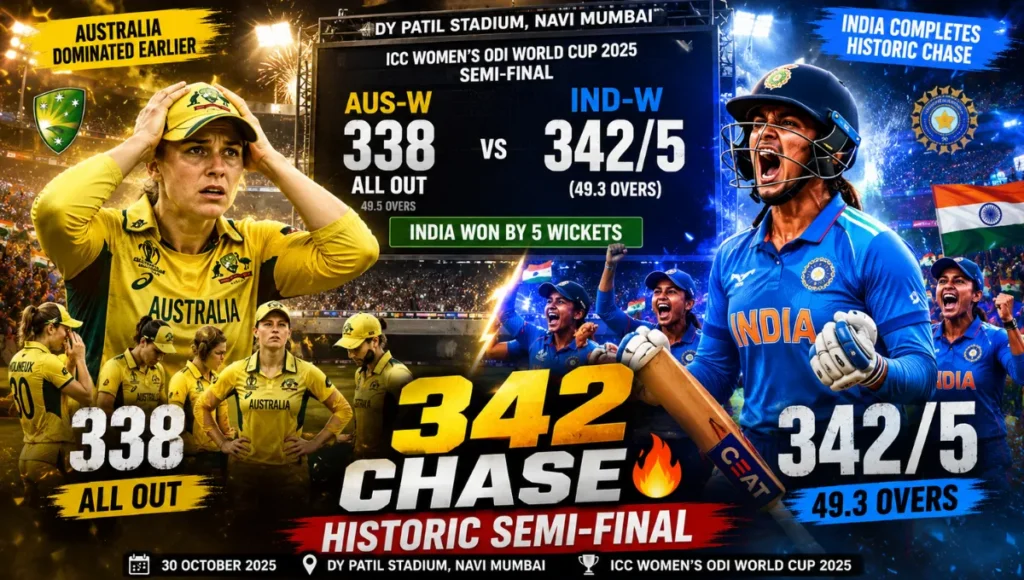
Sometimes a scorecard is just numbers. Other times, it becomes part of cricket history. The India women vs Australia women semi‑final in the 2025 ICC Women’s World Cup is firmly in the second category. Australia posted 338, powered by Phoebe Litchfield’s 119 and strong support in the middle order, then watched India chase it with 341 for 5, driven by Jemimah Rodrigues’ unbeaten 127 and Harmanpreet Kaur’s 89.
This scorecard is not only about a record chase. It also reveals how India swing between nerve, brilliance and heartbreak against the same opponent in ODI, T20 and Test formats.
From Record Chase to Heartbreak Losses
On one page, India look unstoppable: Rodrigues calmly finishes the chase, Harmanpreet controls a giant semi‑final, and Australia’s long dominance cracks under pressure. On another page, India collapse late in a T20 chase and get rolled over in a day‑night Test, showing their vulnerability when conditions, format or decisions turn against them.
That contrast is what makes this rivalry fascinating the same core players experience both historic success and painful defeat against Australia.
What Fans Really Look For Beyond Numbers
Most fans type “india women’s national cricket team vs australia women’s national cricket team match scorecard” to know the score and key figures. Yet, the matches they talk about weeks later are the ones where pressure, mistakes and courage are obvious even in the tables.
This article reads the scorecard like a story so that the numbers stick in memory, not just in a browser tab.
Full Scorecard – India Women vs Australia Women
India Women Innings – Key Runs and Wickets
In the semi‑final, India’s 341 for 5 was built on a blend of aggression and control. Rodrigues finished 127 not out from 134 balls, and Harmanpreet added 89 from 88, forming a partnership worth 167 runs. Before them, India had already attacked Australia with Rawal’s 75 and Mandhana’s 80, giving the chase a fast and confident start even as wickets fell later.
The fall‑of‑wickets sequence shows both strength and fragility: steady progress to 192 for 2, then a cluster of dismissals that could easily have derailed a less composed side.
Australia Women Innings – Healy, Litchfield, Perry
Australia’s 338 came from familiar names and familiar patterns. Alyssa Healy smashed 142 from 107 balls in one high‑scoring encounter, while Litchfield produced a century and Perry anchored innings with controlled tempo. Gardner’s middle‑order runs added a second wave of pressure, making the total look imposing even before India faced the first ball of their chase.
The scorecard shows that India did drag the total back in the final overs, taking wickets and limiting a potential 360+ score, but Australia still entered the chase with a strong psychological edge.
Partnership and Phase‑Wise Summary
When you scan the partnership chart, there is a clear pattern: one or two long stands define each innings. For Australia, opening and middle‑order partnerships set the base. For India, the Rodrigues–Harmanpreet stand transforms a chase that could have drifted into panic into a controlled march to the finish line.
Phase‑wise, Australia dominate early periods; India respond by controlling the stretch where chases usually go wrong, in the final 15 overs.
Read Also:- India National Cricket Team Vs Sri Lanka National Cricket Team Match Scorecard
Match Story in Overs – How the Game Turned
India’s Start and Middle Overs
The match starts with India’s top order confronting both the scoreboard and the weight of history. Rawal and Mandhana score freely, turning what could have been a nervous start into a statement that Australia’s total is chaseable. As the innings moves into the middle overs, wickets fall in bursts. The scorecard shows key dismissals around the 30–40‑over mark, a phase where India have often stumbled in past big chases.africa.
This time, the numbers reveal a different pattern: the run rate stays healthy even when wickets fall, hinting at a batting unit that is willing to manage risk rather than freeze.
Australia’s Response and Momentum Swings
In Australia’s innings, early boundaries and fluent scoring create a familiar story of dominance. Healy’s tall score and Litchfield’s century show a batting order comfortable under pressure.
Yet, once India’s bowlers start taking wickets in clusters, the run rate dips and panic enters the picture. The last 10 overs do not explode in the way early momentum suggested; instead, they give India just enough breathing space to imagine a chase.
The Last 10 Overs – Tension, Errors, and Heroics
The closing stretch is where this match turns from a normal semi‑final into a classic. India still need a heavy chunk of runs, but Rodrigues remains calm while bowlers miss their lengths and fielders make small but costly errors.
Fields spread, bowling plans fray, and the scoreboard shows singles and doubles piling up alongside well‑chosen boundaries, not chaotic hitting. Every dot ball matters; every misfield echoes in the total.
Turning Points – Moments That Broke Australia’s Grip
Missed Stumping on Harmanpreet Kaur
One of the most telling lines in the match report is the missed stumping on Harmanpreet when she was on 10. That single moment could have snapped the backbone of India’s chase.
Instead, she survives and converts that second chance into an 89‑run innings, turning the stumping into a symbol of how Australia let control slip under pressure.
Dropped Catch on Jemimah Rodrigues
Later, when Rodrigues is on 82, Alyssa Healy drops a catch that would have forced India to rebuild again with the game still on edge.
Rodrigues goes on to finish unbeaten on 127. On the scorecard, it looks like a smooth progression; in reality, it rests on that dropped chance and the mental resilience that follows.
Small Decisions That Led to a Big Result
Beyond the big mistakes, there are finer choices that matter: who bowls at which stage, how fields are placed, and how bowlers react after being hit.
In the semi‑final, these small decisions tilt towards India. The scorecard shows it through economy rates, wicket timings and boundary counts but the underlying story is about Australia’s grip loosening, one micro‑moment at a time.
Batting Reality – What People Think vs What Happened
Jemimah Rodrigues’ Century Under Pressure
There is a standard narrative that India struggle to finish big chases against Australia. Rodrigues’ 127 not out rewrites that storyline.
Rather than an all‑out assault, her innings is a model of controlled aggression: she absorbs pressure, keeps the chase within range and chooses her moments to attack. It looks simple on the scorecard; it was anything but simple in the middle.
Harmanpreet Kaur’s Captain’s Knock
Harmanpreet’s 89 carries both tactical and emotional weight. She walks in with the match still finely balanced, carries the chase through tricky middle overs, and leaves with India needing plenty but believing in the path set.
The idea that captains must always play “safe” shots doesn’t quite fit here. Her innings blends responsibility with risk, showing how leadership looks when the whole country expects heartbreak but hopes for history.
Mandhana and Rawal’s Platform vs Final Outcome
Mandhana’s 80 and Rawal’s 75 lay the foundation for a credible chase, but both fall before the end, introducing the risk of a slide.
On many days, such dismissals in the 20s and 30s of overs trigger the collapse fans dread. Here, they become part of a new story: India’s batting depth and clarity of chase plan are finally enough to absorb those setbacks.
Bowling and Fielding – Silent Influencers
Sree Charani, Amanjot and Deepti’s Spells
It is easy to fixate on centuries and partnerships, but the scorecard quietly honours bowlers like Sree Charani, Amanjot and Deepti.
Their figures show wickets at crucial moments, control in overs where Australia could have run away with the game, and discipline that keeps a huge target within reach of a historic chase.
Australian Bowling Figures and Strategies
Annabel Sutherland’s five‑wicket haul in another game against India demonstrates how quickly Australia can rip through an innings when plans stick.
In the semi‑final, however, Australian bowlers leak runs at key phases. Economy rates rise when they most need control, and the scorecard turns those small lapses into a mountain that cannot be defended.
Fielding Mistakes That Shifted the Chase
Fielding is often dragged into analysis only through run‑outs, but in this match two moments missed stumping and dropped catch are enough to change the narrative completely.
They remind that even a champion side can unravel in high‑pressure situations, and that chasing teams need both skill and fortune on their side.
Read Also:- Afghanistan National Cricket Team Vs Sri Lanka National Cricket Team Match Scorecard
Rivalry Map – AUS‑W vs IND‑W Across Formats
World Cup Semi‑Final and ODI Series
The Navi Mumbai semi‑final becomes the emotional centre of this rivalry, but ODI series around it show Australia still capable of imposing wins.
Scorecards from these matches underline a pattern: India touch greatness in one game, then struggle to repeat the same precision and composure across a full series.
T20 Battles and Short‑Format Trends
In T20s, the rivalry throws up tight finishes, quick collapses and sudden bursts of dominance from both sides, with India sometimes taking early leads and Australia fighting back.
Short formats amplify every mistake and every burst of scoring, and AUS‑W vs IND‑W is now one of the most volatile match‑ups in women’s cricket.
Testing India in Longer Formats
In Test cricket, Australia’s advantage in conditions, experience and seam bowling remains clear, as seen in heavy wins including day‑night fixtures.africa.
Scorecards highlight bigger gaps in defensive technique and patience, showing that India’s journey is still ongoing when matches stretch across multiple days.
Key Stats Table – Impact of Batters and Bowlers (Semi‑Final Highlight
| Category | India Women | Australia Women |
|---|---|---|
| Total | 341/5 in 48.3 overse | 338 all out in 49.5 overs |
| Top scorer | Jemimah Rodrigues 127* (134 balls) | Phoebe Litchfield 119 (93 balls) |
| Key support | Harmanpreet Kaur 89 (88 balls) | Middle order contributions, incl. Gardner |
| Highest partnership | Rodrigues–Harmanpreet 167 runs | Litchfield–Perry stand |
| Crucial bowling | Charani 2 for 49 | Sutherland wickets but later leaked runs |
| Turning moments | Missed stumping, dropped catch on Rodrigues | Fielding errors at key stages |
Frequently Asked Questions (FAQs)
Q1. What was the final score in the India women vs Australia women World Cup semi‑final?
Ans. Australia scored 338, and India responded with 341 for 5, winning by five wickets in a record chase.outlookindia+3
Q2. Who scored the most runs for India women in that match?
Ans. Jemimah Rodrigues top‑scored for India with an unbeaten 127 from 134 balls.espn+3
Q3. Who was the leading run‑scorer for Australia women?
Ans. Phoebe Litchfield scored 119, providing the backbone of Australia’s total.bbc+1
Q4. Why is this match considered historic?
Ans. It was one of the highest successful chases in women’s ODI history and ended Australia’s title defence in a dramatic semi‑final.espn+3
Q5. Which moments were the main turning points?
Ans. A missed stumping on Harmanpreet Kaur and a dropped catch on Jemimah Rodrigues shifted momentum decisively towards India.outlookindia+2