


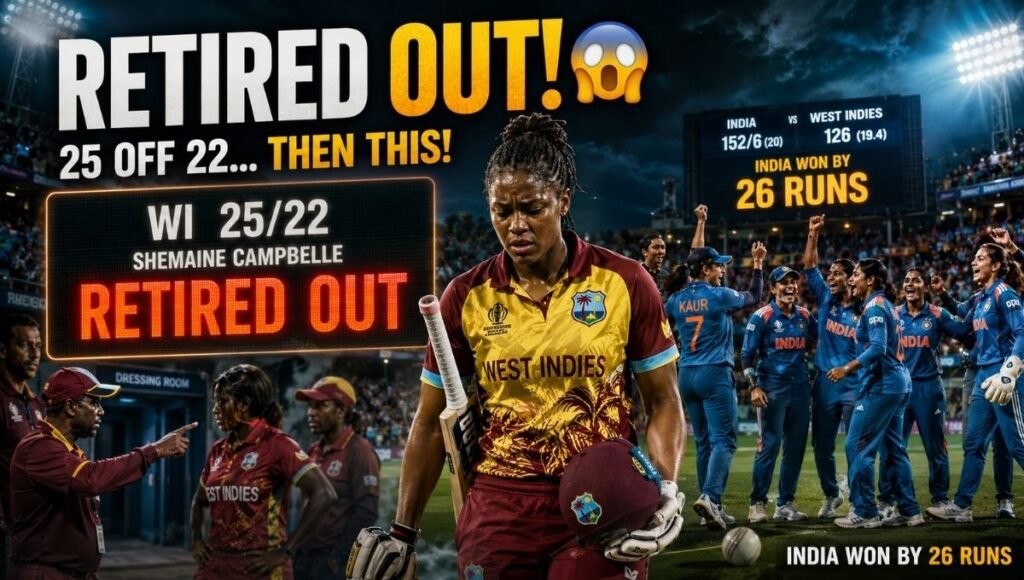
Shemaine Campbelle was batting on 25 off 22 balls, seemingly in decent touch.
India Women’s National Cricket Team Vs West Indies Women Match Scorecard Then the scorecard records something you rarely see: “retired out.” She didn’t get dismissed in the conventional sense her own team pulled her out of the contest deliberately, betting that a fresh hitter gave West Indies a better chance of chasing down India’s total. It didn’t work. India won by 26 runs anyway.
Which India vs West Indies Women Match Are You Looking For?
There’s an older bilateral T20I series between these two teams from the 2024-25 season, played in India, that regularly surfaces in searches for this exact keyword. This article is not about that series. It covers the 2026 T20 World Cup warm-up match at Sophia Gardens, Cardiff the most recent and contextually relevant meeting between these two teams heading into the actual tournament.
| Detail | Information |
|---|---|
| Competition | ICC Women’s T20 World Cup Warm-up Matches 2026, 5th Match |
| Date | 8 June 2026 |
| Venue | Sophia Gardens, Cardiff |
| Toss | West Indies Women won, elected to field first |
| Result | India Women won by 26 runs |
Match Result and Full Scorecard
India Women innings: 179/8 (20 overs)
| Batter | Runs | Balls | Note |
|---|---|---|---|
| Smriti Mandhana | 39 | 23 | Set the early tempo |
| Bharti Fulmali | 56* | 40 | Top scorer, unbeaten, anchored the innings through the middle and death overs |
West Indies bowling
| Bowler | Overs | Runs | Wickets |
|---|---|---|---|
| Afy Fletcher | 4 | 23 | 4 |
| Aaliyah Alleyne | 2 | 17 | 1 |
West Indies Women innings: 153/8 (20 overs)
| Batter | Dismissal | Runs | Balls |
|---|---|---|---|
| Deandra Dottin | lbw | 49 | 44 |
| Shemaine Campbelle | retired out | 25 | 22 |
| Qiana Joseph | bowled | 5 | 4 |
| Jahzara Claxton | caught | 6 | 4 |
| Aaliyah Alleyne | caught | 13 | 7 |
| Chinelle Henry | caught | 1 | 2 |
| Jannillea Glasgow | caught | 19 | 18 |
| Zaida James | bowled | 1 | 2 |
| Shawnisha Hector | not out | 19 | 11 |
| Afy Fletcher | not out | 7 | 6 |
Extras: 8 (b1, w7).
Partnership breakdown by wicket
| Wicket | Partnership Runs | Batters Involved |
|---|---|---|
| 1st | 63 | Dottin / Campbelle |
| 2nd | 12 | Dottin / Joseph |
| 3rd | 6 | Dottin / Claxton |
| 4th | 16 | Dottin / Alleyne |
| 5th | 5 | Henry / Alleyne |
| 6th | 1 | Henry / Glasgow |
| 7th | 10 | James / Glasgow |
| 8th | 31 | Hector / Glasgow |
India bowling
| Bowler | Overs | Runs | Wickets |
|---|---|---|---|
| Shafali Verma | 2 | 9 | 0 |
| Renuka Singh | 4 | 30 | 0 |
| Kranti Gaud | 4 | 43 | 0 |
| Shree Charani | 2 | 9 | 0 |
| Radha Yadav | 4 | 25 | 3 |
| Shreyanka Patil | 4 | 36 | 4 |
Read more :- England Women’s National Cricket Team Vs Australia Women’s National Cricket Team Match Scorecard
- Read more: India Women’s National Cricket Team Vs West Indies Women Match Scorecard
The Turning Point: Explaining the “Retired Out” Dismissal
Here’s what most recaps get wrong. They see “retired out” on a scorecard and either skip past it or assume it’s a scoring error. It isn’t. A batter can voluntarily retire during an innings, and if she doesn’t return to bat later, the scorecard records it as “retired out” functionally similar to being dismissed for the purposes of the total wickets column, but entirely the batter’s own team’s decision rather than the bowling side earning a wicket.
What most people miss is the tactical logic behind it. Campbelle was scoring at a reasonable but not explosive rate 25 off 22 while West Indies needed to accelerate significantly to keep pace with India’s 179. Retiring her out was a deliberate bet that a fresh batter coming in immediately could generate more urgency than Campbelle continuing to build slowly.
Counterintuitive idea worth stating plainly: this is one of the most underused tactical tools in T20 cricket. Teams rarely use the retired-out option even when a set batter is clearly not accelerating fast enough for the situation, and West Indies’ willingness to try it here even though the overall chase still fell short reflects a genuinely progressive, situation-aware approach to batting management.
Why the Tactic Still Didn’t Work
Looking at the partnership table above, the retired-out decision came right at the 63-run mark for the first wicket a reasonable platform, but not one where West Indies were significantly behind the required rate.
The bigger problem was what happened afterward: none of the next six partnerships passed 16 runs until the eighth-wicket stand between Hector and Glasgow finally produced 31.
Practical lesson for any team considering this tactic: swapping a set batter for a supposedly more explosive one only works if the incoming batter actually accelerates immediately. In this case, the middle order that followed Campbelle’s retirement couldn’t build the partnerships needed to make the gamble pay off.
Player Performance Breakdown
- Bharti Fulmali (56* off 40): The most important innings of the match for India, anchoring the middle and death overs after Smriti Mandhana’s early tempo-setting knock.
- Bold opinion worth stating plainly: an unbeaten 56 at the end of an innings often gets less attention than a flashy top-order fifty, but Fulmali’s knock is the specific reason India’s total reached a genuinely defendable 179 rather than something in the 150s.
- Smriti Mandhana (39 off 23): Her innings gave India’s total real early momentum, striking at a rate above 169 before departing to leave the middle overs to Fulmali and the rest of the order.
- Deandra Dottin (49 off 44): The most experienced batter in West Indies’ lineup carried the chase for as long as she could, but her relatively measured strike rate under 112 meant the required rate kept climbing around her even as she stayed at the crease.
- Common mistake in reading a top-scorer’s innings in a losing chase: assuming the highest individual score was automatically the most effective one for the team’s actual run-rate needs.
- Radha Yadav (3/25) and Shreyanka Patil (4/36): Together, India’s spin pairing accounted for 7 of West Indies’ 8 wickets, repeatedly breaking up partnerships in the middle overs exactly when West Indies needed stability.
- Practical takeaway for any T20 side building a bowling attack: a genuinely effective spin partnership, rather than a single standout bowler, is often what actually controls a chase once the powerplay restrictions lift.
- Jannillea Glasgow (19 off 18) and the lower order: West Indies’ innings folded from a promising position after Campbelle’s retirement, with the middle and lower order unable to build the kind of sustained partnership that could have kept the chase alive. Glasgow’s involvement in two of the later partnerships (7th and 8th wickets) shows she was at least trying to rebuild, even if the support around her wasn’t consistent enough.
- Afy Fletcher (4/23): The most impressive bowling figures of the match on either side, restricting India’s total despite the match eventually going the other way.
- Common mistake in reading a losing team’s bowling performance: assuming the whole attack underperformed simply because the team lost Fletcher’s economy of under 6 runs per over was genuinely excellent in a 179-run total.
Read Also:- Mumbai Indians vs Royal Challengers Bengaluru: Both IPL 2026 Matches Explained
What Both Teams Should Take From This Warm-Up
For West Indies, the practical lesson is about depth in the middle order. The retired-out gamble was tactically sound in theory, but it only works if the batters who follow can actually execute the acceleration the team is hoping for. Their coaching staff should focus on identifying specific middle-order batters capable of playing that exact finishing role reliably, rather than relying on the tactic itself to manufacture urgency that isn’t otherwise there in the lineup.
For India, this match confirms a template worth repeating heading into the tournament proper: an aggressive top-order start from Mandhana, followed by a steady anchor innings through the middle overs from Fulmali, backed by a spin-heavy bowling attack that dominates the middle overs of the opposition’s chase.
Practical decision for India’s team management: this specific balance explosive opener, calm finisher, twin spinners controlling the middle is exactly the kind of formula worth protecting rather than experimenting away from as the tournament begins.
Key Highlights and Records From the Match
| Highlight | Detail |
|---|---|
| Result | India Women won by 26 runs |
| Top score, India | Bharti Fulmali, 56* off 40 |
| Top score, West Indies | Deandra Dottin, 49 off 44 |
| Unusual dismissal | Shemaine Campbelle retired out on 25 |
| Best bowling figures | Shreyanka Patil, 4/36 |
| Combined spin impact | Radha Yadav and Shreyanka Patil took 7 of 8 West Indies wickets |
Frequently Asked Questions (FAQs)
Q1. Who won the India Women vs West Indies Women match in the T20 World Cup 2026 warm-up?
Ans. India Women won by 26 runs, posting 179/8 and restricting West Indies Women to 153/8 at Sophia Gardens, Cardiff, on 8 June 2026.
Q2. What does “retired out” mean in cricket, as seen in this match?
Ans. “Retired out” means a batter voluntarily leaves the field during their team’s innings and does not return to bat later. It counts as a dismissal for the wickets column but is a decision made by the batting side, not something earned by the bowling team. Shemaine Campbelle retired out on 25 in this match.
Q3. Who top-scored for India Women in this match?
Ans. Bharti Fulmali top-scored with an unbeaten 56 off 40 balls, anchoring India’s innings after Smriti Mandhana’s early 39.
Q4. Who took the most wickets for India Women against West Indies Women?
Ans. Shreyanka Patil took 4 wickets and Radha Yadav took 3, combining for 7 of West Indies’ 8 wickets in the innings.
Q5. Is this the same as the 2024-25 India Women vs West Indies Women bilateral series?
Ans. No. That was a separate T20I series played in India during the 2024-25 season. This article covers the different 2026 T20 World Cup warm-up match played at Sophia Gardens, Cardiff.