


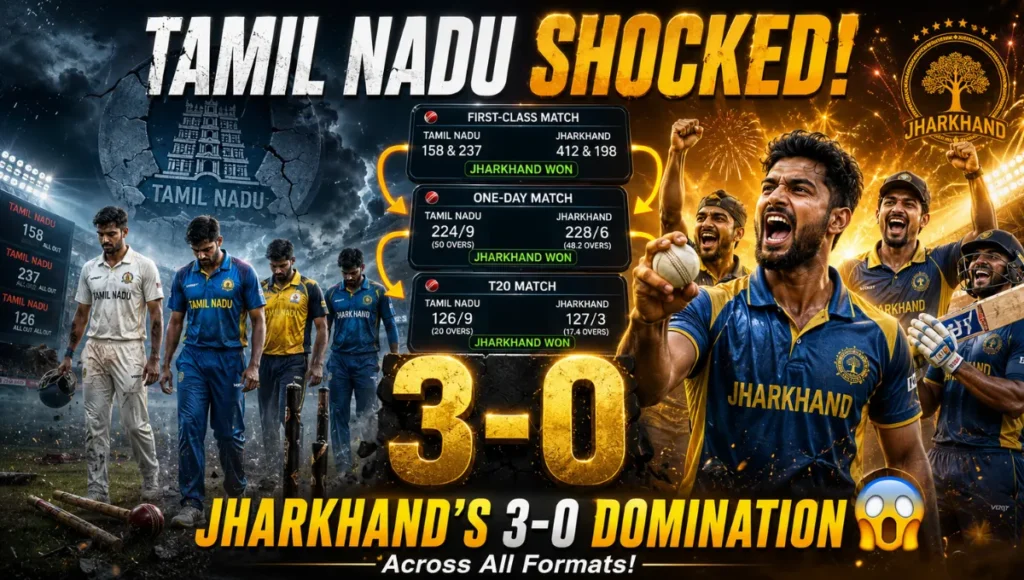
Tamil Nadu, a side with multiple India internationals in its ranks, walked into three separate matches against Jharkhand this season. All three times, they walked out defeated. But here’s the real problem most scorecard pages show you one match at a time, so nobody’s connected the dots on how completely one-sided this fixture became across formats.
This article puts all three results side by side, with full scorecards for each match, and breaks down the specific moments that decided each contest.
One Team, Three Formats, One Pattern
What most people miss is that Jharkhand didn’t just beat Tamil Nadu once this season they swept all three domestic formats against them in 2025-26.
| Tournament | Result | Margin |
|---|---|---|
| Ranji Trophy (Elite Group A) | Jharkhand won | Innings and 114 runs |
| Syed Mushtaq Ali Trophy (Elite Group D) | Jharkhand won | 28 runs |
| Vijay Hazare Trophy (Elite Group A) | Jharkhand won | 9 wickets |
This is where things go wrong for readers relying on single-match scorecards: they see one lopsided result and assume it was a one-off. It wasn’t. Jharkhand beat Tamil Nadu in the longest format, the shortest format, and the 50-over format, in the same domestic season. That’s a rare sweep, even in a league system with 30-plus teams and hundreds of fixtures played every year.
Why This Matters Beyond the Scorecards
A clean sweep across three formats usually signals something structural, not lucky. When one team wins with the bat in one format, with the ball in another, and in a nail-biter in the third, it points to genuine squad depth rather than a single match-winner carrying the team. That distinction matters for anyone using these scorecards to judge either side’s actual strength heading into the next domestic season.
Ranji Trophy: The Innings Win That Set the Tone
Jharkhand won the toss, batted first, and posted 419 all out in 132.1 overs at Chennai in October 2025. Tamil Nadu, in reply, could only manage 212 in their first innings, forcing them to follow on, and Jharkhand completed the innings victory by bowling Tamil Nadu out again cheaply in the second innings.
Full Scorecard: Tamil Nadu vs Jharkhand, Ranji Trophy
| Team | Innings | Score | Key Batters | Key Bowlers |
|---|---|---|---|---|
| Jharkhand | 1st Innings | 419 all out (132.1 overs) | Ishan Kishan 72 off 96 espn+1 | — |
| Tamil Nadu | 1st Innings | 212 all out (followed on) | C Andre Siddarth 80 off 180 | Jharkhand bowling attack |
| Tamil Nadu | 2nd Innings | Bowled out for a low total | Shahrukh Khan (part of 100-run 6th wkt stand) | Jharkhand bowling attack |
Result: Jharkhand won by an innings and 114 runs.
How the Innings Actually Unfolded
Jharkhand’s total didn’t come easily. Early wickets fell in clusters, and by the time the innings reached the halfway mark, the visitors were staring at a modest total on a pitch that offered turn for Tamil Nadu’s spinners. This is exactly the kind of situation where first-class matches are typically decided and it’s also where the standard scorecard tells you almost nothing about how the game actually turned.
Ishan Kishan’s Innings, Broken Down
Everyone’s scorecard shows “Ishan Kishan 72.” Almost nobody explains why that innings mattered more than the number suggests. Jharkhand had slipped to 157/6, in real trouble against a Tamil Nadu attack featuring international-standard bowlers. Kishan then anchored a rebuild alongside the middle and lower order, eventually taking Jharkhand from a precarious 157/6 to 371/7 a stand that added 214 runs and turned a modest total into a match-winning one.
What people think vs reality: fans assume a top-order collapse to 157/6 in a first-class match usually means a below-par total follows. Here, the opposite happened. Kishan’s composure at number seven, unusually low for a batter of his caliber, turned a rescue act into a total large enough to bowl Tamil Nadu out twice.
Tamil Nadu’s Response, and Where It Fell Short
Tamil Nadu’s reply showed genuine fight in patches. Andre Siddarth built a 100-run sixth-wicket stand with Shahrukh Khan that briefly threatened to save the follow-on, but Jharkhand’s bowlers regrouped and wrapped up the innings for 212. The follow-on effectively ended the contest as a genuine battle Tamil Nadu’s second innings never found the same partnership-building resilience, and Jharkhand completed the innings win comfortably.
My honest take: this wasn’t Tamil Nadu being outclassed by superior individual talent their batting lineup on paper was arguably stronger, with more recognizable names. It was Jharkhand’s lower-order depth and bowling discipline that decided the match, a pattern that shows up in domestic cricket far more often than fans realize, since first-class results reward consistency over star power.
Vijay Hazare Trophy: A 9-Wicket Demolition
Two months later, at Narendra Modi Stadium, Ahmedabad, Jharkhand won the toss, chose to field, and bowled Tamil Nadu out for 243. Jharkhand then chased the target down for the loss of just one wicket, reaching 244/1 in 41 overs a comfortable 9-wicket win with nearly nine overs unused.
Full Scorecard: Jharkhand vs Tamil Nadu, Vijay Hazare Trophy
| Team | Innings | Score | Overs | Key Contributors |
|---|---|---|---|---|
| Tamil Nadu | 1st Innings (batting) | 243 all out | 50.0 | Ravisrinivasan Sai Kishore 24 off 20, Sonu Yadav 21 off 16 |
| Jharkhand | 2nd Innings (chasing) | 244/1 | 41.0 | Unbeaten top-order stand |
Result: Jharkhand won by 9 wickets.
The Real Story Behind the Margin
This is where things go wrong for readers checking a bare scorecard: a “9-wicket win” sounds routine, but the actual story is how comprehensively Jharkhand’s bowlers controlled the middle overs. Tamil Nadu never found the acceleration phase that 50-over cricket demands, getting bogged down against Jharkhand’s spin-heavy attack between overs 20 and 40. Sai Kishore’s late cameo of 24 off 20 balls added some respectability to the total, but by then the damage from the middle-overs squeeze was already done.
What people think vs reality: a 9-wicket margin with overs to spare usually signals a batting masterclass from the chasing side. Here, the batting chase was almost secondary the match was effectively won once Jharkhand’s bowlers restricted Tamil Nadu to 243, a below-par total on a ground known historically for high scores.
Why the Chase Felt Like a Formality
Once Jharkhand’s openers got through the new-ball overs without losing early wickets, the chase settled into a low-risk, steady accumulation pattern. There was no need for aggressive risk-taking against a total already 30-40 runs below the ground’s typical par score. This is a common but underappreciated pattern in 50-over cricket: winning the bowling battle first often makes the batting chase look far more dominant than it actually needed to be.
Syed Mushtaq Ali Trophy: The Closer Contest
The T20 format produced the tightest of the three results. Jharkhand posted 207/3 in 20 overs, and Tamil Nadu responded with 179/7, falling 28 runs short.
Full Scorecard: Jharkhand vs Tamil Nadu, Syed Mushtaq Ali Trophy
| Team | Innings | Score | Overs |
|---|---|---|---|
| Jharkhand | 1st Innings (batting) | 207/3 | 20.0 |
| Tamil Nadu | 2nd Innings (chasing) | 179/7 | 20.0 |
Result: Jharkhand won by 28 runs.
What Made This Match Different
Unlike the Ranji and Hazare Trophy meetings, this contest never turned into a one-sided affair on paper. Tamil Nadu’s batters found boundaries consistently through the middle overs, and their required run rate stayed within reach until the final few overs, when Jharkhand’s death bowling finally closed the gap for good.
The practical takeaway for anyone tracking this fixture: T20 cricket remains Tamil Nadu’s best format against Jharkhand, even though they still lost all three meetings this season. Their batting unit performs far more competitively in the shortest format than in first-class or 50-over cricket against this specific opponent a distinction that matters if you’re trying to predict future results based on format rather than just overall reputation.
Season Summary: All Three Scorecards Side by Side
| Tournament | Venue | Jharkhand Score | Tamil Nadu Score | Margin |
|---|---|---|---|---|
| Ranji Trophy | Chennai | 419 | 212 & follow-on | Innings and 114 runs |
| Vijay Hazare Trophy | Ahmedabad | 244/1 | 243 | 9 wickets |
| Syed Mushtaq Ali Trophy | Ahmedabad | 207/3 | 179/7 | 28 runs |
Why Jharkhand Keeps Winning This Fixture
A counterintuitive point worth stating plainly: Jharkhand’s dominance over Tamil Nadu isn’t new, and it isn’t really about individual stars like Ishan Kishan. In the 2024-25 Ranji season, Jharkhand also beat Tamil Nadu, by 44 runs, continuing a pattern that now spans multiple seasons and all three formats.espn
What explains this consistency:
- Jharkhand’s bowling attack spin and seam combined has repeatedly restricted Tamil Nadu’s middle order across formats, not just in one match
- Jharkhand’s batting depth, especially in the lower middle order, has bailed out top-order failures multiple times, most visibly in the Ranji Trophy rebuild
- Tamil Nadu’s star batters have generally performed as individuals (Siddarth’s 80, Sai Kishore’s cameos) without translating into team totals large enough to compete consistently
A common mistake fans make is assuming Tamil Nadu’s stronger reputation in Indian domestic cricket built on a deeper talent pipeline and more India call-ups historically should translate to head-to-head dominance over Jharkhand. The 2025-26 season data says otherwise. Reputation and recent head-to-head results are two very different things, and this fixture is a clear example of that gap.
The One Format Tamil Nadu Should Target
If Tamil Nadu’s team management is looking for where to focus improvement, the T20 result offers the clearest roadmap. Their batting unit already competes credibly in that format against Jharkhand the gap that needs closing is specifically in bowling discipline during the middle overs, the same weakness that also cost them in the Vijay Hazare Trophy meeting.
What This Season’s Results Mean Going Forward
For anyone using these scorecards to judge either team’s form heading into the next domestic cycle, the takeaway isn’t just “Jharkhand won three times.” It’s that Jharkhand’s strength this season came from different sources in each format batting resilience in the Ranji Trophy, bowling control in the Vijay Hazare Trophy, and death-overs execution in the Syed Mushtaq Ali Trophy. That range is harder to replicate than a single standout performer, and it’s the real reason this fixture swung so heavily in Jharkhand’s favor across an entire season.
Frequently Asked Questions (FAQs)
Q1. Who won the Jharkhand vs Tamil Nadu Ranji Trophy match in 2025-26?
Ans. Jharkhand won by an innings and 114 runs after posting 419 in their first innings.
Q2. What was the result of the Jharkhand vs Tamil Nadu Vijay Hazare Trophy match?
Ans. Jharkhand won by 9 wickets, chasing down 244 after bowling Tamil Nadu out for 243.
Q3. Did Jharkhand beat Tamil Nadu in the Syed Mushtaq Ali Trophy 2025?
Ans. Yes. Jharkhand won by 28 runs, posting 207/3 to Tamil Nadu’s 179/7.
Q4. Who was the standout performer in the Jharkhand vs Tamil Nadu Ranji Trophy match?
Ans. Ishan Kishan, scoring 72 to rebuild Jharkhand’s innings from 157/6.
Q5. Has Jharkhand beaten Tamil Nadu before in Ranji Trophy?
Ans. Yes. Jharkhand also won the 2024-25 Ranji Trophy meeting between the two sides, by 44 runs.
Q6. In which format did Tamil Nadu perform best against Jharkhand this season?
Ans. The Syed Mushtaq Ali Trophy T20 match was Tamil Nadu’s closest contest, losing by 28 runs compared to much heavier defeats in the other two formats.