
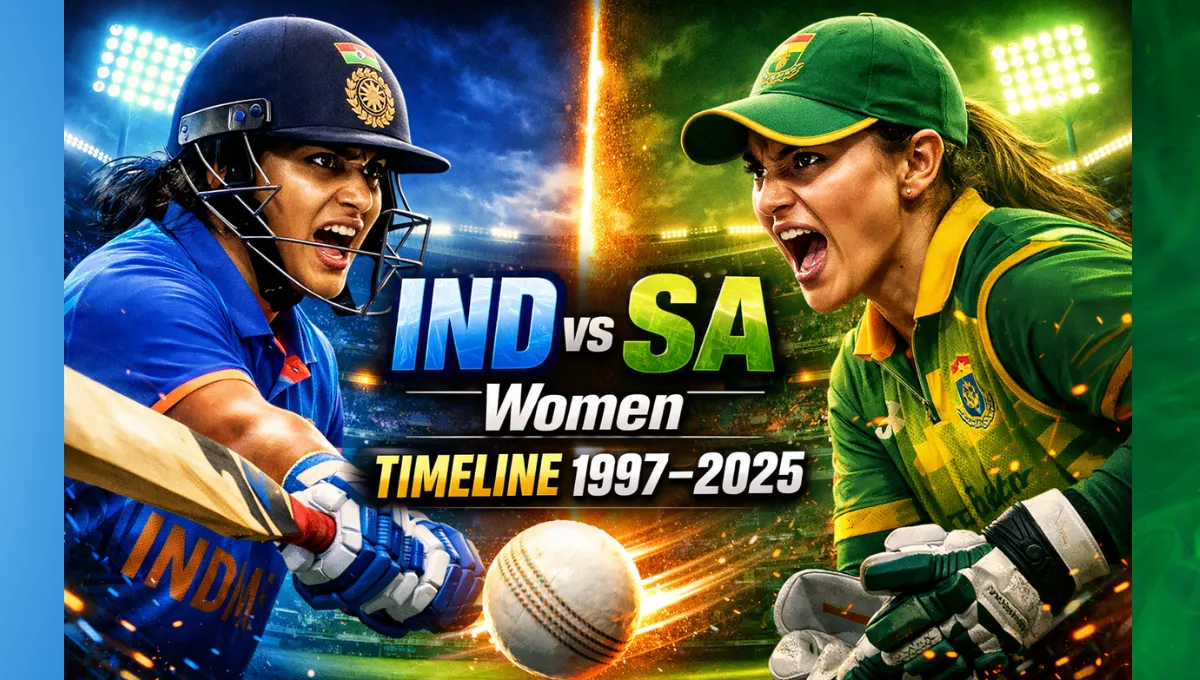
The India women’s national cricket team vs south africa women’s national cricket team timeline stretches from a first cautious ODI meeting in 1997 to a Women’s World Cup final in 2025. What happened between those two points is not a straight line. It is a story of shifting dominance, format-by-format evolution, tactical adaptation, and moments that genuinely changed what this rivalry means.
Quick Snapshot: India Women vs South Africa Women Head-to-Head
Before the timeline, here are the numbers that frame it.
At-a-Glance Record by Format
| Format | Total Matches | India Wins | SA Wins | Ties/NR |
|---|---|---|---|---|
| ODIs | ~34 | ~20 | ~13 | ~1 |
| T20Is | ~30+ | ~16 | ~14 | ~1 |
| Tests | 3 | 1 | 1 | 1 (draw) |
India lead the ODI record clearly. The T20I record is far tighter than most fans realise. Tests are rare but telling. That contrast alone is a clue to how this rivalry actually works.
Why This Rivalry Is Worth Tracking
this is not a lopsided rivalry. The scoreline in ODIs flatters India. In T20Is, the gap barely exists. And in the two Tests that have had a decisive result, both teams have won one each.
What this rivalry really tracks is the story of women’s cricket growing up in India, in South Africa, and in the sport globally. When India started taking women’s cricket seriously through central contracts and BCCI investment, the trajectory of this head-to-head shifted. When South Africa developed pace bowlers and athletic fielding units, the T20I format became their fighting ground.
India Women vs South Africa Women Timeline: Rivalry by Era
1997–2005: The First Meetings and Early Shape of the Rivalry
India and South Africa played their first ODI in 1997. Women’s cricket at that point was still finding its global footing. Neither team had the domestic structure they would later develop. The early exchanges were competitive but infrequent.
India had the edge. Their spinners even in those early years found ways to create awkward angles on subcontinental surfaces. South Africa, still building their women’s programme post-isolation, were capable but inconsistent.
India established early psychological dominance, but South Africa never folded. The pattern of “India leads, South Africa resists” was set here. It would repeat across formats for two decades.
2006–2013: Bilateral Cricket Gives the Rivalry Structure
This is the era that made the rivalry real. More bilateral series meant more context. More context meant more tactical awareness on both sides.
India toured South Africa. South Africa toured India. The format variety primarily ODIs gave fans a chance to see both teams adapt to hostile conditions.
their seam-heavy attack, effective at home on green pitches in Cape Town or Johannesburg, was often neutralised on flat Indian decks. India’s spinners particularly off-spinners kept finding edges and top-edges in the subcontinent. Away from home, India were more vulnerable, but they still managed to hold competitive records.
The 2006–2013 era is where India quietly built their biggest advantage. Not through dominant scorelines, but through the consistency of their batting core. South Africa had match-winners; India had match-winners who turned up repeatedly.
2014–2019: T20Is, ICC Pressure, and a More Modern Rivalry
The introduction of bilateral T20I cricket changed the rivalry’s tempo entirely. In T20Is, South Africa’s aggressive batting approach and athletic fielding became genuine threats.
The 2017 Women’s World Cup in England was a landmark. Both teams faced tournament pressure in the same event the format that would define women’s cricket’s modern era. India’s semi-final run that year announced a new seriousness in Indian women’s cricket globally.
What most people miss is that this era also exposed India’s T20I vulnerability. Their batting depth strong in ODIs sometimes looked thin under T20 pressure. South Africa, by contrast, were developing finishers and power-hitters who could win games in the last five overs.
This is where the T20I record tightened. And it has stayed tight ever since.
2020–Present: Tactical Depth, Closer Contests, and Red-Ball Interest
The 2021 South Africa tour of India was a pivotal moment. South Africa won the ODI series, a result that disrupted the comfortable narrative of Indian dominance. It was a tactical statement their pace attack worked even in Indian conditions when supported by disciplined field settings.
The 2024 Women’s Test between these teams brought red-ball cricket back into the conversation. Women’s Test cricket is rare and precious. When two teams meet in a Test match, it says something about the maturity of their rivalry. this is no longer a rivalry with a clear favourite.
Then came 2025 the Women’s ODI World Cup final at DY Patil Stadium. India vs South Africa for the biggest prize in women’s ODI cricket. In their previous meeting in the tournament (October 9), South Africa had won by 3 wickets, with Nadine de Klerk posting 84* and taking 2–52. That result fed directly into the final’s drama.
The 2020–present era is the first in this rivalry’s history where the result of any given series is genuinely uncertain before it starts. That is new. That matters.
Complete Timeline Table: Milestone Matches from 1997 to 2025
| Year | Format | Event/Series | Venue | Result | Key Performer | Why It Mattered |
|---|---|---|---|---|---|---|
| 1997 | ODI | First ODI meeting | — | India win | — | The rivalry begins |
| 2002 | Test | First Women’s Test | — | Draw | — | First red-ball chapter |
| 2008 | ODI | India tour SA | South Africa | SA competitive | — | SA shows away credibility |
| 2014 | T20I | First bilateral T20Is | — | India edge | — | Format opens new battleground |
| 2017 | ODI | Women’s World Cup | England | Both feature in semis | — | ICC stage raises stakes |
| 2021 | ODI | SA tour India | India | SA win series | — | India’s home dominance broken |
| 2024 | Test | Women’s Test | India | Closely contested | — | Red-ball maturity signal |
| Oct 9, 2025 | ODI | Women’s WC group stage | India | SA win by 3 wkts | N. de Klerk 84*, 2–52 | Final preview context |
| Nov 2025 | ODI | Women’s WC Final | DY Patil, Mumbai | TBC | — | Rivalry peak |
Read Also:- India National Cricket Team vs Pakistan National Cricket Team Timeline
Format-Wise Breakdown: ODI, T20I, and Test History
ODI Timeline and Head-to-Head Pattern
India lead the ODI record by a significant margin approximately 20 wins to 13 across 34 encounters (as of October 2025, per Al Jazeera). But that number requires context.
India’s ODI dominance was built largely on home conditions. Subcontinental pitches suit their spin-heavy attack. When the match moved abroad or to neutral venues in ICC tournaments, the gap narrowed considerably.
The most decisive ODI phases came during the 2017 Women’s World Cup era and the 2021 bilateral series one where India announced themselves on the world stage, the other where South Africa proved they could win in India’s backyard.
T20I Timeline and Style Contrast
This is where the rivalry is genuinely competitive and often unpredictable.
South Africa adapted to T20I cricket faster than their ODI record suggests. They developed finishers explosive batters who could dismantle a bowling plan in three overs. India, meanwhile, built a more structured T20I approach: consistent openers, spin in the middle overs, and controlled aggression.
they assume India’s overall head-to-head lead applies equally to T20Is. It does not. The T20I record is close enough that either team enters a T20I series with a genuine chance.
Test History: Rare but Important Chapters
Three Tests. One India win, one South Africa win, one draw. That is a perfectly balanced ledger on paper.
But Tests reveal something no limited-overs format can: which team has the batting depth to survive long spells, the bowling patience to build pressure over sessions, and the mental strength to bat on day four when conditions deteriorate.
The fact that both teams have now played enough Tests to develop red-ball rivalries within the rivalry is the most underreported story in this head-to-head. Women’s Test cricket is expanding, and this fixture is part of why that matters.
The Turning Points That Changed the Rivalry
1997: The First Meeting Sets the Tone
Any rivalry has a psychological anchor point. The 1997 first ODI established that India were the stronger team but that South Africa would compete. That competitive instinct not dominance, but resistance has defined South Africa’s approach in this fixture ever since.
2017: ICC Stage Pressure Changes Everything
Before 2017, this rivalry was primarily bilateral. The Women’s World Cup in England changed that. Now these teams had to think about each other in tournament contexts different pressure, different tactics, different mental load. India’s strong campaign in 2017 established that they could handle ICC tournament cricket. South Africa were watching and learning.
2021: South Africa’s Dominant Tour Redraws the Map
South Africa winning an ODI series in India was not just a result. It was a statement. It said: our pace attack can work anywhere. Our batting order has depth. We are not here to respect the conditions; we are here to impose our own.
India’s home advantage in ODIs had become a comfortable assumption. South Africa removed that comfort. Every India Women home series since has carried a different weight.
2024: Red-Ball Milestone
The 2024 Women’s Test was a signal that both boards take this fixture seriously enough to schedule the longest format. That decision alone matters. Close results in Tests cement credibility. Both teams earned that credibility here.
2025: The World Cup Final as Rivalry Peak
No analysis of this timeline is complete without acknowledging what the 2025Women’s ODI World Cup final means. India vs South Africa at DY Patil Stadium for the title. South Africa had already beaten India in the group stage. That added a layer of mental pressure to a final that the head-to-head record alone cannot explain.
Performance Breakdown: What Decides IND-W vs SA-W Matches?
India’s Usual Edge
- Spin control in the middle overs. India’s off-spinners and wrist-spinners consistently dry up runs between overs 10–40 in ODIs.
- Batting stability. India’s top order anchored by players like Smriti Mandhana and Shafali Verma builds platforms that chase totals or set defendable scores.
- Experience in high-pressure ICC situations. India have played more knockout cricket in this era and it shows in decision-making under pressure.
South Africa’s Usual Edge
- Pace and seam threat. Especially in South African conditions, their seam attack creates genuine early problems for any batting order.
- Athletic fielding. South Africa are one of the best fielding units in women’s cricket. Saved runs are earned runs and they count.
- Explosive T20 batting. Their middle-to-lower order can flip a game in six overs. That changes the pressure calculation for India’s bowlers.
Where the Contest Often Turns
- Powerplay wickets: Whichever team takes early wickets, or protects early wickets, tends to win in ODIs.
- Middle-over spin control: India use this phase to suffocate; South Africa try to accelerate through it.
- Death overs execution: Neither side is perfect at the death. The team that executes better in overs 41–50 almost always wins close matches.
- Chasing under pressure: South Africa have shown they can chase; the 3-wicket win on October 9, 2025 is the clearest evidence.
Key Players and Rivalry Leaders
Top Run-Scorers in the Rivalry
| Player | Team | Format | Notable Contribution |
|---|---|---|---|
| Smriti Mandhana | India | ODI/T20I | Consistent opener; sets tone in powerplays |
| Mithali Raj (retired) | India | ODI | Historically India’s highest run-getter vs SA |
| Sune Luus | South Africa | T20I | Key SA middle-order anchor |
| Laura Wolvaardt | South Africa | ODI/T20I | SA’s most reliable top-order batter |
Top Wicket-Takers in the Rivalry
| Player | Team | Format | Style |
|---|---|---|---|
| Deepti Sharma | India | ODI/T20I | Off-spin; effective in middle overs |
| Poonam Yadav | India | T20I | Wrist-spin; wicket-taking option |
| Shabnim Ismail | South Africa | ODI/T20I | Fastest women’s bowler; opening menace |
| Marizanne Kapp | South Africa | ODI | Pace + batting; true all-rounder threat |
Clutch Performers in Big Matches
Nadine de Klerk (84*, 2–52 in the 2025 WC group stage) is the most recent example of a player who changed a match’s result single-handedly. That all-round performance in a high-stakes game is exactly what “clutch” means.
India’s version of that has historically been Smriti Mandhana whose powerplay batting sets the tempo in a way that forces opposition bowling changes before the 10th over.
Latest Meeting: What It Says About the Rivalry Now
Date: October 9, 2025 Format: ODI (Women’s World Cup group stage) Venue: India Result: South Africa won by 3 wickets Key performer: Nadine de Klerk 84* with bat, 2–52 with ball
What this result reveals:
- South Africa can win in India, chasing under pressure, in a World Cup setting. That combination would have seemed unlikely ten years ago.
- The rivalry has reached genuine parity in ODIs when conditions are neutral or SA-favourable.
- De Klerk’s match-winning performance suggests South Africa have developed a player who can change a game with both bat and ball — a major rivalry resource.
This result fed directly into the anxiety around the 2025 WC final. India had to prepare knowing South Africa had already beaten them in this campaign. That psychological reality is part of the rivalry now.
Final Read: A Rivalry That Has Earned Its Status
this rivalry spent its first fifteen years as a regional fixture with predictable results. India dominated. South Africa competed but rarely threatened the bottom line.
But here’s where the conventional story ends and the real one begins.
From 2021 onwards, this rivalry entered a new phase. South Africa started winning where they were not supposed to win. India started facing pressure they were not used to feeling. Tests were scheduled. World Cups were won and lost between these two teams.
The India women’s national cricket team vs south africa women’s national cricket team timeline is not a neat upward line. It is a complex, format-specific, era-shaped story of two programmes that grew up at different speeds, in different conditions, with different resources and still managed to produce one of women’s cricket’s most genuinely competitive and watchable rivalries.
Frequently Asked Questions (FAQs)
Q1: When did India Women first play South Africa Women?
Ans. India Women and South Africa Women played their first ODI in 1997. Their first Women’s Test match took place in 2002, and bilateral T20Is began around 2014. The 1997 ODI was the starting point of the full rivalry timeline.
Q2: What is the head-to-head record between India Women and South Africa Women in ODIs?
Ans. As of October 2025, India lead the ODI head-to-head with approximately 20 wins from 34 matches, compared to South Africa’s 13. The record is tighter in T20Is, where both teams are closely matched with roughly 16 wins each from 30+ games.
Q3: Have India Women and South Africa Women played Test matches?
Ans. Yes. The two teams have played 3 Women’s Test matches. India won one, South Africa won one, and one ended in a draw. The most recent Test was played in 2024 and was closely contested, reflecting the growing maturity of both sides in the red-ball format.
Q4: What is the biggest match in this rivalry?
Ans. The 2025 Women’s ODI World Cup final at DY Patil Stadium, Mumbai, is the highest-stakes encounter in the history of this rivalry. Prior to the final, South Africa had beaten India in the same tournament by 3 wickets (October 9, 2025), adding significant psychological weight to the showpiece match.
Q5: Who are the top performers in India Women vs South Africa Women matches?
Ans. India’s top performers historically include Smriti Mandhana (batting), Mithali Raj (ODIs), Deepti Sharma, and Poonam Yadav (bowling). For South Africa, Marizanne Kapp, Shabnim Ismail, Laura Wolvaardt, and Nadine de Klerk have been the most influential players across formats.


Leave a Reply