
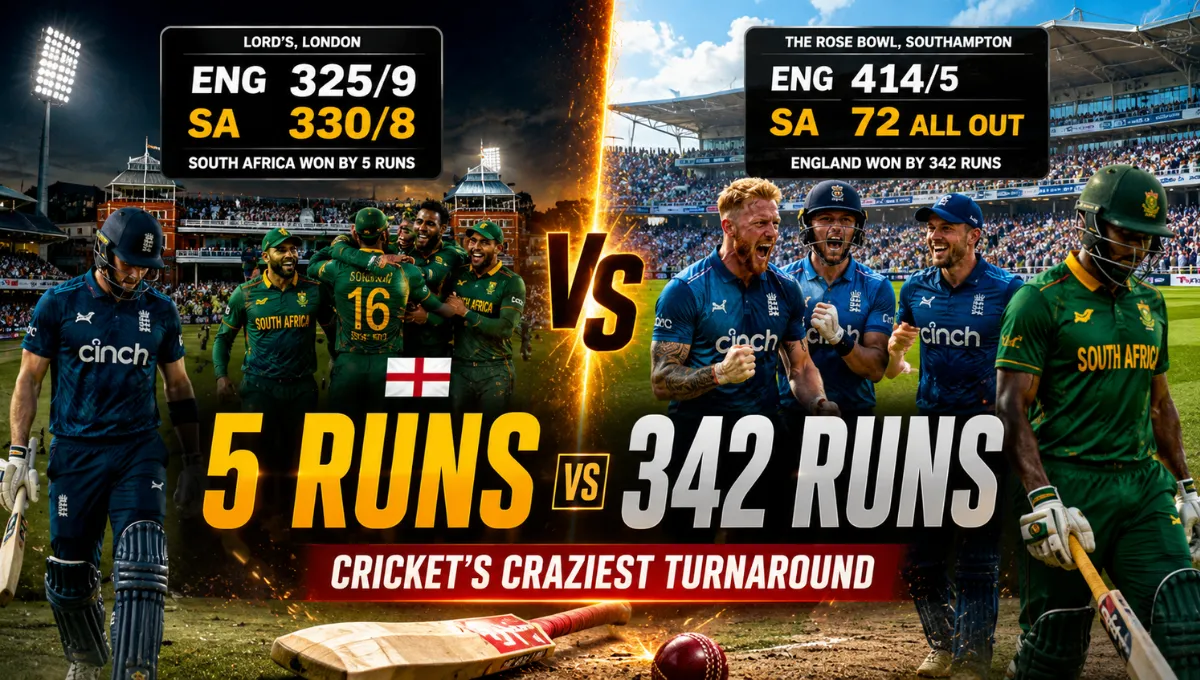
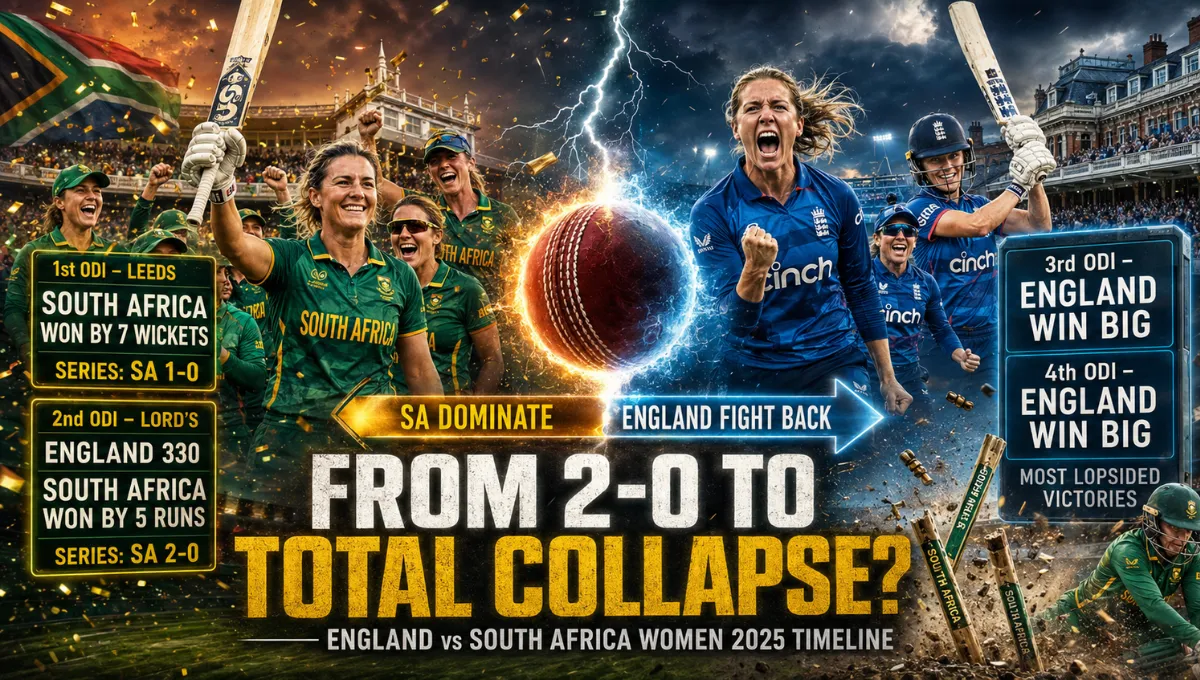
September 4, 2025. Lord’s Cricket Ground, London. 2nd ODI. South Africa bat first and post 330/8 in 50 overs. England, responding, reach 325/9 in 50 overs.
South Africa win by 5 runs at Lord’s. One hundred and thirty-seven years of matches between these two nations, and the venue that has hosted more defining moments in this rivalry than any other Lord’s produces a 5-run win for the away team, at the ground where Graeme Smith once scored 277 and 259 in the same series.
Three days later, at The Rose Bowl, Southampton England 414/5, South Africa 72 all out. England win by 342 runs. The same bilateral series. The same two teams. One match decided by 5 runs on the last ball. The next decided by 342 runs in under 31 overs.
This swing from 5-run defeat to 342-run triumph is the most extreme same-series momentum reversal in bilateral cricket history. And it captures perfectly what the England-South Africa rivalry has always been: unpredictable, high-scoring, and structurally one of cricket’s richest bilateral relationships.
Head-to-Head Snapshot: England vs South Africa (2025)
| Format | Matches | ENG Wins | SA Wins | Draws/NR |
|---|---|---|---|---|
| Tests | 156+ | 36 | 28 | 55+ |
| Test Series | 37 | 20 | 10 | 7 |
| ODIs | 80+ | ~43 | ~35 | — |
| T20Is | 25+ | ~14 | ~11 | — |
| 2025 ODI series | 3 | 1 | 2-1 SA | — |
| 2025 T20I series | 3 | 1 | 1 | 1 abandoned |
England lead Tests (36-28) and Test series (20-10) all-time. South Africa won the most recent bilateral series in England the 2025 ODI series 2-1.
England’s 36-28 Test lead across 156 Tests was built substantially in two periods: the pre-isolation era (1888–1965), when England consistently won home series and South Africa were still developing their cricket infrastructure; and the post-Bazball era (2022), when Stokes’s England have beaten visiting South Africa with aggressive batting that typically targets away bowling attacks. South Africa’s 28 Test wins remain the highest by any team other than Australia against England.
The Trophy That Defines This Rivalry
The bilateral Test series between England and South Africa is contested for the Basil D’Oliveira Trophy named after a player who was never allowed to play against South Africa in South Africa.
Basil D’Oliveira was born in Cape Town, South Africa in 1931. Under apartheid, he could not play first-class cricket in South Africa. He emigrated to England in the 1960s and became one of England’s most important Test batters.
In 1968, D’Oliveira was selected for England’s tour of South Africa. The South African government refused to accept the team on the grounds that it included D’Oliveira. The tour was cancelled. International cricket’s relationship with South Africa never recovered from that refusal and 22 years of isolation followed.
The Basil D’Oliveira Trophy is one of the few bilateral cricket trophies named after a player rather than a sponsor or a nation. It is also the only trophy in international cricket where the name itself carries a specific historical and political indictment: D’Oliveira was never allowed to play in the country whose team competes for the trophy named after him. Every Test series between England and South Africa is contested in the shadow of that fact.
Phase 1: The Early Era (1888–1965): England’s Dominant Foundation
1888: First England Tour of South Africa: The Rivalry Begins
England toured South Africa for the first time in 1888-89, winning the series 2-0 in two Tests.
South Africa’s first Test cricket was in its embryonic phase. England were the world’s premier cricket power they had been playing Tests since 1877.
South Africa’s first Test win against England didn’t come until the 1905-06 series in South Africa, which they won 4-1. The first 18 years of this rivalry from 1888 to 1905 were almost entirely one-sided in England’s favour. Yet within one series, in 1905-06, South Africa reversed the pattern and won their first series win against England. Cricket’s bilateral power relationships shift faster than they appear to.
All-Time Test Records: England Lead 36-28 Across 156 Tests
Across 37 Test series between 1888 and 2022, England have won 20 series, South Africa have won 10, and 7 have been drawn.
Key historical series results:
Read Also:- Australian Men’s Cricket Team vs South Africa National Cricket Team Timeline
Phase 2: The D’Oliveira Affair and 22-Year Isolation (1968–1994)
1968: The D’Oliveira Affair: The Cricket Decision That Changed History
In 1968, England were scheduled to tour South Africa. Tom Cartwright withdrew injured from the England squad. Basil D’Oliveira born in Cape Town, playing for England was selected as replacement.
South African Prime Minister B.J. Vorster declared the team “the team of the anti-apartheid movement” and refused England’s entry with D’Oliveira in the squad.
The tour was cancelled. The International Cricket Conference subsequently excluded South Africa from international cricket. South Africa did not play official international cricket again until 1991 (readmission) and their first official tour was in 1991-92.
The D’Oliveira affair was not primarily a cricket controversy it was a diplomatic crisis that cricket happened to detonate. The South African government’s refusal was not just about one player; it was the moment that made it impossible for any international sports body to continue ignoring apartheid. Tennis, athletics, rugby, and cricket all followed with exclusions. Cricket’s D’Oliveira moment was the beginning of South Africa’s total international sports isolation and it was an English cricket selection that triggered it.
22 Years of Silence: What Cricket Lost
Between 1965 and 1994, England and South Africa played no official Test cricket.
What was lost: Graeme Pollock (career Test average 60.97 higher than virtually every batter of his era), Barry Richards, Mike Procter, and Peter Pollock all at or approaching their peaks in 1970 never played England in an official series again.
South Africa in 1970 when their isolation began had arguably the strongest cricket side in the world. They had just beaten Australia 4-0 at home with Graeme Pollock scoring 274 in one innings and Peter Pollock and Mike Procter sharing 45 wickets between them. Their isolation came at the precise moment their cricket was reaching its ceiling. The 22-year absence removed from England-South Africa cricket one of the greatest missed chapters in the sport’s bilateral history.
Phase 3: Post-Readmission Era (1994–2021)
2003: Graeme Smith’s Lord’s Debut: 277 and 259
“Who’s Graeme Smith?” England captain Nasser Hussain’s dismissive response when asked about South Africa’s new captain arriving in England in 2003. Five Tests later: Hussain had resigned the Test captaincy. Smith had scored 277 at Lord’s and 259 at Edgbaston. The 2003 series ended 2-2. South Africa’s first series draw in England since 1965.
Graeme Smith was 22 years old in 2003. His 277 at Lord’s came in his first Test as South Africa’s full-time captain. His 259 at Edgbaston came three matches later. No debut captain in Test history had scored more runs at Lord’s in their first series. The magnitude of England’s misjudgement “Who’s Graeme Smith?” and the magnitude of what followed, is the most dramatic single-personality turn in this rivalry’s post-readmission history.
2012: South Africa Reach Number One at Lord’s
In the 2012 series, South Africa became the ICC’s number one ranked Test side by winning at Lord’s.
South Africa won the series 2-0. Their most comprehensive series win in England since readmission.
South Africa’s climb to Test number one in 2012 came at Lord’s a venue that has been the site of some of South Africa’s most important results against England. Smith’s 277 in 2003. The number one ranking in 2012. The 5-run ODI win in 2025. Lord’s is the most psychologically significant venue in this bilateral relationship for South Africa, not England.
Phase 4: South Africa in England 2022: Bazball’s First Test Loss
1st Test, Lord’s (Aug 17-19): SA Win by Innings and 12 Runs
England 1st innings: 165 (45 overs)
South Africa 1st innings: 326
England 2nd innings: 149
South Africa won by an innings and 12 runs
This was the first Test defeat of Ben Stokes’s captaincy and Brendon McCullum’s coaching era which had just produced stunning wins against New Zealand and India. South Africa bowled England out for 165 and 149 dismissing Bazball’s attacking intent with a disciplined pace attack.
The 2022 1st Test at Lord’s was Bazball cricket’s first genuine reality check. England had just beaten New Zealand 3-0 and India in a single-Test rescheduled match with the exact same aggressive approach. South Africa’s seamers operating in the same Lord’s swing conditions bowled England out twice for under 165 combined. The lesson: Bazball works on flat English pitches against moderate bowling. It does not automatically work against world-class seam bowling under overhead cloud.
2nd and 3rd Tests: England Win Series 2-1
2nd Test, Manchester: England won by an innings and 85 runs (SA 151 and 179, ENG 415/9d).
3rd Test, The Oval: England won by 9 wickets (SA 118 and 169, ENG 158 and 130/1).
England win the series 2-1.
England’s 9-wicket and innings-and-85-run wins after losing by an innings in the 1st Test shows the exact Bazball cycle: absorb the opening loss, reset the batting template, then produce total dominance in subsequent matches. The 2022 SA in England series established the blueprint that England have used in every subsequent home series including against Australia in the 2023 Ashes.
Phase 5: South Africa Tour of England 2025: Complete Scorecards
ODI Series (Sep 2–7, 2025): South Africa Win 2-1
| Match | Date | Venue | Score | Result |
|---|---|---|---|---|
| 1st ODI | Sep 2, D/N | Headingley, Leeds | ENG 131 (24.3 ov) — SA 137/3 (20.5 ov, target 132) | SA won by 7 wkts |
| 2nd ODI | Sep 4, D/N | Lord’s, London | SA 330/8 (50 ov) — ENG 325/9 (50 ov, target 331) | SA won by 5 runs |
| 3rd ODI | Sep 7 | The Rose Bowl, Southampton | ENG 414/5 (50 ov) — SA 72 (20.5 ov, target 415) | ENG won by 342 runs |
South Africa win the ODI series 2-1.
Performance breakdown 1st ODI, Headingley: England bowled out for 131 in 24.3 overs at Headingley an extraordinary batting collapse on an English home surface. South Africa’s bowling attack (likely Rabada, Ngidi, and spinners) dismissed England before the powerplay restrictions could be fully exploited. South Africa chased 132 in 20.5 overs, losing only 3 wickets. The series was effectively won in 45 overs of cricket across two teams.
Performance breakdown — 2nd ODI, Lord’s (SA win by 5 runs): South Africa’s 330/8 and England’s 325/9 a 5-run win in the highest-scoring Lord’s ODI in this bilateral. The 5-run margin at Lord’s, England’s home ground and cricket’s most famous venue, means South Africa led 2-0 before Southampton.
What most people miss: England’s 414/5 in the 3rd ODI at Southampton is the highest total England have ever posted against South Africa. South Africa’s 72 all out in reply is among the lowest totals South Africa have ever posted in England. England won by 342 runs their highest winning margin in ODI cricket. Both of these individual records exist within a series England lost 2-1. This series contains both the most extreme individual match result and the most extreme team narrative divergence in this bilateral’s entire ODI history.
T20I Series (Sep 10–14, 2025): Series Tied 1-1
Read Also:- India Women’s National Cricket Team vs Australia Women’s National Cricket Team Timeline
Performance breakdown — 2nd T20I, Old Trafford: England’s 304/2 in 20 overs only the second time any T20I team has posted 300+ is the single highest score ever made against South Africa in T20I cricket. England won by 146 runs. South Africa, defending 97 in a rain-hit 1st T20I (DLS win), then conceded 304 in the same series. The same bilateral, the same two teams, three days apart one match won with 97 runs in 7.5 overs, the next conceding 304 in 20 overs.
England’s 304/2 at Old Trafford with players like Ben Duckett and Phil Salt likely opening is the 2nd T20I performance that most directly connects to how England’s white-ball game has transformed under the McCullum-Stokes era. The T20I team that posted 304 against South Africa is not the same team that scraped 131 in an ODI at Headingley three days earlier. England’s white-ball cricket has a format personality gap: their T20I batting is among the world’s most explosive; their ODI batting in 2025 was inconsistent.
All-Time Series Records (2025 Updated)
Three Original Observations
- The 2025 ODI series contains both the highest winning margin in England-South Africa ODI history (England by 342 runs) and one of the tightest losses in this bilateral’s history (England by 5 runs at Lord’s) — in the same 3-match series. No bilateral ODI series in cricket history has contained this range of outcome divergence in three consecutive matches. The 5-run Lord’s result and 342-run Southampton result are structurally incompatible as a single bilateral reading yet they are the same two teams, same conditions, separated by three days.
- South Africa’s ODI series win in England in 2025 (2-1) was built entirely on their first two matches and the ODI they lost was by 342 runs. The practical lesson: South Africa’s 2025 England conditions plan targeting England’s ODI batting unpredictability in early-innings powerplay phases worked perfectly in matches 1 and 2. By match 3, England made tactical adjustments (likely batting first and posting 414 rather than chasing) that South Africa’s bowling had no answer for. Cricket series are often decided by one team finding an adjustment before the other. In 2025, South Africa found theirs in matches 1-2; England found theirs in match 3, one game too late.
- England’s 304/2 in the 2nd T20I at Old Trafford is the single most important T20I result in this bilateral’s history — and it happened in a series England technically drew 1-1. The 304/2 score will define how South Africa prepare for England in T20I conditions for the next four years. Their 97/5 (7.5 overs, rain) DLS win in Cardiff is a statistical anomaly. England’s 304/2 at Old Trafford is a talent statement.
Frequently Asked Questions (FAQs)
Q1: What is England vs South Africa head-to-head in Tests all-time?
Ans. England lead 36-28 in 156+ Tests with 55+ draws. England have won 20 of 37 Test series, South Africa have won 10, and 7 have been drawn. The bilateral Test series is contested for the Basil D’Oliveira Trophy, named after the Cape Town-born England batter whose 1968 selection triggered South Africa’s 22-year international isolation.
Q2: What was the result of the South Africa tour of England 2025?
Ans. ODI series (Sep 2-7): South Africa won 2-1 — SA won 1st ODI Headingley by 7 wkts (ENG 131); SA won 2nd ODI Lord’s by 5 runs (SA 330/8, ENG 325/9); England won 3rd ODI Southampton by 342 runs (ENG 414/5, SA 72). T20I series (Sep 10-14): Series tied 1-1 — SA won 1st T20I Cardiff by 14 runs (DLS); England won 2nd T20I Old Trafford by 146 runs (ENG 304/2, SA 158); 3rd T20I Trent Bridge abandoned.
Q3: What is England’s highest ODI winning margin vs South Africa?
Ans. England beat South Africa by 342 runs in the 3rd ODI at The Rose Bowl, Southampton, on September 7, 2025. England posted 414/5 in 50 overs; South Africa were all out for 72 in 20.5 overs.
Q4: What is England’s highest T20I score vs South Africa?
Ans. England posted 304/2 in 20 overs against South Africa in the 2nd T20I at Emirates Old Trafford, Manchester, on September 12, 2025. England won by 146 runs (SA all out 158 in 16.1 overs).
Q5: What is the Basil D’Oliveira Trophy?
Ans. The Basil D’Oliveira Trophy is the prize contested in England vs South Africa Test series. Named after Basil D’Oliveira — a Cape Town-born player who emigrated to England and played for England — whose inclusion in England’s 1968 touring squad to South Africa was refused by the South African government under apartheid, triggering South Africa’s 22-year isolation from international cricket.
Q6: What happened in England vs South Africa 2022 Tests?
Ans. South Africa won the 1st Test at Lord’s by an innings and 12 runs (ENG 165 and 149, SA 326). England won the 2nd Test at Manchester by an innings and 85 runs (SA 151 and 179, ENG 415/9d). England won the 3rd Test at The Oval by 9 wickets (SA 118 and 169, ENG 158 and 130/1). England won the series 2-1.


Leave a Reply