
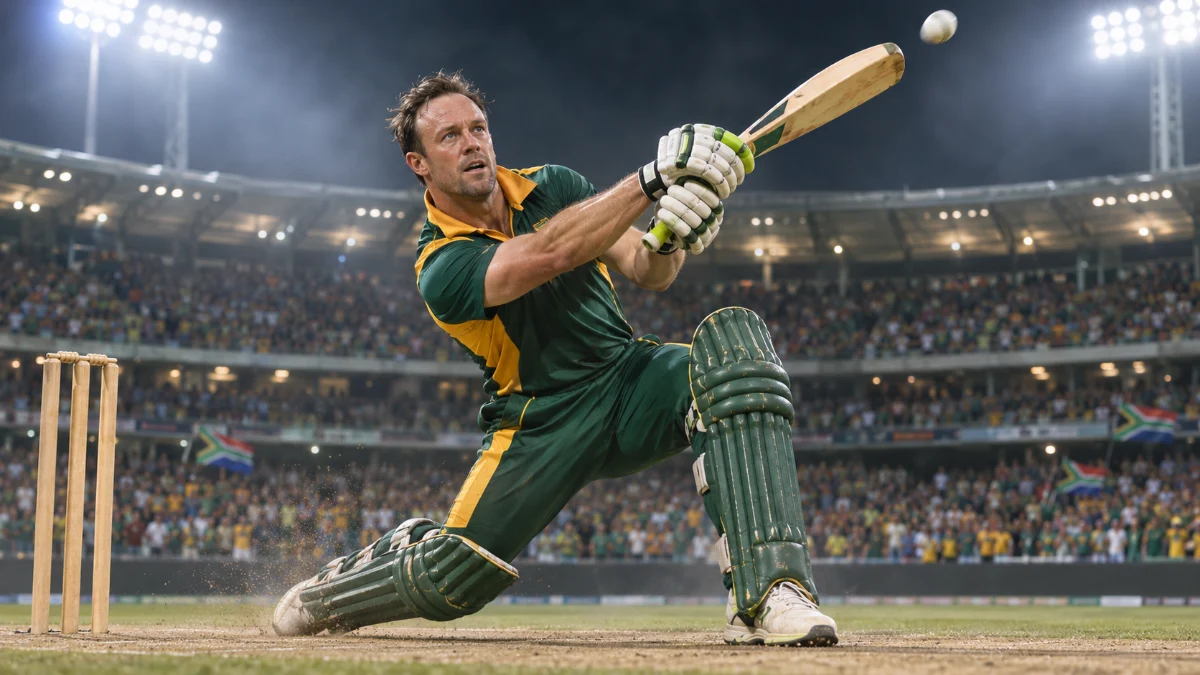
Who Is the Most Dangerous Batsman in the World AB de Villiers is the strongest all-round pick for the most dangerous batsman in the world in men’s cricket. He could take apart a bowling attack from the moment he walked in, score through gaps most batters couldn’t reach, and change his approach when the match demanded patience. His 31-ball ODI century against West Indies in 2015 is the clearest example of how quickly he could take control of a game.
The answer changes with the format and the situation. Chris Gayle has a strong case for pure T20 power, Virat Kohli stands out in pressure chases, and Virender Sehwag showed how quickly an opener could dictate the pace of a Test. This all-time selection weighs scoring speed, shot range, and the ability to turn a match.
AB de Villiers — The Most Versatile Attacker
De Villiers earned the nickname “Mr. 360” because he could hit the same delivery into several parts of the ground. A fast bowler aiming for the stumps could see the ball scooped over fine leg. Moving a fielder there opened space elsewhere, and de Villiers had the footwork and bat control to use it.
His 31-ball ODI hundred shows his speed, while his 174 off 381 balls against England at Headingley in 2008 shows how much he could slow the game down when needed. That range gives him the edge here. A captain could set a field to protect the boundary and still have to worry about de Villiers taking singles until the next scoring opportunity arrived.
Chris Gayle — The Biggest T20 Power Hitter
Gayle’s unbeaten 175 for Royal Challengers Bangalore against Pune Warriors India in 2013 remains the defining example of his IPL power. He reached his century in just 30 balls. For a batting side with only 20 overs, an opener scoring that quickly can force the opposition to use its best bowlers earlier than planned.
Gayle’s straight hitting gave captains a particular problem. With him at the crease, pushing fielders back could save fours, but there was little protection when he cleared them comfortably. For sheer boundary-hitting power in franchise T20 cricket, Gayle is the standout choice on this list.
Viv Richards — ODI Aggression Ahead of His Time
Viv Richards scored 189 not out against England at Old Trafford in 1984, an ODI record at the time. England managed 168 in reply, fewer runs than Richards had scored on his own. His innings is also a reminder of how much one batter can contribute when the rest of the lineup struggles.
Richards belongs high on an all-time list because of how aggressively he played relative to his era. Comparing his raw scoring rate with that of a modern T20 specialist misses the context in which he built his reputation.
Who Is the Most Dangerous Batsman in the World Rohit Sharma — The ODI Opener Who Builds Huge Scores
Rohit Sharma’s 264 off 173 balls against Sri Lanka at Eden Gardens in 2014 shows what can happen when he bats deep into an ODI. He reached his hundred in the 32nd over and scored another 164 runs before being dismissed from the final ball of the innings.
That innings captures what makes Rohit dangerous. A bowling attack can keep him relatively quiet early and still concede a huge score if he is there for the closing overs. Once set, he can pick up length early and turn a ball aimed at limiting his options into a boundary.
Read more: Who Is the Most Dangerous Batsman in the World
Virender Sehwag — The Test Opener Who Changed the Tempo
Sehwag scored 319 against South Africa in Chennai in 2008, reaching his triple century in 278 balls. It was an extraordinary rate for an innings of that size in Test cricket, where an opening batter often spends the first session wearing down the new-ball attack.
An opener who scores that quickly changes how a captain manages the session. Bowlers can lose their attacking fields earlier, and the batting side can build a large total while leaving more time to bowl the opposition out.
Virat Kohli — The Chase Specialist Under Pressure
Kohli’s 82 not out off 53 balls against Pakistan at the 2022 T20 World Cup in Melbourne showed how he can pace a chase under pressure. India needed a late surge, and Kohli delivered it with two consecutive sixes off Haris Rauf in the penultimate over.
His threat builds as the target comes into view. He can keep a chase within reach with singles and twos, then pick a bowler or an over to attack. That makes him especially difficult to contain when the fielding side has one expensive over to spare.
Glenn Maxwell — The Batter Who Can Rescue a Chase
Australia were 91 for seven chasing 292 against Afghanistan at the 2023 ODI World Cup when Glenn Maxwell produced an unbeaten 201 off 128 balls. His boundary hitting turned a match Afghanistan looked poised to win into an Australian victory.
Maxwell’s reverse sweeps and unconventional angles gave him ways to find boundaries against fields set for conventional shots. His innings against Afghanistan shows how valuable that range can be when wickets are scarce and the required rate leaves little room for caution.
Travis Head — The Early Attacker in Big Matches
Travis Head scored 137 off 120 balls against India in the 2023 ODI World Cup final. His innings helped Australia recover from early wickets and complete the chase. When a team loses wickets at the start, a batter who keeps finding boundaries can prevent the required rate from becoming a second problem.
Frequently Asked Questions
Who is the most dangerous batsman in cricket history?
AB de Villiers is the strongest overall choice here. His shot range made him difficult to contain in limited-overs cricket, and he could adapt to longer innings in Tests.
Who is the most dangerous IPL batsman for pure power?
Who scored the fastest century in men’s ODI cricket?
Which Indian batsman was most dangerous in ODI run chases?
What makes a batsman dangerous besides strike rate?
Shot range, adaptability, and timing matter. A batter who can rotate the strike when boundaries are scarce and accelerate against the right bowler can shape a game even before the big shots arrive.










Leave a Reply