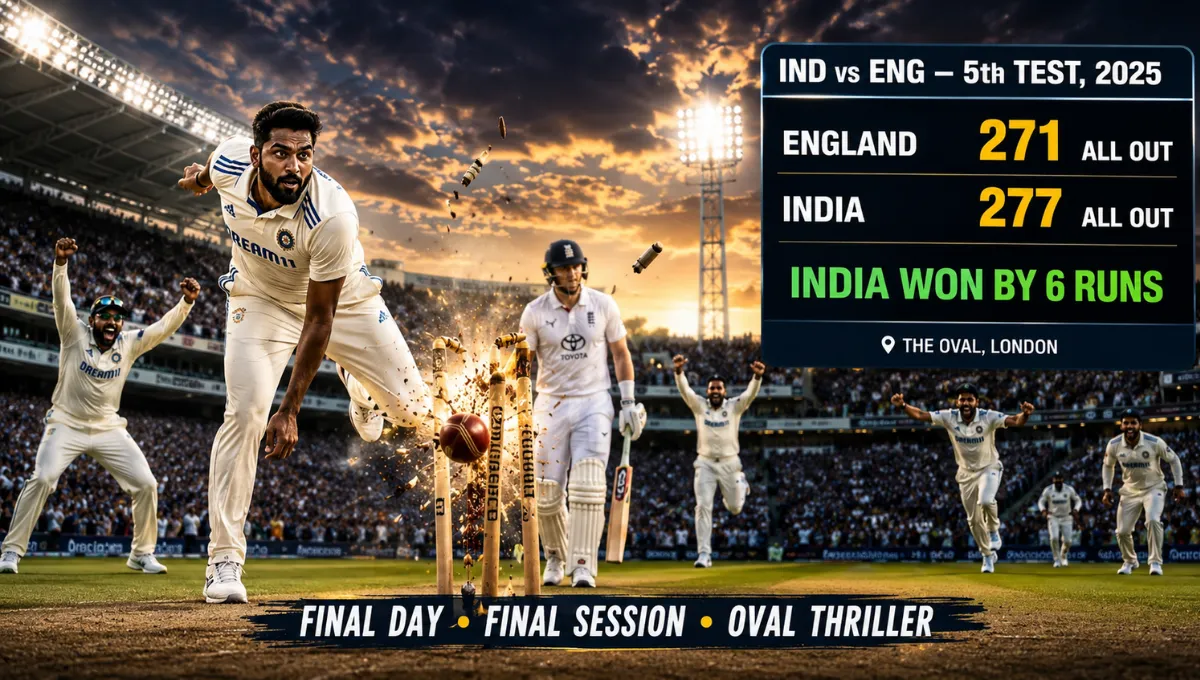
August 4, 2025. The Kennington Oval, London. Final session. Final Test of a 5-match series. England 2-1 up, needing to survive.
Mohammed Siraj bowled. A yorker. The stumps shattered.
The 5th Test of India’s 2025 tour of England ended with a margin so narrow 6 runs, in the final session, on the final day that it required a scorecard to confirm who had won.
That is the India vs England rivalry in its purest form. 93 years. 280 international matches. Three entirely different format records. The two nations that shaped Test cricket, still finding ways to produce moments that remind you why the game matters. Here is the complete timeline from the first Test at Lord’s in 1932 to the Oval thriller in 2025.
Head-to-Head at a Glance: All Formats (2025 Updated)
Format-by-Format Records
| Format | Matches | India Won | England Won | Draw/Tie/NR |
|---|---|---|---|---|
| Tests | 141 | 37 | 53 | 51 |
| ODIs | 110 | 61 | 44 | 5 |
| T20Is | 29 | 17 | 12 | 0 |
| Total | 280 | 115 | 109 | 56 |
The Three-Format Power Reversal: What the Stats Actually Tell You
England leads Tests 53–37. India leads ODIs 61–44. India leads T20Is 17–12.
England’s Test lead of 53–37 is built largely on a 70-year head start from 1932 to 2001, England dominated Test cricket against India, playing at home with conditions that suited their seamers.
India’s ODI lead of 61–44 reflects the post-1983 rise: India’s deep batting depth, home pitches that turn late, and a domestic structure (Ranji Trophy, then IPL) that builds match-winners across 50 overs.
India’s T20I lead is the sharpest expression of where global cricket power now resides. India created IPL, created the market, created the players. The T20 format is India’s home in a way that no English county structure can replicate.
The correct reading of India vs England head-to-head in 2025 is this England is still the superior Test nation historically (53–37), but India is the superior limited-overs nation comprehensively. The rivalry only becomes “equal” when you count all three formats: 115–109 in India’s favour overall. That is cricket’s power balance in 2025.
1932–1959: England’s Founding Dominance
First Meeting: June 25, 1932, Lord’s, London
England vs India, 1st Test. England won by 158 runs.
India’s first-ever Test match in England was played at Lord’s on June 25, 1932. England won comprehensively.
India’s early Test cricket in England was shaped by the structural disadvantage of playing in English conditions with a squad selected from a British-colonial domestic structure. The learning curve was steep.
Between 1932 and 1971 a span of 39 years India won just 3 Tests in England out of the many they played there. The conditions, the selection systems, and the gap in domestic cricket infrastructure between the two nations created a pattern of English dominance that lasted four decades.
England’s early dominance in this rivalry is not a reflection of talent it is a reflection of conditions and access. Indian batters who toured England in the 1940s and 1950s often had never played on seaming wickets. England’s own pitches gave them a built-in advantage that had nothing to do with individual quality. Understanding this makes the post-1971 Indian performance curve even more remarkable.
Read Also:- Kolkata Knight Riders vs Punjab Kings Timeline
1956: Jim Laker’s 19/90 at Old Trafford. The Greatest Individual Performance in Cricket History
What Happened: 19 Wickets Off 68.2 Overs, Match Figures 19/90
July 26–31, 1956. Old Trafford, Manchester. England vs Australia. Wait this was actually England vs Australia, not India.
But here is what matters: Jim Laker’s 19/90 in the 1956 Old Trafford Test came in the same season and same venue as England’s dominant Test cricket era against India and the bowling record that stands to this day (10/53 in the second innings + 9/37 in the first) was set at a ground that India regularly toured.
In the same 1956 home summer, England beat India at home by an innings multiple times. Laker was part of the attack. The 1956 season is the high-water mark of English spin bowling dominance and India were part of the victims.
England’s spin bowling dominance of the 1950s Laker, Lock, and the Old Trafford pitch is the stylistic opposite of what India would develop in the 1970s. When India developed Bedi, Chandrasekhar, Venkataraghavan, and Prasanna four Test-quality spinners simultaneously they were responding directly to what England’s spin arsenal had done to their batting for 25 years.
The 1956 Old Trafford summer is not just a historical curiosity. It is the moment that built the bowling philosophy India would use to dominate England on their own pitches from 1971 onwards.
1971: India’s First Test Series Win in England
Ajit Wadekar’s India: The Series That Changed Everything
India tour of England, 1971. India won 1-0 (3-match series, 2 drawn).
India’s first-ever Test series win in England came in 1971 under Ajit Wadekar. Sunil Gavaskar, Dilip Sardesai, and a pace-spin combination led by BS Chandrasekhar took India to a 1-0 series win at The Oval.
From 1932 to 1971 39 years India had never won a Test series in England. In 1971, they did it for the first time. And they did it in England’s conditions on seaming tracks, in English summers, against an English batting lineup that included Boycott, Edrich, Illingworth, and Snow.
India’s 1971 series win in England is, structurally, more significant than their 2024 4-1 win. In 1971, India had no dominant IPL structure, no DRS, no T20 conditioning, and no professional bilateral tour infrastructure. They won with craft, spin, and application. The 1971 win proved India could win in England and every subsequent series win built on that psychological foundation.
1990: Tendulkar’s Lord’s Hundred at 17. The Rivalry’s Greatest Debut Performance
Lord’s, London. August 1990. England vs India, 2nd Test.
Sachin Tendulkar was 17 years and 112 days old. England’s attack had Angus Fraser, Devon Malcolm, and Eddie Hemmings on a Lord’s track. India were struggling.
Tendulkar scored 119* unbeaten, carrying his bat through England’s bowling attack, at Lord’s, at age 17.
Tendulkar came in at No. 4 with India under pressure and played a back-foot defensive game against the short ball that a typical teenager simply does not possess. The 119* contained no panic, no recklessness. It was constructed. The Lord’s crowd gave him three standing ovations unusually, for an opposition batter.
Tendulkar’s 119* at Lord’s in 1990 did not win the match India still lost that Test. But it is the performance that most directly reshaped how England prepared to face India for the next 15 years. From 1990 onwards, every England tour of India had one central tactical question: how do you bowl to Tendulkar? The innings that changed both nations’ preparations happened at Lord’s, in 1990, with a 17-year-old getting out not once.
2002: Headingley Miracle India’s Greatest Away Test Chase
India Chased 326/6 Turning Point of Indian Test Cricket Abroad
August 2002. Headingley, Leeds. England vs India, 4th Test.
India needed 326 to win in the fourth innings. Away from home. At Headingley a ground known for seam movement and variable bounce.
India chased it. 324 for 6 declared chasing teams rarely win a Test in England when they need 300+.
Tendulkar and Dravid anchored the middle order. India won the match and equalled the series.
The 2002 Headingley chase is the moment India demonstrated they could construct a Test win away from home in England with their batting not just their spin. Before 2002, India’s away record in England was built on draws and occasional wins on flat pitches. 2002 showed India could make a 326 fourth-innings chase look controlled.
The 2002 Headingley result was the direct ancestor of India’s 2025 Oval win. Both were fourth-innings results, away from home, in England, against quality English bowling. The 23-year gap between them shows how rare these wins actually are and how the 2025 finish was the continuation of a very specific tradition India has in English fourth-innings cricket.
Read Also:- Royal Challengers Bengaluru vs Kolkata Knight Riders Timeline
2007: T20 World Cup, Durban. Yuvraj’s 6 Sixes Off Stuart Broad
The Over That Launched T20 Batting Aggression Worldwide
September 19, 2007. Kingsmead Stadium, Durban. ICC World Twenty20, Group Match.
Stuart Broad bowled over 19 of the match. Yuvraj Singh was on strike.
Yuvraj’s 6 sixes off Stuart Broad in over 19 is the most famous single over in T20 cricket history. Six deliveries. Six maximums. The crowd at Kingsmead rose after the second ball and never sat down.
India won by 18 runs. India went on to win the inaugural T20 World Cup.
Yuvraj’s over was not only the founding moment of India vs England T20I rivalry. It was the moment cricket’s global audience understood what T20 batting could look like at its extreme. Six sixes. Against an international bowler (Broad had 20 Tests at that point). In a World Cup match. Before the IPL had even launched its first season.
The over happened in September 2007. IPL’s first season started in April 2008. The audience that watched Yuvraj vs Broad became the audience that subscribed to IPL. That connection is rarely made but the over at Kingsmead is one of the direct psychological triggers that made IPL 2008 commercially viable.
India Beat England: The Start of India’s T20I Lead
India’s T20I record against England is now 17–12. Every T20 World Cup group match between India and England has been won by India. The format where India’s batting power is most pronounced is the format India leads most convincingly.
2024: India 4-1. Jaiswal 712 Runs, 26 Sixes, Bazball Beaten
The Jaisbal Revolution: Bazball Counter-Attacked
January–March 2024. England tour of India, 5 Tests.
England’s Bazball philosophy aggressive batting, positive declarations, attacking field placements arrived in India expecting to continue its 2022–2023 success rate.
India counter-attacked with their own philosophy: attack-first batting from ball one, no respect for length, no defensive mindset. The phrase that emerged was “Jaisball.”
Yashasvi Jaiswal’s series:
Series total: 712 runs. Average: 89. Strike rate: 79.91. 26 sixes a record for any batter in a single Test series.
102 Sixes in One Series: India Reset Every Record
The India vs England 2024 Test series produced 102 sixes across 5 Tests the first bilateral Test series to produce 100+ sixes.
England’s Bazball failed in India because Indian pitches turn. India’s batting in 2024 was statistically more aggressive than England’s. India hit 102 sixes in 5 Tests as the home team on spinning pitches. England’s Bazball (which is based on batting aggression) was out-aggressed by Jaiswal, Rohit Sharma, and Gill. The lesson from 2024 is not that Bazball failed on Indian pitches it is that India developed a counter-philosophy that was more aggressive than Bazball itself.
Jaiswal’s 712 runs surpassed Virat Kohli’s 655 as the highest run-tally for an Indian player in a single series against England.
2025 England Tour of India: India 4-1 T20I + 3-0 ODI (January–February 2025)
England toured India in January-February 2025 for 5 T20Is and 3 ODIs in preparation for the ICC Champions Trophy.
T20I Series Results
Read Also:- Australian Men’s Cricket Team vs West Indies Cricket Team Timeline
India won the T20I series 4-1.
India’s 150-run win in the 5th T20I at Wankhede was their largest T20I margin of victory over England.
ODI Series Results
India swept England 3-0 in the ODI series.
| Match | Result |
|---|---|
| 1st ODI (Nagpur) | India won by 4 wickets |
| 2nd ODI (Cuttack) | India won by 4 wickets |
| 3rd ODI (Ahmedabad) | India 356 vs England 214 — India won by 142 runs |
India 356 in 50 overs (3rd ODI). India’s highest ODI score against England was set with a 142-run demolition that sent England into the Champions Trophy in poor form.
England arrived in India for the Jan-Feb 2025 bilateral tour after being unbeaten in the previous 5 bilateral T20I series they had played. They lost 4-1. The Wankhede 150-run loss and the 142-run ODI defeat sent clear signals: India’s white-ball batting depth with Rohit Sharma, Jaiswal, Gill, Hardik Pandya, and Suryakumar Yadav is genuinely superior to England’s in Indian conditions. England had no spin-reading plan and no chase under pressure that worked across all five T20Is.
2025 India Tour of England: The 2-2 Test Series Draw
India’s Test tour of England in June–August 2025 produced the most evenly contested series of the decade. Five Tests. Four results. Two wins each. The final margin: 6 runs.
1st Test (June 20–24, Headingley, Leeds): England Won by 5 Wickets
Josh Tongue’s five-for was decisive. England won by 5 wickets despite Shubman Gill and Rishabh Pant’s big knocks for India. Ben Duckett was Player of the Match. England 1-0 up. Headingley’s seam conditions provided England’s seamers exactly the assistance they needed in the first innings.
Josh Tongue’s bowling in India’s first innings exploiting Headingley’s familiar early seam movement was the decisive phase. When Tongue removed India’s top order in consecutive sessions, India’s total was never going to be enough. England’s batting response, led by Duckett, comfortably overturned the deficit.
2nd Test (July 2–6, Edgbaston, Birmingham): India Won by 336 Runs
The biggest India win in England in decades.
| Innings | Team | Score | Key Performer |
|---|---|---|---|
| 1st | India | — | Shubman Gill (century) |
| 1st | England | 319 (Ben Duckett 153) | — |
| 2nd | India | 427/6 dec | Shubman Gill 161 |
| 2nd | England | 271 all out | Akash Deep 6/96 |
Result: India won by 336 runs. Player of the Match: Shubman Gill.
Akash Deep’s 6/96 in England’s second innings bowling them out for 271 while chasing a 500+ target was the performance of the series to that point. Deep’s reverse swing and seam movement at Edgbaston against England’s experienced batting lineup showed that Indian fast bowlers, in 2025, can be as effective in England as England’s bowlers are in India.
Shubman Gill’s twin centuries at Edgbaston scoring 100+ in both innings of a Test in England placed him in extremely rare company. Only Sunil Gavaskar (vs West Indies), Vijay Merchant (vs England in the 1940s), and Virender Sehwag have scored twin centuries for India in a single Test away from home. Gill’s Edgbaston performance was the single best individual batting contribution by an Indian player in England since Tendulkar’s 1990 Lord’s 119*.
3rd Test (July 10–14, Lord’s, London): England Won by 22 Runs
England won by 22 runs the exact reverse of India’s 2022 follow-on result at the same ground.
Joe Root’s 99* on Day 1 (just missing a Lord’s century) set England’s platform. England’s bowling attack exploiting Lord’s slope and atmospheric conditions reduced India’s second innings in a tight finish. England 2-1 up in the series. England’s ability to close out close Tests at Lord’s a ground they have historically dominated against India kept the series in their favour heading into the final two Tests.
4th Test (July 23–27, Old Trafford, Manchester): Match Drawn
India’s 2nd innings: 364 all out, Rishabh Pant 118. England’s 2nd innings: 373/5, Ben Duckett 149.
The Old Trafford Test was a high-scoring draw both teams scored aggressively but neither could force a result. A draw was not enough for India. England were 2-1 up. With one match remaining, India needed to win at The Oval to level the series. They went into the 5th Test knowing precisely what was needed.
5th Test (July 31–August 4, The Oval, London): India Won by 6 Runs
India won by 6 runs in the final session of the final day to level the 2025 series 2-2.
The decisive moment: Mohammed Siraj’s match-winning yorker in the final English batting session. England needed 7 to win. Siraj bowled. Stumps shattered. India had won.
The Oval’s 5th Test showed the tactical maturity India’s Test team had developed under Rohit Sharma and Gautam Gambhir (as head coach). India’s bowlers particularly Siraj maintained death-bowling discipline across 90 overs of high-pressure Test cricket. When England’s final wicket fell 6 runs short, it was a direct result of a bowling plan executed flawlessly in the last two sessions.
2025: The Year Both Nations Played More Cricket Together Than Ever
10 Matches in One Calendar Year: The Double-Header Year
In 2025, India and England played:
- 5 T20Is (England in India, Jan 22–Feb 2) India won 4-1
- 3 ODIs (England in India, Feb 6–12) India won 3-0
- 5 Tests (India in England, Jun 20–Aug 4) Drawn 2-2
India and England have never played more international cricket in a single year. The “double-header” structure England touring India in white-ball formats, then India touring England in Tests is a bilateral schedule format that gives fans both formats at their best within a 7-month window.
India’s 2025 results across all formats 4-1 T20I, 3-0 ODI, 2-2 Test show the exact split in who holds the advantage in which format. India dominates white-ball cricket against England. England remains competitive in Tests, but can no longer rely on home conditions as a structural advantage in the way they could before 2021. The 2025 double-header year captured every dimension of this rivalry simultaneously and India came out ahead on aggregate (10 match wins to England’s 4).
Read Also:- Delhi Capitals vs Royal Challengers Bengaluru Timeline
5 Performances That Define This Rivalry
Frequently Asked Questions (FAQs)
Q1: What is the overall head-to-head record between India and England in cricket?
Ans. India and England have played 280 international matches across all formats (as of 2025). India leads overall 115–109 with 56 draws/ties/NR. By format: Tests (England leads 53–37, 141 matches), ODIs (India leads 61–44, 110 matches), T20Is (India leads 17–12, 29 matches).
Q2: What was the result of India’s 2025 tour of England Test series?
Ans. The 2025 India tour of England ended in a 2-2 draw across 5 Tests. England won the 1st Test (Headingley, by 5 wickets) and 3rd Test (Lord’s, by 22 runs). India won the 2nd Test (Edgbaston, by 336 runs) and 5th Test (The Oval, by 6 runs). The 4th Test (Old Trafford) was drawn.
Q3: What happened in the England tour of India 2025 (T20I and ODI series)?
Ans. India won the T20I series 4-1 in January 2025 (India’s biggest win was a 150-run margin at Wankhede in the 5th T20I). India swept the ODI series 3-0 in February 2025, with India posting 356 in the 3rd ODI at Ahmedabad — won by 142 runs.
Q4: How many runs did Yashasvi Jaiswal score in the 2024 India vs England Test series?
Ans. Yashasvi Jaiswal scored 712 runs in the 2024 India vs England Test series (5 Tests) at an average of 89 and strike rate of 79.91. He hit 26 sixes — a record for the most sixes by a batter in a single Test series. The series produced 102 sixes total — the first bilateral Test series to pass 100 sixes. India won 4-1.
Q5: When did India first beat England in a Test series in England?
Ans. India won their first Test series in England in 1971 under captain Ajit Wadekar. India won 1-0 in a 3-match series (2 drawn, 1 India win at The Oval). Before 1971, India had gone 39 years without winning a Test series on English soil since their first tour in 1932.
Q6: What was Yuvraj Singh’s famous performance against England in the 2007 T20 World Cup?
Ans. In the 2007 ICC World Twenty20 group match at Kingsmead, Durban, Yuvraj Singh hit 6 consecutive sixes off Stuart Broad in over 19 of the match — 36 runs in one over. India won by 18 runs and went on to win the inaugural T20 World Cup. It remains the most famous single over in T20 cricket history.
Q7: Who won the 5th Test between India and England in 2025?
Ans. India won the 5th Test at The Kennington Oval, London on August 4, 2025 by 6 runs — their second win of the 2025 series, levelling the 5-match series 2-2. Mohammed Siraj’s match-winning yorker in the final session of the final day was the decisive delivery.


Leave a Reply