
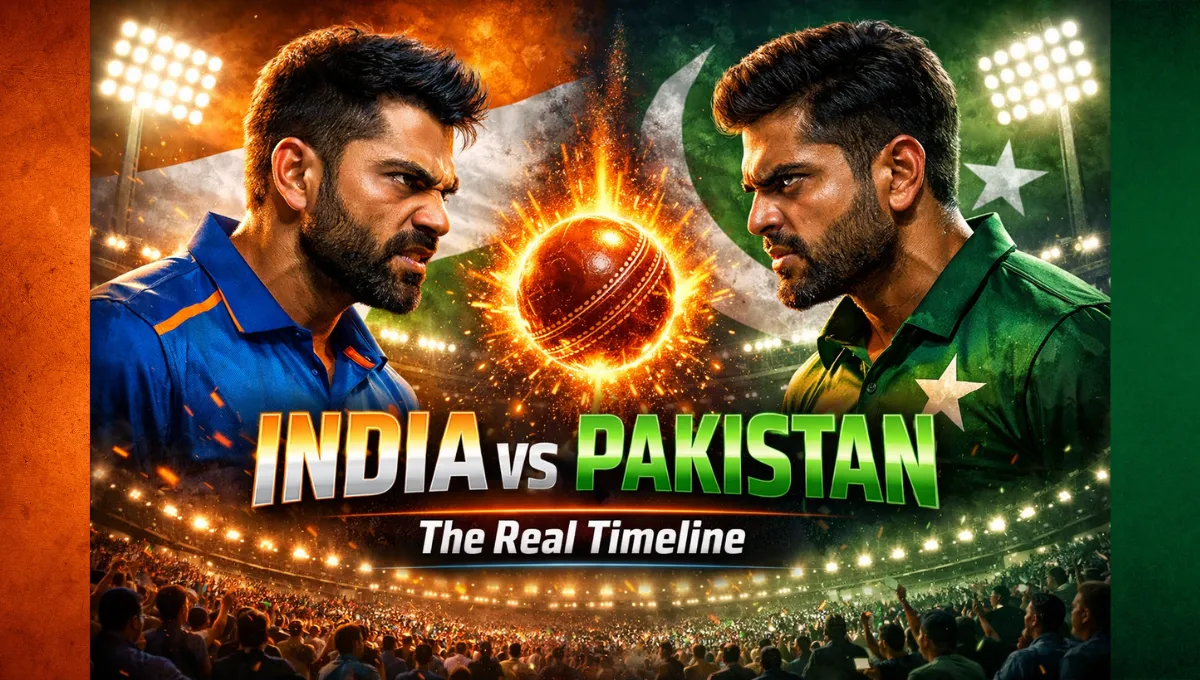
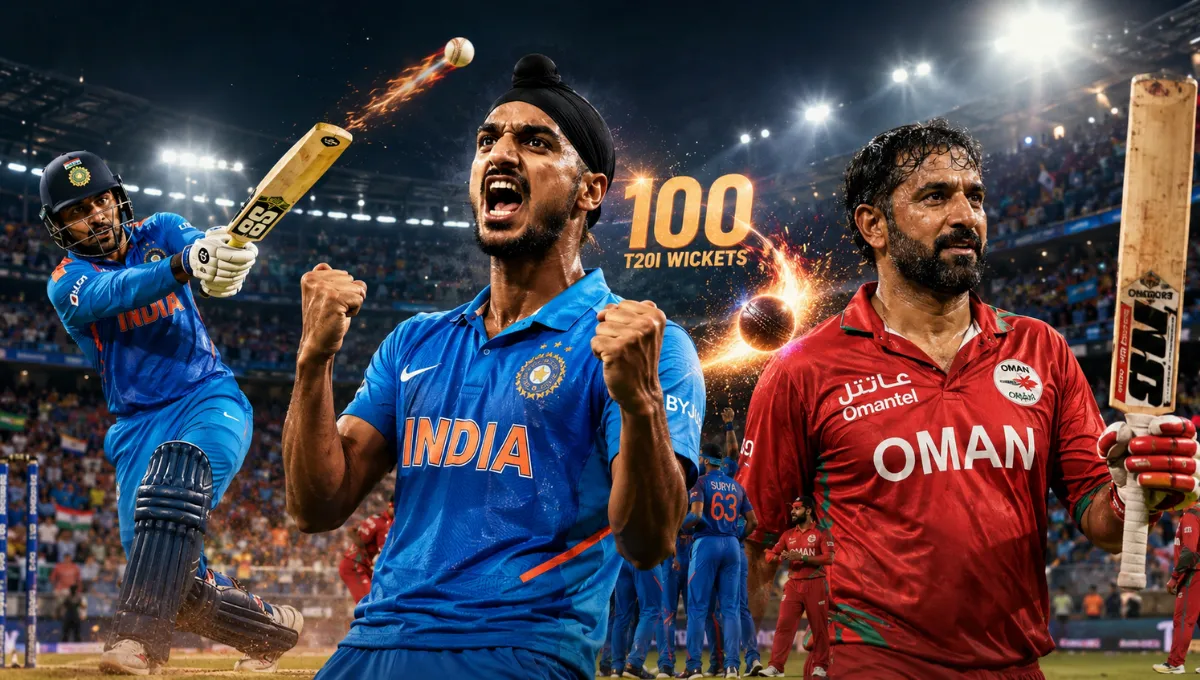
February 15, 2026. R. Premadasa Stadium, Colombo. India captain Suryakumar Yadav walks out for the toss. Pakistan’s Salman Ali Agha is across from him.
No handshake. India wins by 61 runs still no handshake after the match.
This is where 74 years of cricket between these two nations has arrived. But here’s the real problem with how this rivalry usually gets explained: most articles either dump raw statistics on you, or they tell the political story without ever connecting it to what actually happened on the field, match by match, decade by decade. This timeline does both in order, with the moments that actually explain how we got here.
India vs Pakistan: the rivalry at a glance
| Format | Matches | India wins | Pakistan wins | Draws/No result |
|---|---|---|---|---|
| Test | 59 | 9 | 12 | 38 |
| ODI | 136 | 58 | 73 | 5 |
| T20I | 17 | 14 | 3 | 0 |
| Total | 212 | 81 | 88 | 43 |
India leads ICC World Cup meetings 8-0 and T20 World Cup meetings 8-1, while Pakistan holds the edge in bilateral-heavy formats like Tests and ODIs. That contradiction is the key to understanding this entire rivalry, and we’ll unpack exactly why later.
1952-1999: from first Test to first suspension
India and Pakistan first met in Test cricket in October 1952, with India winning by an innings and 70 runs. What followed wasn’t smooth cricket diplomacy, It was decades interrupted by actual war.
The wars that stopped cricket
Unique insight: No cricket was played between the two nations from 1962 to 1977 a 15-year gap caused directly by the 1965 and 1971 Indo-Pakistani wars. This wasn’t a scheduling gap; it was a complete freeze caused by active military conflict, and it set the template for every future suspension this rivalry would experience.
What people think vs reality:
- What people think: Cricket suspensions between India and Pakistan are a modern, post-2008 phenomenon.
- Reality: The pattern of war and conflict directly halting cricket ties started as early as the 1960s and has repeated at least four distinct times since 1962-77, after the 1999 Kargil War, after 2008, and again in the tension surrounding 2025-26.
The neutral-venue era in Sharjah and Canada
Through the 1980s and 1990s, large expatriate populations of both nations led boards to schedule series at neutral venues Sharjah in the UAE and even Toronto, Canada, where series were officially branded the “Friendship Cup.”
Original observation: The fact that two nations needed a third country’s stadium, thousands of miles from either home, just to host a “Friendship Cup” tells you the diplomatic temperature was already too hot for home-and-away cricket, decades before the 2008 attacks made that the permanent norm.
What this era teaches modern fans
Understand that neutral-venue cricket between India and Pakistan isn’t a recent workaround it’s the rivalry’s most common historical format, used for over two decades before ICC tournaments became the primary meeting ground.
Read Also:- Mumbai Indians Vs Punjab Kings Timeline
2000-2008: the peak years before everything changed
This is the only extended stretch of genuinely normal bilateral cricket this rivalry has ever had.
Sehwag’s 309 and India’s historic 2004 tour
Following Prime Minister Atal Bihari Vajpayee’s peace initiative, India toured Pakistan in 2004, Their first tour there in almost 15 years. Virender Sehwag scored 309 in the first Test, India’s first-ever Test triple century against Pakistan, and India won the series 2-1.
Real-world example: Between 2003 and 2007, India and Pakistan played five full bilateral tours in five years more normalized cricket contact than in the previous three decades combined. This period proves the rivalry can function as pure sport when political conditions allow it.
The 2008 Mumbai attacks end bilateral cricket
Counterintuitive idea: Most fans assume the 2008 Mumbai terror attacks immediately ended all India-Pakistan cricket. The reality is more specific: they ended bilateral tours only. India suspended its planned 2009 tour of Pakistan and has refused all bilateral engagement since but the two teams have continued meeting regularly at ICC and Asia Cup events, right up through 2026. The rivalry didn’t die in 2008. It just changed venues permanently, from home soil to neutral, ICC-controlled tournaments.
What fans need to understand now
Stop expecting a bilateral series announcement the last full tour was 2007, and every structural signal since (BCCI statements on government approval, PCB’s own tournament boycotting threats) shows this is now a permanent arrangement, not a temporary pause.
2009-2023: ICC-only cricket and India’s rise
The format paradox: why Pakistan leads Tests and ODIs but India dominates T20Is
What most people miss: Pakistan holds a commanding 12-9 lead in Tests and 73-58 in ODIs formats built on decades of bilateral cricket played mostly in the 1980s and 1990s, when Pakistan’s bowling attacks (Imran Khan, Wasim Akram, Waqar Younis) were genuinely dominant. India’s 14-3 T20I lead and 8-0 World Cup record, by contrast, comes almost entirely from the ICC-tournament era post-2007 a period defined by India’s batting depth and bench strength in white-ball cricket.
Slightly bold opinion: This isn’t a coincidence it’s a structural story. Pakistan’s format dominance is a legacy asset from an era of bilateral cricket that no longer exists. India’s format dominance reflects the current era of ICC-only meetings. As long as bilateral cricket stays frozen, expect this format paradox to keep widening in India’s favor, because every new match added to the head-to-head record now comes from the format where India already leads.
2023 Asia Cup: India’s record 228-run demolition
In the 2023 Asia Cup Super Four clash, India scored 356/2, Their highest-ever ODI total against Pakistan and bowled Pakistan out for 128, winning by 228 runs, the largest run-margin victory in the history of this fixture.
Common mistake in analysis: Fans often treat this as just “another big India win.” It’s specifically the largest ODI victory margin ever recorded between these two teams, breaking a record that had stood since 2004-05. Records like this matter because they show the scale of India’s white-ball dominance has actually grown, not just continued, in the post-bilateral era.
What analysts should track from this era
Track ICC tournament seeding and scheduling specifically since bilateral cricket is frozen, Asia Cup and World Cup group draws are now the only mechanism determining how often (or rarely) these teams meet each year.
2025-2026: the coldest chapter yet
The Pahalgam attack and the Asia Cup that changed everything
The 2025 Asia Cup unfolded under extreme tension following the Pahalgam terror attack by a Pakistan-based group and the subsequent military conflict. India’s government eventually allowed the tournament to proceed, but captain Suryakumar Yadav’s team refused to shake hands with Pakistan after their group-stage win, dedicating the victory to Pahalgam’s victims and the Indian Army.
Unique insight: The controversy escalated further in the Super Four stage: Pakistani players Haris Rauf and Sahibzada Farhan made gestures widely interpreted as references to Pakistan’s claimed shootdown of Indian aircraft during Operation Sindoor, resulting in fines for both Yadav and Rauf. Then, after India won the tournament final, the Indian team refused to accept the trophy from ACC president Mohsin Naqvi who also serves as Pakistan’s Interior Minister creating a diplomatic standoff that delayed the entire award ceremony.
Original observation: This wasn’t a spontaneous protest, it was a structured, escalating sequence: refused handshake, then symbolic gestures and fines, then a refused trophy. Each stage this tournament shows both nations’ cricket boards using match ceremonies as a deliberate extension of geopolitical signaling, not just sport. That’s a genuinely new phase for this rivalry, distinct even from the post-2008 freeze.
2026 T20 World Cup a boycott threat and a silent toss
Ahead of their 2026 T20 World Cup group match, Pakistan’s government reportedly asked their team not to play India at all, reportedly linked to the ICC’s refusal to relocate Bangladesh’s matches away from India after Mustafizur Rahman’s IPL 2026 removal. The ICC warned of sanctions for any boycott, and Pakistan played. There was no handshake at the toss, and none after India’s 61-run win.
Slightly bold opinion: This should be read as a genuine turning point, not a repeat of 2025’s tension. A government reportedly instructing its own team to consider skipping a scheduled ICC match not a bilateral series, but a tournament fixture signals that even neutral ICC cricket, once the reliable fallback venue for this rivalry, is no longer guaranteed to stay insulated from politics.
What fans should actually expect going forward
Stop expecting ceremonial normalcy at India-Pakistan matches handshakes, trophy presentations, and joint appearances have become unreliable at best since 2025, and fans should treat every future meeting as carrying real diplomatic risk, not just sporting stakes.
Read Also:- Mumbai Indians Vs Delhi Capitals Timeline
The stat that confuses everyone 57 or 58 ODI wins?
Common mistake in analysis: Search results show India with either 57 or 58 ODI wins over Pakistan, depending on the source. This isn’t an error it reflects a genuine classification discrepancy in how certain matches (particularly older no-results and the 1984-85 abandoned series, halted after the assassination of Indira Gandhi) get counted across different record-keeping platforms.
Wikipedia’s most recently updated table, current as of February 2025, lists the total at 58 wins for India against 73 for Pakistan across 136 matches, with 5 no-results.
What readers should do with conflicting stats
Always check the “as of” date on any head-to-head statistic before citing it this rivalry’s numbers update after nearly every ICC tournament meeting, and a source even six months old may already be one match behind.
Frequently Asked Questions (FAQs)
Q1. When did India and Pakistan first play cricket against each other?
Ans. India and Pakistan first played a Test match in October 1952, which India won by an innings and 70 runs. Their first ODI meeting came in October 1978, and their first T20I was in September 2007.
Q2. Why haven’t India and Pakistan played a bilateral cricket series since 2007?
Ans. The 2008 Mumbai terror attacks, carried out by a Pakistan-based terrorist group, led India to suspend its planned 2009 tour and all future bilateral engagements with Pakistan. Since then, the two teams have met only at ICC and Asia Cup tournaments.
Q3. Who leads the overall India vs Pakistan cricket head-to-head record?
Ans. Pakistan leads the overall head-to-head across all formats 88 wins to India’s 81 in 212 total matches. However, India leads in T20Is (14-3) and has an 8-0 record against Pakistan in ICC Cricket World Cups.
Q4. What happened between India and Pakistan at the 2025 Asia Cup?
Ans. Tensions ran high following the Pahalgam terror attack. India’s team refused to shake hands after group-stage and final wins, Pakistani players made controversial gestures resulting in fines, and India refused to accept the trophy from ACC president Mohsin Naqvi, who also holds a senior Pakistani government position.
Q5. What happened during the India vs Pakistan match at the 2026 T20 World Cup?
Ans. Pakistan’s government reportedly asked their team not to play the scheduled group match against India, but the team played after ICC sanctions warnings. There was no handshake at the toss or after the match, which India won by 61 runs at R. Premadasa Stadium, Colombo, on February 15, 2026.


Leave a Reply