


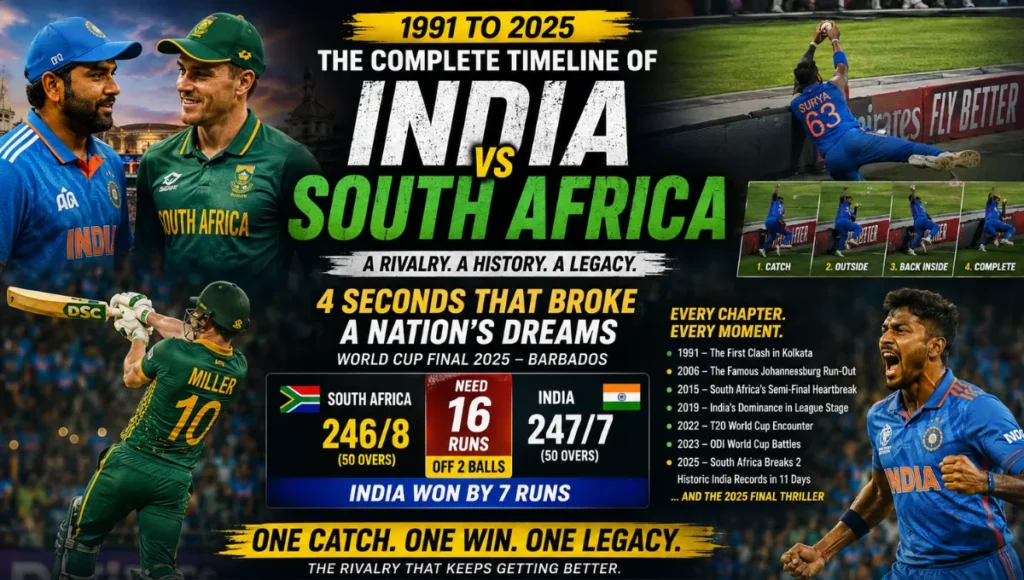
Twelve straight wins. A defending title. A home crowd expecting a coronation. And then, in the space of three and a half hours in Ahmedabad, South Africa tore it all apart, piece by piece, over by over. The South Africa national cricket team vs India national cricket team timeline from this ICC Men’s T20 World Cup 2026 Super 8 clash reads less like a cricket scorecard and more like a horror script for the co-hosts.
This wasn’t just a loss. It was India’s first defeat at the tournament since 2022, snapping a 12-match unbeaten streak and fittingly, it came against the very team India had beaten in the 2024 final. What makes this South Africa vs India match analysis worth revisiting isn’t just the 76-run margin. It’s how completely the momentum flipped, not once, but twice, inside a single innings.
Match Overview: Pitch, Toss, and Early Signals
The match was played at Narendra Modi Stadium, Ahmedabad, on February 22, 2026, as the opening Super 8 fixture for both unbeaten sides. Aiden Markram won the toss and chose to bat first a call that looked shaky within minutes but would pay off spectacularly by the innings break.
The black-soil surface offered genuine seam movement early, then gripped and slowed as the game wore on, holding the ball just enough to punish anyone hitting through the line. That subtle shift, barely visible at the toss, ended up defining the entire match.
Read Also:- England Cricket Team vs Australian Men’s Cricket Team Timeline
Powerplay Analysis (Overs 1-6): India’s False Dawn
India’s bowlers didn’t just start well they started like a team hunting a knockout blow.
- Jasprit Bumrah struck in his very first over, dismissing Quinton de Kock with a sharp nip-backer, continuing a personal stranglehold that had seen de Kock manage just 29 runs across eight previous innings against him.
- He followed it up by deceiving Aiden Markram and then Ryan Rickelton with a beautifully disguised slower ball, finishing a stunning burst of 2/7 in two overs.
- South Africa crashed to 20/3 inside the powerplay the kind of scoreboard pressure that has buried far stronger batting units than this one.
- For six overs, Ahmedabad roared. It felt, genuinely, like a rout was forming the kind of powerplay collapse that ends World Cup campaigns before lunch.
Nobody in that stadium expected what came next.
Middle Overs Breakdown (Overs 7-15): Momentum Shifted, Completely
This is where the match and arguably South Africa’s entire tournament turned on its head, and where India’s tactical plan quietly fell apart.
- David Miller and Dewald Brevis walked out into the wreckage and did something counter-intuitive: they slowed the game down even further, refusing to chase the required rate against a rampant attack.
- The pair built a stand of 97 runs off just 51 balls one of the most significant recovery partnerships in recent T20 World Cup history.
- The real damage came against India’s spin. South Africa specifically targeted Varun Chakravarthy and Washington Sundar, plundering 50 runs off just five overs between the two spinners.
- Here’s why India couldn’t break the stand: their captain kept returning to Chakravarthy for control, but Miller and Brevis had clearly pre-planned the assault using the depth of the crease and clearing leg side boundaries against his googly, which meant every “defensive” spin over actually leaked runs and offered false hope rather than real containment.
- Brevis brought raw aggression, striking three fours and three sixes in his 45, while Miller played the anchor-turned-executioner, eventually reaching fifty off just 26 balls with a six off a free hit.
Momentum Shift Explanation: What made this stand so decisive wasn’t just the runs it was the psychological reset it forced. India had spent six overs playing with total control, and suddenly found themselves defending against batters who weren’t rushing, weren’t panicking, and were picking apart specific bowlers rather than boundaries at random. Once a set batting pair neutralizes the fear factor a strong powerplay creates, the chasing team’s entire plan built on early wickets, not sustained pressure collapses with it. That’s exactly what happened here.
Looking back, a sharper move might have been introducing Bumrah earlier for a second spell to break the partnership’s rhythm, rather than saving him purely for the death overs since Miller and Brevis were scoring far more freely against pace-off options than genuine pace at this stage. Shivam Dube eventually got the breakthrough, having Brevis miscue to deep midwicket, but by then the total had already swelled beyond a defendable par score.
Death Overs Drama (Overs 16-20): Stubbs Seals It
- Miller fell for 63 off 35 balls seven fours, three sixes caught off Chakravarthy, who despite conceding at 11.75 an over still struck at the most critical moment.
- Tristan Stubbs walked in and played with total freedom, smashing an unbeaten 44 off just 24 balls to launch South Africa well past the 180-mark.
- South Africa finished at 187/7 a total that, given how the pitch was gripping by this stage, carried far more menace than the number on the board suggested.
- Bumrah returned to finish with 3/15, a genuinely world-class display that also made him India’s all-time leading wicket-taker in T20 World Cup history small consolation on a night that belonged to South Africa.
The Turning Point of the Match
Every serious South Africa vs India full match report arrives at the same conclusion: the turning point wasn’t a six or a dropped catch it was the sheer duration of the Miller-Brevis partnership, and India’s inability to adjust their bowling plans against it in real time.
Suryakumar Yadav later admitted the game was effectively decided by South Africa’s ability to build partnerships when India could not replicate the same in the chase a rare, honest concession from a losing captain that speaks volumes about how the tactical battle unfolded.
Key Performances (Detailed)
David Miller (SA) Player of the Match
His 63 off 35 wasn’t just a rescue act; it was a statement of calculated experience. Miller absorbed pressure at 20/3, then methodically picked apart India’s spin options over 15 overs before Chakravarthy finally ended the innings-defining stand.
Marco Jansen (SA)
His figures of 4/22 in 3.5 overs turned India’s chase from difficult into impossible. Using his 6’8″ height to extract awkward, inconsistent bounce with heavy-length deliveries, Jansen troubled India’s middle order specifically, removing set batters just as partnerships threatened to form.
Lungi Ngidi (SA)
Often overlooked in the headlines, Ngidi’s figures of 4-0-15-0 were the “slow poison” of the innings. Reading the gripping pitch early, he abandoned pace entirely, bowling off-cutters and slower-ball bouncers for roughly 54% of his deliveries a tactical masterstroke that strangled India’s scoring rate without ever looking spectacular.
Jasprit Bumrah (IND)
Despite the eventual defeat, Bumrah’s 3/15 was genuinely world-class, and the performance pushed him past previous marks to become India’s all-time highest wicket-taker in T20 World Cup history during this very match.
Tactical Analysis: Captaincy, Bowling, and Match-ups
Aiden Markram’s decision to bat first, unconventional given India’s bowling reputation, ultimately allowed South Africa to control tempo once they weathered the powerplay storm but the sharper captaincy call came later, in the field. Faf du Plessis and the South African think tank had done specific homework on Abhishek Sharma, setting a point and extra cover to push him into unfamiliar scoring zones rather than bowling to his obvious strengths, a plan du Plessis later confirmed was deliberately “out of the box”.
On India’s side, the tactical cracks were structural rather than individual. Leaving Axar Patel out of the playing eleven drew scrutiny after the game, particularly once Keshav Maharaj dominated the middle overs of the chase on a surface that was gripping more with every passing over. More damaging still was India’s death-overs bowling allocation handing crucial overs to part-time pace options like Hardik Pandya and Shivam Dube instead of finding a way to squeeze one more over out of Bumrah or Arshdeep Singh, a decision that drew pointed criticism for lacking clarity in a title-defense scenario.
The bigger match-up story, though, was South Africa’s collective read of India’s spinners. Chakravarthy’s mystery variations, so effective throughout the tournament, were neutralized by batters willing to use depth of crease and target specific boundary zones rather than react ball by ball proof that even India’s most potent weapon can be planned around with enough preparation.
What Went Right and What Went Wrong
What went right for South Africa:
- Trusting Miller and Brevis to rebuild patiently rather than panicking after 20/3.
- Pre-planned tactical assaults on India’s spin duo, rather than trying to simply survive them.
- Marco Jansen and Lungi Ngidi’s disciplined, pace-off lengths in the middle overs of India’s chase.
- Tristan Stubbs providing late-innings acceleration exactly when needed.
What went wrong for India:
- Ishan Kishan’s dismissal for a four-ball duck set an immediately negative tone for the chase.
- The middle order Tilak Varma, Washington Sundar, and Suryakumar Yadav himself all fell without building any real partnership.
- Persisting with Chakravarthy through the Miller-Brevis stand instead of introducing Bumrah for an earlier second spell.
- Leaving out Axar Patel proved costly against a spin-friendly, increasingly gripping surface.
Final Moments: How It Ended
By the time Bumrah was caught attempting one final blow, India were bowled out for 111 in 18.5 overs seven balls unused, and any semblance of hope long gone. What had started as a promising powerplay full of Indian bowling brilliance ended as their heaviest defeat in T20 World Cup history, stunning a packed Ahmedabad crowd that had arrived expecting a home celebration.
South Africa’s players embraced in the middle, not with wild celebration, but with the quiet satisfaction of a team that had answered every question asked of them from an early batting collapse to a spin-heavy chase target.
Read Also:- Australian Men’s Cricket Team vs South Africa National Cricket Team Timeline
Conclusion
This South Africa vs India match analysis ultimately tells a story of two contrasting responses to identical pressure. South Africa faced early adversity and engineered their way out of it through patience, partnership, and pre-planned tactics; India faced the same kind of pressure later and had no adjusted plan to fall back on. For a defending champion with a 12-match streak on the line, that gap in tactical clarity proved to be worth exactly 76 runs and a serious reality check heading into the rest of the Super 8 stage.
Frequently Asked Questions (FAQs)
Q1. What was the final result of the South Africa vs India T20 World Cup 2026 match?
Ans. South Africa won by 76 runs, restricting India to 111 all out after posting 187/7 in their innings.
Q2. Who was named Player of the Match in the South Africa vs India Super 8 clash?
Ans. David Miller was named Player of the Match for his innings of 63 off 35 balls, which anchored South Africa’s recovery from 20/3.
Q3. Why couldn’t India break the Miller-Brevis partnership during the middle overs?
Ans. India persisted with Varun Chakravarthy and Washington Sundar even after South Africa had clearly pre-planned their approach against both spinners, allowing 50 runs to be scored off just five overs before the stand was finally broken.
Q4. What bowling changes might have worked better for India against South Africa?
Ans. Introducing Jasprit Bumrah for an earlier second spell to disrupt the Miller-Brevis rhythm, rather than saving him solely for the death overs, was widely seen as a missed tactical opportunity.
Q5. How did this defeat affect India’s T20 World Cup 2026 campaign?
Ans. The loss ended India’s 12-match unbeaten streak at the tournament and left them needing wins in their remaining Super 8 fixtures to stay in semifinal contention.
What was the final result of the South Africa vs India T20 World Cup 2026 match?
South Africa won by 76 runs, restricting India to 111 all out after posting 187/7 in their innings.
Who was named Player of the Match in the South Africa vs India Super 8 clash?
David Miller was named Player of the Match for his innings of 63 off 35 balls, which anchored South Africa’s recovery from 20/3.
Why couldn’t India break the Miller-Brevis partnership during the middle overs?
India persisted with Varun Chakravarthy and Washington Sundar even after South Africa had clearly pre-planned their approach against both spinners, allowing 50 runs to be scored off just five overs before the stand was finally broken.
What bowling changes might have worked better for India against South Africa?
Introducing Jasprit Bumrah for an earlier second spell to disrupt the Miller-Brevis rhythm, rather than saving him solely for the death overs, was widely seen as a missed tactical opportunity.
How did this defeat affect India’s T20 World Cup 2026 campaign?
The loss ended India’s 12-match unbeaten streak at the tournament and left them needing wins in their remaining Super 8 fixtures to stay in semifinal contention.