
Vaibhav Sooryavanshi was fourteen years old. He reached fifty off 17 balls, then a century off 32. By the time he was finally caught, he had scored 144 off just 42 deliveries, with 15 sixes. That single innings is the entire reason this match is still worth reading about, and following it as a timeline moment by moment tells the story better than any final scoreline can.
Which India vs UAE Match Are You Looking For?
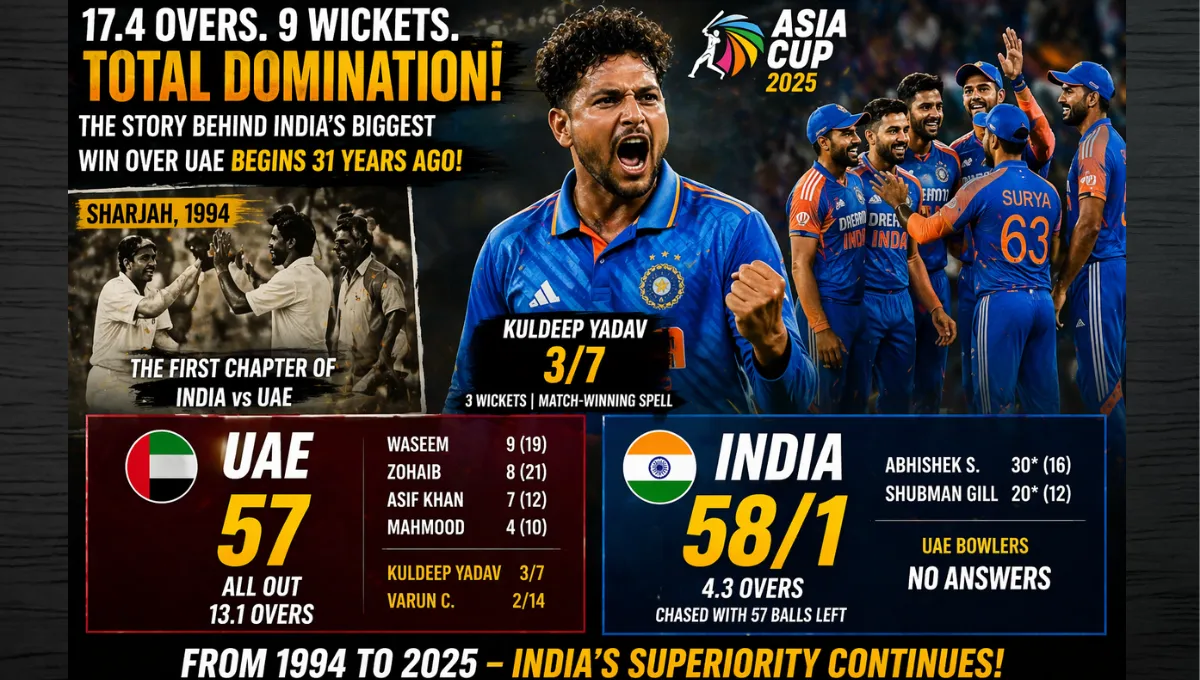
Around this same period, two entirely different Indian cricket teams played UAE: the senior India national team beat UAE by 9 wickets at the Asia Cup 2025 in Dubai, bowling them out for a record-low 57. Separately, and completely unrelated to that senior fixture, India A beat UAE by 148 runs at the Asia Cup Rising Stars tournament in Doha, Qatar, a development-level competition for emerging players.
If you searched specifically for “UAE Cricket Team vs India A Cricket Team,” you want this second match the Rising Stars fixture in Doha. This article covers that match in full, with a comparison to the senior-team result at the end for context.
Quick Result and Match Snapshot
| Detail | Information |
|---|---|
| Competition | ACC Men’s Asia Cup Rising Stars 2025, Match 2, Group B |
| Date | 14 November 2025 |
| Venue | West End Park International Cricket Stadium, Doha, Qatar |
| Result | India A won by 148 runs |
| Player of the Match | Vaibhav Sooryavanshi |
India A innings: 297/4 (20 overs). UAE innings: 149/7 (20 overs).
Why This Match Deserves a Genuine Timeline, Not Just a Scorecard
A final score of 297/4 to 149/7 tells you one team dominated. It doesn’t tell you that a 14-year-old batter accelerated through triple figures faster than most adult professionals manage in a full T20 innings, or that his dismissal actually triggered a second, equally impressive finishing performance from his captain. Breaking this match into its actual sequence of events milestone by milestone is the only way to understand why this particular Rising Stars fixture is still being discussed well after the tournament ended.
The Full Timeline: India A’s Innings, Over by Over
- Early overs: India A’s top order, including Priyansh Arya and Vaibhav Sooryavanshi, began the innings against a UAE attack that had no answer for the pace at which the scoring rate climbed.
- Sooryavanshi reaches 50 off 17 balls: The first major milestone of the innings, signalling that this was not going to be a conventional Rising Stars fixture.
- Sooryavanshi reaches 100 off 32 balls: Continuing to strike at a rate few batters of any age achieve, he brought up his century well before the innings had even reached the 15-over mark.
- Sooryavanshi dismissed for 144 off 42 balls: Caught by A Tariq off the bowling of Muhammad Farazuddin, ending an innings built on 11 fours and 15 sixes, at a strike rate of 342.86.
- Jitesh Sharma’s finishing burst: With Sooryavanshi gone, captain and wicketkeeper Jitesh Sharma took over the finishing duties, ending unbeaten on 83 to push India A toward 300.
- Innings close: India A 297/4: A total built almost entirely on one extraordinary individual innings, supported by a genuinely effective finishing partner.
Here’s what most recaps get wrong about this timeline. They treat Sooryavanshi’s innings as one continuous highlight reel and skip past the specific milestones. But here’s the real problem with that approach the speed between each milestone (17 balls to fifty, then only 15 more balls to reach a century) is what actually separates a very good T20 innings from a genuinely historic one.
What most people miss is that his scoring rate barely slowed down as he approached triple figures, which is usually exactly when younger batters lose composure.
Read Also:- Royal Challengers Bengaluru Vs Gujarat Titans Timeline
Why the Gap Between Milestones Matters More Than the Final Number
A 144 sounds impressive on its own, but the pacing tells the deeper story. Reaching fifty in 17 balls suggests a batter attacking from the very first over rather than settling in cautiously. Needing only 15 more balls to reach a century essentially matching the speed of the first fifty shows no slowdown at all, which is the specific pattern that separates a “big score against weaker bowling” from a genuinely elite hitting display.
Common mistake in judging young batters: assuming a big score against a weaker opponent doesn’t reveal much. In reality, the consistency of scoring rate across an entire innings, regardless of opposition quality, is exactly the kind of repeatable skill selectors and coaches look for when projecting a player’s ceiling.
The Timeline of UAE’s Reply
UAE’s chase of 298 was never a realistic prospect from the outset, but the shape of their innings still tells a story. Gurjapneet Singh and Harsh Dubey combined to take five wickets between them, repeatedly breaking any partnership before it could develop. UAE’s innings limped to 149/7 by the end of 20 overs, a competitive-looking number on paper that was still 148 runs short of the target.
Bowling figures conceded by UAE: Mohammed Faraazuddin 4-0-64-1, Muhammad Rohid 4-0-40-0, Aayan Afzal Khan 3-0-42-1, Muhammad Jawadullah 4-0-64-0, Muhammad Arfan 4-0-57-1, Harshit Kaushik 1-0-30-0.
This is where things go wrong for a bowling attack facing a total this size: several of UAE’s bowlers ended up conceding at rates above 14 runs per over, a direct consequence of the tactical bind Sooryavanshi’s innings created. Once a batter is scoring at that pace, a bowling attack has no good options left defensive lines get hit for boundaries just as easily as attacking ones.
What UAE Could Have Done Differently
Facing a batter scoring at over three runs per ball, a bowling attack’s best realistic option is often to sacrifice economy entirely and attack the stumps with variations, accepting some boundaries in exchange for a higher chance of a wicket. UAE’s figures suggest a more containment-focused approach that simply couldn’t work against this level of hitting.
Practical lesson for any associate-nation bowling attack facing a similarly explosive opponent: once a batter’s strike rate crosses a certain threshold, defensive lines stop being defensive they become predictable targets. A more aggressive, wicket-hunting approach, even at the cost of a higher economy rate in the short term, often produces better outcomes than trying to simply survive the over.
Player Performance Breakdown
- Vaibhav Sooryavanshi (144 off 42, Player of the Match): At 14 years old, this innings placed him in an extremely small group of players capable of that kind of destructive hitting at senior representative level, regardless of age.
- Bold opinion worth stating plainly: age-grade cricket produces a lot of promising young batters, but very few who can strike at over 340 against genuine international-standard bowling this innings alone justified his selection in India’s broader development pathway.
- Jitesh Sharma (83* not out, captain): Often overshadowed in recaps focused entirely on Sooryavanshi, Jitesh’s finishing innings was what actually took India A’s total from a very good 240-ish score to a genuinely intimidating 297.
- Practical lesson for any finishing batter: coming in after a record-breaking partner is a difficult psychological position, but Jitesh didn’t try to match the previous six-hitting rate he found his own method and still finished at a strike rate comfortably above 150.
- Gurjapneet Singh and Harsh Dubey (combined 5 wickets): The bowling story of the match, breaking up UAE’s innings before any real partnership could form.
- Common mistake in reading a lopsided scoreline: assuming the bowling side had an easy day once such a large total was on the board. In reality, taking wickets against a team simply trying to survive the overs still requires discipline and skill.
- Priyansh Arya: His role at the top of the order alongside Sooryavanshi gave the innings an early platform, even if his own individual contribution was overshadowed by what followed. A settled opening partnership, even briefly, is what allowed Sooryavanshi the confidence to attack from the very first over without worrying about an immediate collapse at the other end.
How This Compares to the Senior Team’s UAE Result
| Factor | India A vs UAE (Rising Stars, Doha) | Senior India vs UAE (Asia Cup, Dubai) |
|---|---|---|
| Result | India A won by 148 runs | India won by 9 wickets |
| Standout individual performance | Vaibhav Sooryavanshi, 144 off 42 | Kuldeep Yadav, 4 wickets, bowling UAE out for 57 |
| Winning method | Overwhelming batting total | Overwhelming bowling collapse |
| Chase completed in | Not applicable (defended a huge total) | 4.3 overs |
What people think vs reality: fans searching for “India vs UAE” around this period might assume both results reflect the same broad gap in quality between the nations. In reality, they reflect two completely different tactical stories one decided by a batting record at development level, the other by a bowling collapse at senior international level. Both are legitimate results, but they answer different questions about the state of cricket between these two nations.
What Both Results Together Reveal About the Gap Between Nations
Reading these two matches side by side gives a more complete picture than either one alone. The senior team’s win shows UAE’s senior bowling and batting depth still lags well behind a top-tier Asian side under maximum pressure.
The India A result shows something slightly different: even at development level, India’s talent pipeline includes individuals capable of producing performances that would be considered world-class at any level of the game.
Practical takeaway for cricket administrators in emerging nations: the gap isn’t just about senior-team resources it extends all the way down to the age-group and development pathways, where India’s structural advantages in talent identification and coaching depth become visible even before players reach full international level.
Why Rising Stars Tournament Results Deserve Genuine Analysis, Not Just Highlight Clips
Development-level tournaments like the Asia Cup Rising Stars often get treated as highlight-reel fodder rather than matches worth serious analytical attention. That’s a mistake, and this fixture is a clear example of why. A 148-run margin of victory and a teenage batter’s record-paced century are the kind of numbers that end up as short video clips online, stripped of any context about how the innings actually developed or what it signals about player development pathways.
Common mistake in covering youth and development cricket: treating every big score as interchangeable entertainment content rather than genuine competitive achievement. Sooryavanshi’s innings deserves to be analysed with the same rigour as a senior international century the milestone timing, the bowling attack’s tactical failure to adapt, and the finishing partnership that followed all matter just as much at this level as they would in a full international match.
What Selectors Should Track From This Match Going Forward
For India’s talent pathway specifically, this match offers concrete evidence worth tracking across a player’s development. Sooryavanshi’s ability to maintain his scoring rate as he approached triple figures rather than slowing down out of caution is a specific, measurable trait that selectors can watch for in his subsequent appearances at higher levels.
If that same pattern repeats against progressively stronger bowling attacks, it becomes a much stronger predictor of senior-team readiness than a single big score in isolation.
Practical decision for India’s age-group selectors: rather than fast-tracking a player purely on the size of one innings, the more useful approach is tracking whether specific underlying patterns milestone pacing, shot selection under pressure, performance against genuine international-standard bowling rather than clearly weaker opposition repeat consistently across multiple matches and tournaments.
This Rising Stars innings is one data point in what should be an ongoing evaluation, not a standalone verdict on a player’s readiness for senior cricket.
Read Also:- India National Cricket Team Vs Afghanistan National Cricket Team Timeline
The Broader Context of Associate Nations at Rising Stars Tournaments
For UAE and other associate nations competing in tournaments like the Asia Cup Rising Stars, matches like this one carry a different kind of value than the result alone suggests. Facing a batter performing at this level, even in a losing effort, gives UAE’s own development players direct experience of what elite hitting looks like up close information that’s harder to gain from watching televised cricket alone.
Bold opinion worth stating plainly: associate nations should not measure the value of these fixtures purely by wins and losses. The exposure to facing genuinely elite performances, even in defeat, is part of what closes the gap over time, provided the lessons are actually absorbed into future team preparation rather than dismissed as an unfortunate one-off result.
Key Highlights and Records
- Vaibhav Sooryavanshi’s 144 off 42 balls, including 15 sixes, was the standout individual performance of the Asia Cup Rising Stars 2025 group stage.
- He reached fifty off 17 balls and a century off just 32, one of the fastest hundreds recorded at this level of representative cricket.
- Jitesh Sharma’s unbeaten 83 was the ideal finishing complement to Sooryavanshi’s innings, pushing India A’s total to 297/4.
- Gurjapneet Singh and Harsh Dubey combined for 5 wickets in UAE’s reply, restricting them to 149/7 despite the match being already decided.
- India A’s 148-run margin of victory reflects one of the most one-sided results of the tournament’s group stage.
Frequently Asked Questions (FAQs)
Q1. Who won the India A vs UAE match at the Asia Cup Rising Stars 2025?
Ans. India A won by 148 runs, posting 297/4 and restricting UAE to 149/7 at West End Park International Cricket Stadium, Doha, on 14 November 2025.
Q2. How fast was Vaibhav Sooryavanshi’s century against UAE?
Ans. He reached fifty off 17 balls and a century off just 32 balls, eventually being dismissed for 144 off 42 deliveries with 15 sixes.
Q3. Is this the same as the senior India vs UAE Asia Cup 2025 match?
Ans. No. The senior India national team beat UAE by 9 wickets in a separate Asia Cup 2025 fixture in Dubai, bowling UAE out for a record-low 57. This article covers the different India A vs UAE match at the Asia Cup Rising Stars tournament in Doha.
Q4. Who was Player of the Match in India A vs UAE?
Ans. Vaibhav Sooryavanshi was named Player of the Match for his 144 off 42 balls.
Q5. Who took the most wickets for India A against UAE?
Ans. Gurjapneet Singh and Harsh Dubey combined for 5 wickets in UAE’s innings, sharing the bowling workload between them as India A’s key wicket-takers.












Leave a Reply