
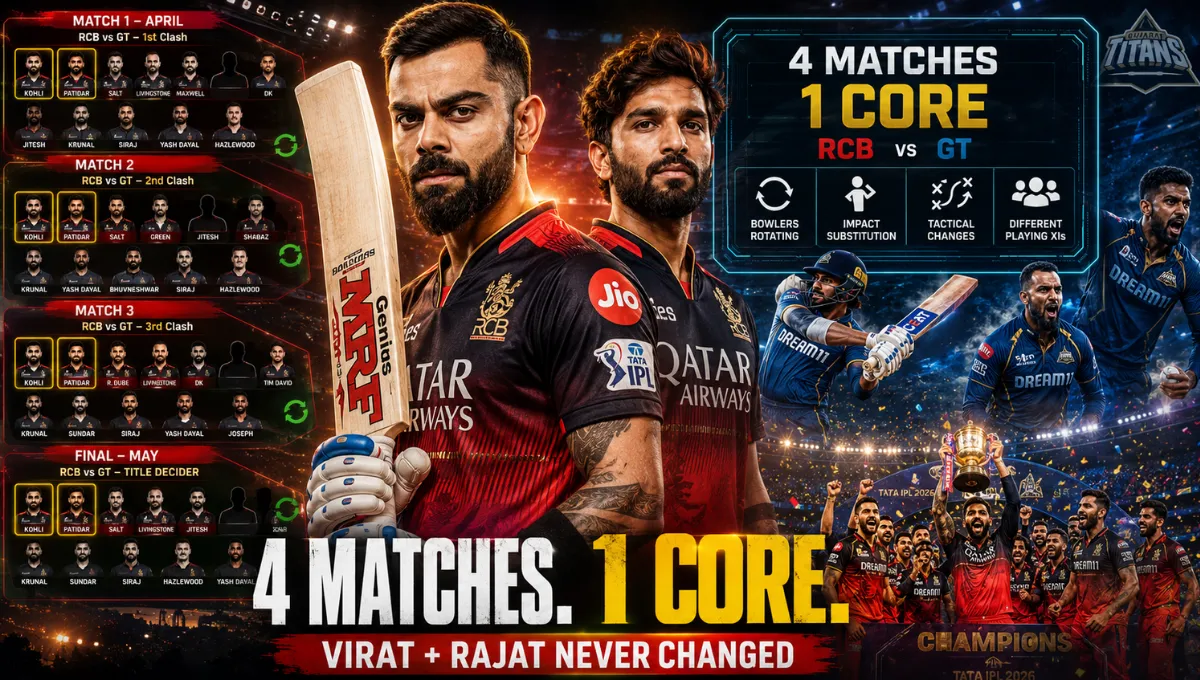
Virat Kohli played every single one of RCB’s four matches against Gujarat Titans in IPL 2026. So did Rajat Patidar. The players around them changed constantly bowlers rotated in and out, an Impact Player substitution here, a tactical tweak there but this core stayed fixed from the first league match in April to the title-winning final in May.
That consistency at the top, paired with real change underneath it, is the actual story of the players behind this rivalry. Here is every playing XI from all four 2026 meetings, and what changed between them.
Quick Overview: Four Matches, Two Squads, One Title
| Match | Date | Venue | Result |
|---|---|---|---|
| Match 34 | 24 April 2026 | M. Chinnaswamy Stadium, Bengaluru | RCB won by 5 wickets |
| Match 42 | 30 April 2026 | Narendra Modi Stadium, Ahmedabad | GT won by 4 wickets |
| Qualifier 1 | 26 May 2026 | HPCA Stadium, Dharamsala | RCB won by 92 runs |
| Final | 31 May 2026 | Narendra Modi Stadium, Ahmedabad | RCB won by 5 wickets |
Why Tracking Players Across a Rivalry Beats Reading One Playing XI at a Time
A single playing XI list tells you who took the field on one day. It doesn’t tell you whether a team trusted the same finishing option all season, or whether a struggling bowler got dropped after one bad outing and never returned. Following the same group of players across four matches against the same opponent reveals patterns that a standalone lineup page simply cannot show which is exactly the gap every competitor source leaves unfilled for this exact keyword.
Match 34 Players: RCB vs GT, Bengaluru
Gujarat Titans: Sai Sudharsan, Shubman Gill (captain), Jos Buttler (wicketkeeper), Washington Sundar, Rahul Tewatia, Jason Holder, Rashid Khan, Kagiso Rabada, Mohammed Siraj, Prasidh Krishna, plus supporting bowling options.
Royal Challengers Bengaluru: Virat Kohli, Devdutt Padikkal, Rajat Patidar (captain), Krunal Pandya, Tim David, plus the bowling attack that restricted GT to 205/3.
Key player context: Kohli’s 81 off 44 after being dropped in the very first over anchored RCB’s chase, while Krunal Pandya sealed the win with a boundary in the final over. Sai Sudharsan’s century for GT set the tone for what would become a defining trend: his top-order partnership with Gill was the most consistent thread running through the entire rivalry.
What this match revealed about squad depth: RCB’s finishing responsibility fell to Krunal Pandya rather than a specialist death-overs batter, a role assignment that would repeat across the season.
Common mistake in early-season squad analysis: assuming a single finishing performance locks in a permanent role. In RCB’s case, it genuinely did Krunal’s finishing duties became a consistent thread through the rest of the rivalry.
Match 42 Players: GT vs RCB, Ahmedabad
Royal Challengers Bengaluru: The same core batting group from Match 34, bowled out for 155, with the middle order struggling to build partnerships against GT’s bowling plan.
Gujarat Titans: Shubman Gill (captain), Sai Sudharsan, Jos Buttler, plus Jason Holder, who came in as an Impact Player substitute and both finished the chase and took a spectacular catch to win Player of the Match.
Key player context: This is where things go wrong for reading playing XIs as static lists. Holder’s role as an Impact Player substitute, rather than a fixed starting XI member, shows exactly how GT used the rule to their tactical advantage bringing in a finisher specifically for the chase phase of the match rather than committing him to the full XI from the start.
The tactical lesson embedded in this XI change: GT’s team management identified that RCB’s middle-overs bowling created specific opportunities for a calm finisher, and they built their Impact Player strategy around exploiting exactly that.
Practical takeaway for any franchise using the Impact Player rule: the substitution isn’t just about adding fresh legs it’s about matching a specific player’s skill set to a specific phase of the opposition’s likely game plan.
Qualifier 1 Players: RCB vs GT, Dharamsala
Royal Challengers Bengaluru: Rajat Patidar (captain), Virat Kohli, Devdutt Padikkal, plus a bowling attack that dismantled GT’s top order inside the powerplay.
Gujarat Titans: Sai Sudharsan, Shubman Gill, Jos Buttler, Rahul Tewatia the same top-order core from the league matches, now facing genuinely elevated stakes for the first time in this head-to-head.
Key player context: Patidar’s unbeaten 93 off 33 balls, including nine sixes, was the standout individual performance of the entire rivalry.
What most people miss about the playing XI context here: RCB’s batting order didn’t change dramatically from the league phase, but the aggression with which Patidar and Kohli approached the same roles was entirely different, reflecting a deliberate strategic shift for knockout cricket.
Bowling personnel shift worth flagging: By this stage of the season, RCB’s bowling attack had visibly sharpened compared to the group that conceded 158 in Match 42.
Bold opinion worth stating plainly: this wasn’t a coincidence of form it reflects specific personnel and tactical adjustments made in the weeks between the two league matches and this knockout fixture, the kind of mid-season correction that separates title-winning squads from merely talented ones.
Read Also:- Sunrisers Hyderabad vs Kolkata Knight Riders Match Scorecard
The Final Players: RCB vs GT, Ahmedabad
Gujarat Titans: Shubman Gill, Sai Sudharsan, Nishant Sindhu, Jos Buttler, Arshad Khan, Washington Sundar the same top-order names that had featured throughout the rivalry, this time collapsing early before Sundar’s rescue act.
Royal Challengers Bengaluru: Virat Kohli, batting through the entire chase, alongside Rasikh Salam, whose 3/27 was the best bowling figures on either side.
Key player context: Bold opinion worth stating plainly: the fact that GT’s top order Gill, Sudharsan, Buttler collapsed in the final in almost the exact same pattern RCB’s bowlers had exposed in Qualifier 1 just five days earlier shows a playing XI that never adjusted its top-order approach between the two biggest matches of the season.
Rasikh Salam’s emergence: His 3/27 in the final wasn’t an isolated brilliant spell it capped a run of improving form across the back half of the season for RCB’s bowling attack.
Practical lesson for tracking a squad’s form across a tournament: a bowler delivering his best figures in the tournament’s single most important match, rather than in a routine league game, is one of the clearest signals a team is peaking at exactly the right time.
Players Who Featured in Every Match
| Player | Team | Role Across All Four Matches |
|---|---|---|
| Virat Kohli | RCB | Top-order batter, played every match |
| Rajat Patidar | RCB | Captain and top-order batter, played every match |
| Devdutt Padikkal | RCB | Supporting batter, featured in most matches |
| Shubman Gill | GT | Captain and opening batter, played every match |
| Sai Sudharsan | GT | Opening batter, played every match |
| Jos Buttler | GT | Wicketkeeper-batter, played every match |
Common mistake in reading this list: assuming these six players alone explain the rivalry’s outcome. In reality, the supporting cast RCB’s bowling unit especially is what actually shifted between matches, even while this core group stayed constant on both sides.
What This Consistency Tells Us About Squad-Building Philosophy
Both franchises clearly built their entire campaign around a settled top three or four batters, resisting the temptation to rotate their most important names even after a poor result. RCB kept faith with the same top order after losing Match 42 badly, rather than making a knee-jerk change. GT did the same after their Qualifier 1 defeat, sticking with Gill, Sudharsan, and Buttler in the final. The difference between the two teams wasn’t personnel loyalty both showed it equally.
The difference was what each team did with the rest of the XI around that stable core, and specifically how much RCB’s bowling attack improved while GT’s did not.
Comparing the Bowling Personnel Across the Rivalry
| Match | RCB’s Key Bowlers | GT’s Key Bowlers |
|---|---|---|
| Match 34 | Rotating attack, no standout figures | Kagiso Rabada, Mohammed Siraj, Prasidh Krishna |
| Match 42 | Struggled collectively, no bowler under an economy of 8 | Jason Holder (Impact Player), Rashid Khan |
| Qualifier 1 | A sharper, more disciplined attack that bowled GT out for 162 | Rashid Khan, Kagiso Rabada, Mohammed Siraj |
| Final | Rasikh Salam (3/27), a clearly improved unit | Rashid Khan, Washington Sundar |
This table makes visible something no single-match report captures: RCB’s bowling personnel didn’t change dramatically in terms of names, but their collective performance level rose sharply between the league phase and the playoffs.
Common mistake when analysing a team’s turnaround: assuming a new signing or dramatic squad change explains improved form. In RCB’s case, the same core bowling group simply executed their plans better once the stakes rose, which is a coaching and mental performance story as much as it is a personnel one.
Impact Player Substitutions That Mattered
| Match | Impact Player Used | Effect |
|---|---|---|
| Match 42 | Jason Holder (GT) | Finished the chase and took a matchwinning catch, winning Player of the Match |
| Various league matches | Rotating bowling options for both sides | Allowed both teams to adjust their attack without committing a specialist bowler for the full match |
Read Also:- Ireland Cricket Team Vs India National Cricket Team Match Scorecard
Practical takeaway for reading any IPL playing XI in 2026: the Impact Player rule means a team’s starting XI on paper is not necessarily the XI that finishes the match. Holder’s Match 42 contribution is the clearest example in this entire rivalry of a substitute player deciding the outcome more than any specialist named in the original XI.
What Selectors and Fans Should Watch For Next Season
Following this rivalry’s playing XIs across an entire season offers a genuinely useful template for evaluating any two-team head-to-head going forward. Three practical questions are worth asking about any rivalry with multiple 2026 meetings:
- Did the same core top order stay in place across every match? If yes, as with RCB and GT here, look at the supporting cast and bowling unit for the real explanation of shifting results.
- Was the Impact Player rule used reactively or strategically? GT’s use of Jason Holder in Match 42 was a specific tactical decision, not a routine substitution tracking when and why teams use their Impact Player slot reveals real coaching intent.
- Did losing a big match trigger panic changes or calculated consistency? Both RCB and GT chose consistency after bad defeats in this rivalry. Whether that approach continues to pay off, or whether a franchise eventually needs to break from a settled top order, is one of the most interesting storylines to track into the next season.
For RCB specifically, the players who delivered in Qualifier 1 and the final Patidar, Kohli, and a suddenly sharper bowling unit featuring Rasikh Salam give the franchise a clear template heading into their title defence: keep the top order settled, and continue investing coaching attention into sharpening the bowling group rather than searching for a marquee overseas replacement every season.
Key Highlights and Player Performance Breakdown
- Virat Kohli: Played all four matches, top-scoring in Match 34 (81) and finishing unbeaten in the Final (75*) the standout individual performer at both ends of the rivalry’s timeline.
- Rajat Patidar: His Qualifier 1 innings of 93* off 33 balls, with nine sixes, is the single most destructive individual performance by any player across all four matches.
- Shubman Gill: Ever-present for GT, but his top-order partnership with Sudharsan never solved the specific vulnerability RCB’s bowlers repeatedly targeted from Qualifier 1 onward.
- Jason Holder: The most impactful Impact Player substitution across the rivalry, directly winning Match 42 for GT.
- Rasikh Salam: His 3/27 in the Final was the best bowling figures of the match, part of a broader RCB bowling improvement that began in Qualifier 1.
- Devdutt Padikkal: A consistent, if less headline-grabbing, presence across every match, providing support at the top of RCB’s order without ever needing to be the standout name.
Frequently Asked Questions (FAQs)
Q1. Which players featured in all four RCB vs GT matches in IPL 2026?
Ans. Virat Kohli and Rajat Patidar played in all four matches for RCB, while Shubman Gill, Sai Sudharsan, and Jos Buttler featured in every match for Gujarat Titans.
Q2. Who was the standout individual player across the RCB vs GT rivalry in 2026?
Ans. Rajat Patidar’s unbeaten 93 off 33 balls in Qualifier 1 was the single most destructive individual performance, while Virat Kohli was the most consistent, featuring prominently in both Match 34 and the Final.
Q3. How did GT use the Impact Player rule against RCB in 2026?
Ans. GT’s most notable use of the Impact Player rule came in Match 42, when Jason Holder came on as a substitute, finished the chase, and took a matchwinning catch, winning Player of the Match.
Q4. Did the same playing XI core feature for both teams across the rivalry?
Ans. Yes, largely. Both teams kept their top-order batters consistent across all four matches, while the bowling attacks and supporting batting order saw more rotation, especially for RCB heading into the playoffs.
Q5. Who were the RCB and GT captains across these four matches?
Ans. Rajat Patidar captained Royal Challengers Bengaluru in all four matches, while Shubman Gill captained Gujarat Titans throughout the rivalry.




Leave a Reply