
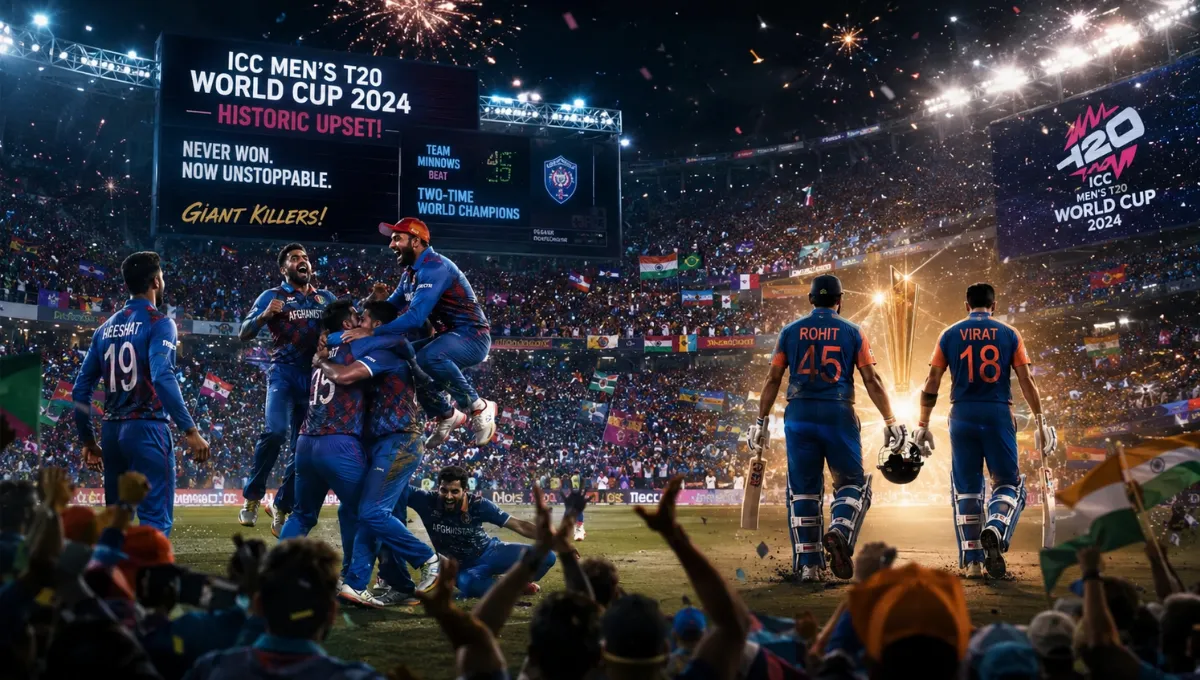
Imagine building a bigger stage for cricket’s shortest format, doubling the number of teams almost overnight, and then watching a country that had never won a World Cup match beat a two-time former champion within the first week. That’s exactly what happened at the ICC Men’s T20 World Cup 2024. The tournament didn’t just crown a champion.
it validated a massive format gamble, delivered one of cricket’s greatest upsets, and ended with two legends walking away from the format on the same night they won it all. Here’s the complete story.
Tournament Snapshot: A Historic 20-Team Format
The ICC Men’s T20 World Cup 2024 was co-hosted by the USA and West Indies from June 1 to June 29, featuring a record 20 teams, expanded from 16 in previous editions. The 20 teams were split into four groups of five for the opening round, with the top two from each group advancing to a Super Eight stage, followed by semi-finals and a final in Barbados.
India won the tournament, beating South Africa by 7 runs in the final at Kensington Oval, securing their second T20 World Cup title and first since the inaugural 2007 edition.
What most people miss when they scan a “20 teams, 55 matches” summary is how genuinely risky this expansion was for the ICC. Doubling the field usually means more one-sided group games and less overall quality. This tournament proved almost the opposite.
The USA Shock: Proof the Expansion Worked
Here’s where things go wrong for anyone who assumed the expanded format would just mean more lopsided matches involving Associate nations. In just the second week of the tournament, co-hosts USA beat Pakistan in a Super Over in Dallas, one of the biggest upsets in cricket history.
USA vs Pakistan: Group A, Dallas
| Team | Score | Result |
|---|---|---|
| Pakistan | 159/7 (20 overs) | Tied, lost Super Over |
| USA | 159/3 (20 overs) | Tied, won Super Over |
Pakistan posted 159 for 7, built around a 72-run partnership between Babar Azam and Shadab Khan, but USA matched them exactly, reaching 159 for 3 thanks to half-centuries from captain Monank Patel and support from Aaron Jones and Andries Gous. Nitish Kumar smashed the final ball of USA’s innings for four just to force the tie, sending the match into a Super Over.
Super Over Result
| Team | Runs |
|---|---|
| USA | 18 |
| Pakistan | 13 |
Read Also:- India vs West Indies T20 2026: Match Highlights, Full Scorecard
What people think happened here is that USA simply outbatted Pakistan in a lucky one-over shootout. The reality is more layered:
Mohammad Amir bowled the Super Over for Pakistan and conceded three wides plus a string of overthrows, meaning Pakistan’s own execution errors were just as responsible for the loss as USA’s batting. This is a genuinely important correction for anyone retelling this match reducing it to “USA batted well” ignores the bowling and fielding collapse that handed them the opening.
Turning point: Saurabh Netravalkar’s composed final over in the Super Over, conceding just 13 runs under immense pressure as a co-host debutant nation, turned what could have been a forgettable group match into one of the format’s defining shocks.
A genuinely bold opinion worth stating directly: this single match did more to justify the ICC’s 20-team expansion than any pre-tournament marketing could have. A non-Test nation beating a two-time world champion in their maiden World Cup appearance is exactly the kind of moment that proves associate nations belong on the biggest stage.
The Final: India’s Second Title
India batted first in the final at Kensington Oval, Bridgetown, and stumbled early, slipping to 34 for 3 against a dangerous South African bowling attack. This is where the tournament’s most understated storyline comes into focus.
India Innings: Final, Kensington Oval: 176/7 (20 overs)
| Batter | Runs | Balls | Notes |
|---|---|---|---|
| Virat Kohli | 76 | 59 | Player of the Match, Player of the Final |
| Axar Patel | 47 | 31 | Run out, crucial middle-order support |
| Shivam Dube | 9 | 5 | Quick cameo |
What people think happened is that Kohli simply turned up and delivered his best innings when it mattered most.
The reality is far more dramatic: Kohli had scored just 75 runs across seven innings in the entire tournament before the final, at an average below 11, making him one of the most out-of-form major batters heading into the biggest match of the event. His 76 off 59 balls, including a slow 50 off 48 balls before accelerating late, wasn’t a continuation of good form it was a complete reversal under maximum pressure.
South Africa’s reply fell agonizingly short. They were restricted to 169 for 8, with Hardik Pandya defending 16 runs in the final over to seal a 7-run win for India.
South Africa Innings: Final, Kensington Oval: 169/8 (20 overs)
| Result | Margin |
|---|---|
| South Africa lost | 7 runs |
Turning point: Hardik Pandya’s composed final over, successfully defending a tight target against South Africa’s lower order, sealed India’s second-ever T20 World Cup title and ended South Africa’s search for their first global trophy.
Minutes after the win, Virat Kohli announced his retirement from T20 Internationals during his Player of the Match interview, and captain Rohit Sharma followed with his own retirement announcement in the post-match press conference. Kohli finished his T20I career with 4,188 runs in 125 matches at an average of 48.69, while Rohit ended with 4,231 runs in 159 matches.
What people think happened is that both players retired simply because of age.
The reality, as Kohli later explained, was far more calculated: he wanted to give India’s next generation of players enough runway to prepare properly for the following T20 World Cup cycle.
Key Moments and Turning Point
- USA’s Super Over win over Pakistan validated the tournament’s 20-team expansion within the first week.
- Kohli’s poor group-stage form (75 runs in 7 innings) set up one of the most dramatic final-innings turnarounds in World Cup history.
- India’s collapse to 34 for 3 early in the final tested their batting depth before Kohli and Axar Patel rebuilt the innings.
- Hardik Pandya’s final over defense of 16 runs sealed the title by the narrowest of margins.
- Kohli and Rohit Sharma’s joint retirement announcement turned a title-winning night into the end of an era.
Turning point: The single most decisive moment of the entire tournament was Kohli’s transition from a subdued 50 off 48 balls to an aggressive 76 off 59 in the closing overs of the final, directly building the total that Pandya would defend by exactly 7 runs.
Player Performance Breakdown
| Player | Team | Tournament Stat Line | Context |
|---|---|---|---|
| Rahmanullah Gurbaz | Afghanistan | 281 runs, tournament’s leading scorer | Played for a team that didn’t win the title |
| Virat Kohli | India | 76 in the final, Player of the Final | Turned around a poor tournament with the innings that mattered most |
| Monank Patel | USA | 50 off 38 in the Super Over upset | Captained co-hosts to their signature win |
| Hardik Pandya | India | Defended 16 in the final over | Sealed India’s second World Cup title |
| Saurabh Netravalkar | USA | Bowled the decisive Super Over | Software engineer turned national cricket hero |
| Rohit Sharma | India | 4,231 T20I runs career total | Retired as captain immediately after the title win |
Read Also:- India Women vs Sri Lanka Women: Complete Series Guide
An original observation worth stating plainly: Rahmanullah Gurbaz finishing as the tournament’s leading run-scorer with 281 runs, while playing for Afghanistan rather than the eventual champions, is a detail that deserves far more attention than it typically gets.
It’s a clear reminder that individual batting excellence and team success remain only loosely connected in T20 cricket, something every fantasy team builder and analyst should factor into future tournament predictions.
What This Tournament Changed Forever
The USA’s Super Over win over Pakistan didn’t just create a viral moment it directly justified the ICC’s decision to expand the World Cup to 20 teams, a decision so consequential that the ICC later approved further changes to the format for 2028 and is reportedly exploring a 24-team expansion from 2032.
Kohli and Rohit’s retirement, timed deliberately to give young Indian players a full four-year runway before the next World Cup, reflects a genuinely bold succession-planning decision rather than a reactive exit. Going forward, any global cricket board managing legendary players nearing retirement should study.
This exact template: exit on the highest possible note, and do it early enough that your successors get real preparation time, not a rushed handover.
Frequently Asked Questions (FAQs)
Q1. Who won the ICC T20 World Cup 2024?
Ans. India won the ICC Men’s T20 World Cup 2024, beating South Africa by 7 runs in the final at Kensington Oval, Barbados, securing their second title.
Q2. Who was Player of the Match in the T20 World Cup 2024 final?
Ans. Virat Kohli was named Player of the Match for his 76 off 59 balls, which built India’s total of 176 for 7 in the final.
Q3. Why did Virat Kohli and Rohit Sharma retire from T20Is?
Ans. Both players retired immediately after India’s 2024 World Cup final win, with Kohli later explaining the timing was meant to give young players enough preparation time before the next World Cup.
Q4. What was the biggest upset of the T20 World Cup 2024?
Ans. USA beat Pakistan in a Super Over in Dallas, one of the biggest shocks in cricket history, after both teams tied on 159 in their group match.
Q5. Who was the leading run-scorer in the T20 World Cup 2024?
Ans. Rahmanullah Gurbaz of Afghanistan finished as the tournament’s leading run-scorer with 281 runs, despite his team not winning the title.



Leave a Reply