


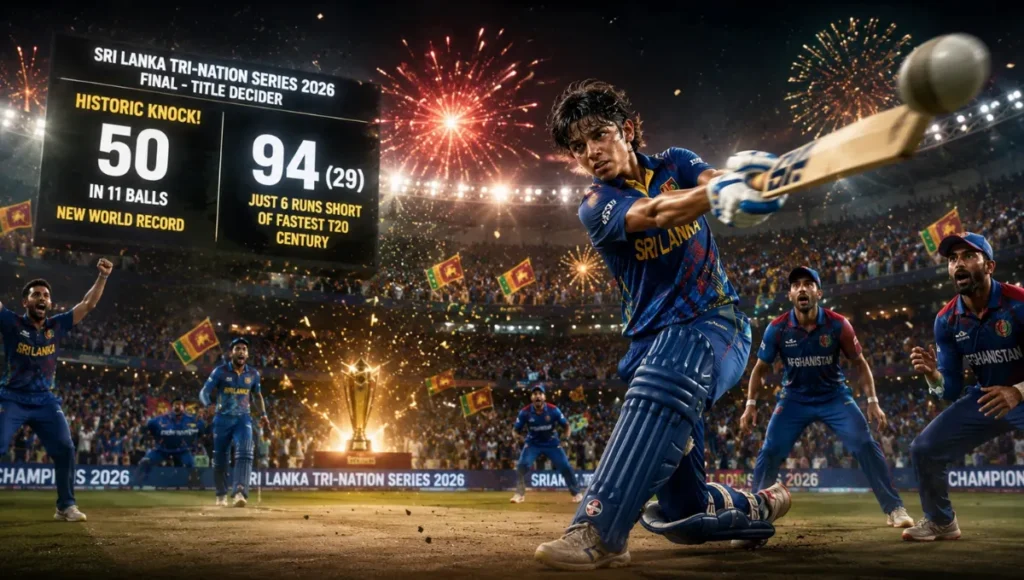
Picture a 15-year-old walking out to bat in a title-deciding final against the exact team he’d clashed with on the field just days earlier. He’d been quiet with the bat all tournament.
Nobody could have predicted what happened next: an 11-ball fifty that broke a world record standing since 2005, and a 29-ball 94 that fell just six runs short of what would have been one of the fastest centuries in the format’s history. This is the story of how the 2026 Sri Lanka Tri-Nation Series ended, and why it was about far more than just a trophy.
Tournament Snapshot: A Title Built on a Wobble
India A won the 2026 Sri Lanka Tri-Nation Series, beating hosts Sri Lanka A by 66 runs in the final at the Rangiri Dambulla International Stadium on June 21, 2026. The tournament featured India A, Sri Lanka A, and Afghanistan A across six league matches before the top two teams met in the title decider.
What most people miss when they see “India A won the tri-series” as a simple headline is how close their campaign came to falling apart entirely they lost 2 of their first 4 league matches before a dramatic turnaround carried them to the final.
India A’s Complete League Campaign
| Match | Result |
|---|---|
| vs Sri Lanka A | Won by 8 runs |
| vs Afghanistan A | Lost by 4 runs (DLS method) |
| vs Sri Lanka A | Lost via Super Over |
| vs Afghanistan A | Won by 101 runs |
Here’s where things go wrong for anyone assuming India A cruised to this title. After the Super Over loss to Sri Lanka A in their 4th match, India A needed a genuine statement win over Afghanistan A just to reach the final, and Sri Lanka A finished the league phase as table-toppers with 3 wins from 4 matches, entering the final as favorites on current form.
The Flashpoint: Why the Final Became Personal
This is the section every competitor coverage genuinely underplays. The last time these two India A and Sri Lanka A sides had met, in their 4th league match, the contest ended in genuinely ugly scenes on the field, described directly as a “fight” in post-match coverage.
What people think happened is that this was just another tied Super Over finish like dozens of other close matches in franchise and A-team cricket. The reality is this specific finish carried real tension between the two camps, tension that Sooryavanshi and India A carried directly into the final.
A genuinely bold observation worth stating directly: sporting “revenge” narratives are often manufactured by media coverage after the fact, but this one wasn’t. The on-field confrontation happened first, was reported as genuine friction, and then India A’s most explosive batter produced arguably the most emphatic response possible against the exact same opponent in the very next meeting.
The Final: Sooryavanshi’s Record-Breaking Payback
India A won the toss and elected to bat first in the final. Vaibhav Sooryavanshi, who had gone through a genuinely quiet league stage with no big scores, opened the innings and immediately signaled his intent. His first 11 deliveries read 4, 4, 4, 6, 6, 0, 6, 4, 4, 6, 6 fifty runs in eleven balls.
Sooryavanshi’s Inning: Final, Dambulla: 94 off 29 balls
| Milestone | Balls Faced | Detail |
|---|---|---|
| Fifty | 11 balls | Fastest fifty in List A cricket history |
| Final score | 29 balls | 10 fours, 8 sixes, strike rate of 324.14 |
Read Also:- India National Cricket Team Vs Afghanistan National Cricket Team Timeline
Here’s the genuinely important historical context every competitor coverage skips. Sooryavanshi’s 11-ball fifty broke a record held by Sri Lanka’s own Kaushalya Weeraratne, who had scored a 12-ball fifty in a Sri Lankan domestic match back in 2005 a record that had stood for 21 years before this innings.
What people think happened is that this was simply a good innings in a tri-series final. The reality is this specific record had survived two full decades of List A cricket evolution, including the rise of T20 batting techniques, before a 15-year-old broke it against the very country whose player had originally set it.
Sooryavanshi was eventually dismissed by Sri Lanka A captain Sahan Arachchige for 94, caught at mid-off in the ninth over with India A’s score reading 132, falling just six runs short of what would have been one of the fastest centuries in List A history. Tilak Varma added a composed 67 and Ruturaj Gaikwad chipped in 40, propelling India A to 377 for 9.
India A Innings: Final: 377/9 (50 overs)
| Batter | Runs | Balls | Notes |
|---|---|---|---|
| Vaibhav Sooryavanshi | 94 | 29 | Fastest List A fifty in history |
| Tilak Varma | 67 | 90 | Steadying middle-order innings |
| Ruturaj Gaikwad | 40 | — | Supporting contribution |
A common mistake worth correcting directly: some readers assume falling six runs short of a century in this situation represents a missed opportunity or a failure of concentration. The reality is a 29-ball 94 with a record-breaking fifty embedded inside it is arguably more valuable to cricket history than a slower, chanceless hundred would have been the record itself, not the round number, is what will be remembered decades from now.
Sri Lanka A’s Response: A Fight That Fell Short
Chasing 378, Sri Lanka A never gave up. Sadeera Samarawickrama scored 52 and Wanuja Sahan fought hard for 62 off 69 balls, the highest individual contribution of the innings, keeping Sri Lanka A in contention deep into their chase. But Yash Thakur and Vipraj Nigam took three wickets each, and Sri Lanka A were eventually bowled out for 311 in 47.1 overs, falling 66 runs short.
Sri Lanka A Innings: 311 all out (47.1 overs)
| Batter | Runs | Balls | Notes |
|---|---|---|---|
| Wanuja Sahan | 62 | 69 | Highest individual score for Sri Lanka A |
| Sadeera Samarawickrama | 52 | 44 | Key middle-order support |
Bowling: India A
| Bowler | Wickets | Runs |
|---|---|---|
| Yash Thakur | 3 | 45 |
| Vipraj Nigam | 3 | 60 |
What people think happened here is that Sri Lanka A simply couldn’t chase such a massive total.
The reality is more nuanced: the dismissal of Wanuja Sahan, their highest contributor, is specifically cited as the moment that broke Sri Lanka A’s genuine resistance, meaning this wasn’t a meek surrender but a fight that had a clear, identifiable breaking point.
Key Moments and Turning Point
- Sooryavanshi’s 11-ball fifty in the opening overs of the final immediately set an impossible tempo for Sri Lanka A’s bowlers to recover from.
- His eventual dismissal for 94, caught at mid-off attempting to extend the assault, ended a genuine shot at cricket history but had already secured India A’s platform.
- Wanuja Sahan’s dismissal for 62, Sri Lanka A’s top contribution, removed their last realistic hope of completing the chase.
- Anukul Roy’s diving catch to seal the final wicket completed both the match and the series in dramatic fashion.
Turning point: Sooryavanshi’s opening burst inside the first nine overs effectively decided the final before Sri Lanka A’s bowlers had settled into any rhythm, transforming a title decider into a total India A never seriously looked like losing.
Player Performance Breakdown
| Player | Team | Tournament Contribution | Context |
|---|---|---|---|
| Vaibhav Sooryavanshi | India A | 94 off 29 in the final | Broke a 21-year-old world record for fastest List A fifty |
| Wanuja Sahan | Sri Lanka A | 62 in the final | Sri Lanka A’s highest individual contribution in the chase |
| Tilak Varma | India A | 67 in the final, tournament captain | Provided the composure Sooryavanshi’s fireworks needed around him |
| Yash Thakur | India A | 3 wickets in the final | Central to restricting Sri Lanka A’s chase |
| Vipraj Nigam | India A | 3 wickets in the final, key league performances | Consistent all-round impact across the tournament |
| Sadeera Samarawickrama | Sri Lanka A | 52 in the final | Kept Sri Lanka A’s chase alive in the middle overs |
Read Also:- India Women vs Sri Lanka Women: Complete Series Guide
An original observation worth stating plainly: Vaibhav Sooryavanshi’s final-innings record deserves recognition as one of the most significant individual List A performances in the sport’s recent history, not simply because of the runs, but because of the specific record broken. Fastest-fifty records in 50-over cricket tend to stand for years precisely because the format rewards accumulation over explosiveness breaking a 21-year-old mark in a title-deciding final, against the team he’d just clashed with, is the kind of moment that genuinely transcends a single tournament.
What This Tournament Reveals
India A’s path to the title, surviving a genuine mid-tournament wobble that included a DLS loss and a Super Over defeat, shows that tri-series success often hinges on peaking exactly when it matters rather than maintaining dominance throughout. The Sooryavanshi flashpoint-to-record-innings storyline proves that genuine competitive tension between young talents can produce historically significant performances, rather than simply generating controversy.
Going forward, tournament organizers and broadcasters covering emerging player rivalries like this should recognize that these personal narratives, when they’re genuine rather than manufactured, often produce the most memorable moments in a tournament’s history.wikipedia+3
Frequently Asked Questions (FAQs)
Q1. Who won the India vs Sri Lanka Tri Series 2026?
Ans. India A won the 2026 Sri Lanka Tri-Nation Series, beating Sri Lanka A by 66 runs in the final at Dambulla.
Q2. What record did Vaibhav Sooryavanshi break in the Tri-Series final?
Ans. Sooryavanshi scored the fastest fifty in List A cricket history, reaching his half-century in just 11 balls, breaking a 21-year-old record held by Sri Lanka’s Kaushalya Weeraratne.
Q3. What was Vaibhav Sooryavanshi’s final score in the Tri-Series 2026 final?
Ans. Sooryavanshi scored 94 off 29 balls, including 10 fours and 8 sixes, falling six runs short of a century.
Ans. Did India A lose any matches before winning the Tri-Series 2026 title?
Ans. Yes, India A lost 2 of their first 4 league matches, including a DLS defeat to Afghanistan A and a Super Over loss to Sri Lanka A, before turning their campaign around.
Ans. Why was the India A vs Sri Lanka A final considered personal?
Ans. The two sides had clashed in genuinely tense scenes during their earlier Super Over match in the league stage, adding extra motivation to their final meeting.