
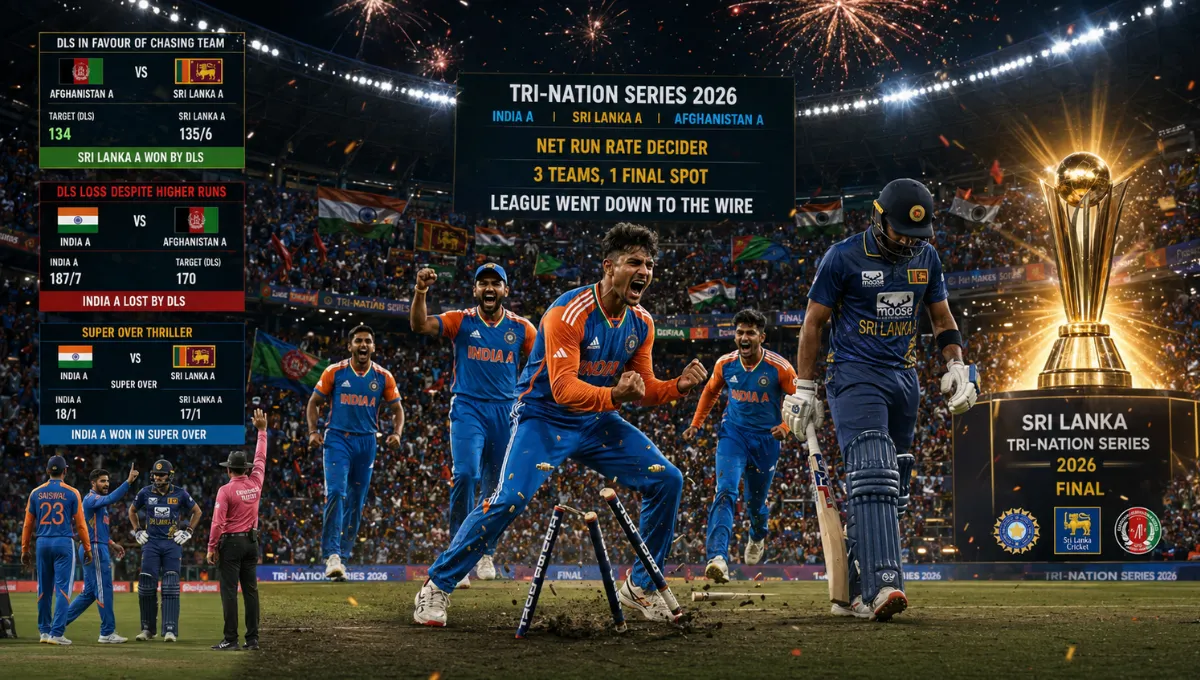
Picture a six-match league phase where one match gets decided by DLS in the chasing team’s favor, another gets decided by DLS against the team that scored more runs, and a third goes all the way to a Super Over. That’s not a hypothetical that’s exactly what happened in the 2026 Sri Lanka Tri-Nation Series. India A, Sri Lanka A, and Afghanistan A produced six league matches so tightly contested that the final qualification spot came down to net run rate.
Then the final itself turned into a one-sided demolition inside the first ten overs. Here’s the complete breakdown.
Tournament Snapshot: Three Teams, Three Different Close Finishes
The 2026 Sri Lanka Tri-Nation Series ran from June 9 to June 21 at the Rangiri Dambulla International Stadium, featuring India A, Sri Lanka A, and Afghanistan A in a round-robin format followed by a final between the top two teams. Each team faced the other two sides twice during the league stage, before the top two met in a title decider. India A, captained by Tilak Varma, ultimately won the series, beating Sri Lanka A by 66 runs in the final.
What most people miss when they see “India A won the tri-series” as a headline is how genuinely messy the path to that final was. Across six league matches, three different results came down to tiebreaker rules or a one-over shootout a level of competitive balance that’s rare even in bilateral series, let alone a three-team tournament.
League Phase: A Genuinely Chaotic Points Race
The opening match set a tense tone immediately. India A posted 277 for 6, and despite Sri Lanka A’s spirited chase to 269, India A held on to win by 8 runs. The 2nd match saw India A put up a massive 349 for 9, but rain intervened during Afghanistan A’s chase, and the DLS method awarded them the win at 177 for 2 after 25.5 overs.
League Phase Results: 2026 Tri-Nation Series
| Match | Teams | Result |
|---|---|---|
| 1st | Sri Lanka A vs India A | India A won by 8 runs |
| 2nd | India A vs Afghanistan A | Afghanistan A won via DLS method |
| 3rd | Afghanistan A vs Sri Lanka A | Sri Lanka A won via DLS method |
| 4th | India A vs Sri Lanka A | Match tied, Sri Lanka A won Super Over |
| 5th | Afghanistan A vs India A | India A won by 101 runs |
| 6th | Sri Lanka A vs Afghanistan A | Sri Lanka A won |
Read Also:- Icc T20 World Cup 2024: Full Schedule, Teams, Venues and Match Details
Here’s where things go wrong for anyone judging the 3rd match by the final scoreline alone. Afghanistan A posted 245, and Sri Lanka A reached 231 for 2 in 28.1 overs when the match ended again via DLS, meaning Sri Lanka A didn’t actually need to overhaul the full target, just stay ahead of the rain-adjusted par score.
What people think happened is that DLS results are rare statistical footnotes. The reality in this tournament is that two of the first three league matches were decided by DLS, making it a genuinely defining feature of this series rather than an occasional quirk.
The 4th match produced the tournament’s most dramatic finish. India A posted 265, Sri Lanka A matched them exactly at 265 for 9, tying the match and sending it to a Super Over. Sri Lanka A scored 16 without loss in their over, while India A, even with Vaibhav Sooryavanshi at the crease, could only manage 9 runs, handing Sri Lanka A the win by the smallest possible margin.
Turning point: India A’s collapse in the Super Over, falling one run short after Sooryavanshi’s dismissal in the closing stages, meant they entered their final league match against Afghanistan A knowing anything less than a win would end their tournament.
The Must-Win Match: India A’s Turning Point
This is the section every competitor coverage genuinely underplays. After two losses in their previous three matches, India A faced a straightforward must-win scenario against Afghanistan A in the 5th match on June 17. Captain Tilak Varma led from the front, combining with fifties from Priyansh Arya and Kumar Kushagra to post a commanding 319 for 9.
India A Innings: 5th Match: 319/9 (50 overs)
| Batter | Runs | Notes |
|---|---|---|
| Priyansh Arya | 58 | Key top-order contribution |
| Vipraj Nigam | 30 | Off just 20 balls, late acceleration |
| Tilak Varma | — | Fifty as captain |
Afghanistan A started their chase promisingly, reaching 157 for 3 after 25 overs, but collapsed dramatically to 218 all out, with more than 13 overs unused. India A won by 101 runs, sealing their place in the final.
What people think happened here is that India A simply had a good day with the bat. The reality is this was a genuine must-win elimination match, and India A responded to the pressure of a faltering campaign with their most emphatic performance of the entire tournament a common mistake would be treating this as just another league game rather than the moment that defined their entire campaign.
Turning point: Afghanistan A’s batting collapse after a promising start at 157 for 3 handed India A a canvas to bowl them out well inside the overs, converting a competitive chase into a statement 101-run win that secured their final spot.
The Final: Sooryavanshi’s Statement Innings
India A and Sri Lanka A met again in the final on June 21, and this time there was no tiebreaker drama needed. India A batted first and posted a massive 377 for 9 in their 50 overs, built around a genuinely explosive innings from Vaibhav Sooryavanshi.
India A Innings: Final 377/9 (50 overs)
| Batter | Runs | Balls | Notes |
|---|---|---|---|
| Vaibhav Sooryavanshi | 94 | 29 | Explosive opening assault |
Sri Lanka A’s chase never recovered from the platform India A’s total had built. They were bowled out for 311 in 47.1 overs, falling 66 runs short despite a genuinely competitive fightback.
Final Result: Rangiri Dambulla International Stadium
| Team | Score | Result |
|---|---|---|
| India A | 377/9 (50 overs) | Won by 66 runs |
| Sri Lanka A | 311 (47.1 overs) | Lost |
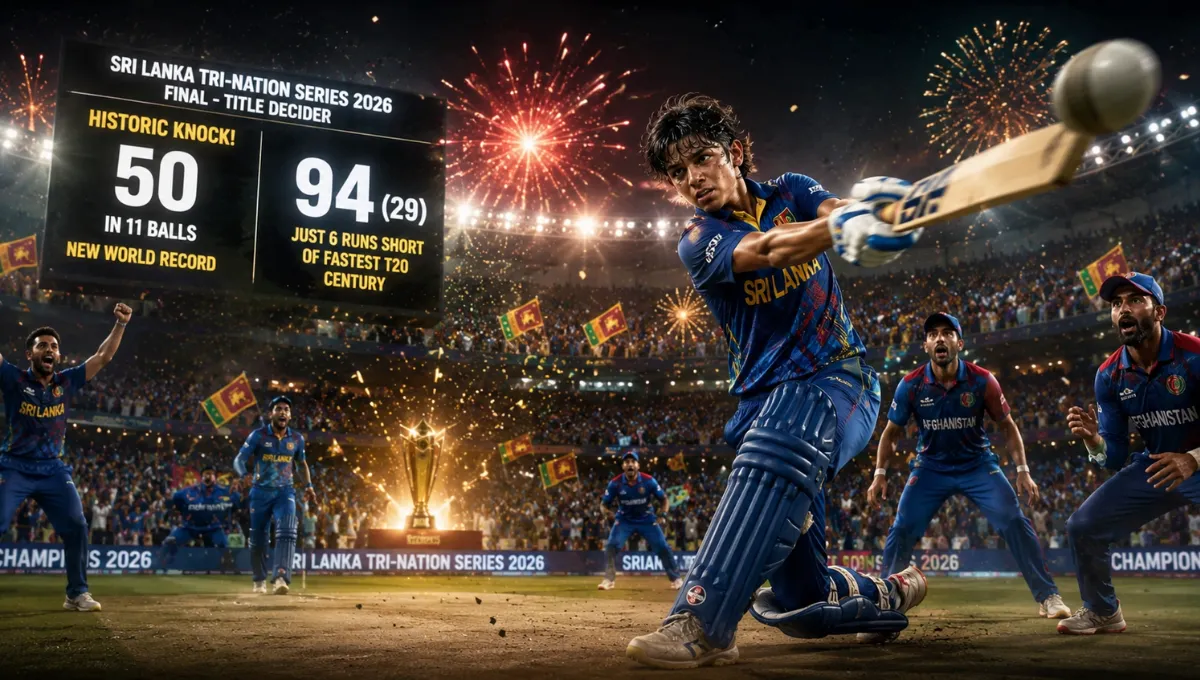
Here’s a genuinely counterintuitive idea worth stating directly: a 66-run margin sounds like a comfortable, low-drama final, but the reality is this match was effectively decided inside the first 10 overs. Sooryavanshi’s 94 off just 29 balls came at a strike rate above 320, meaning his innings alone set a total that Sri Lanka A’s bowlers had no realistic answer for before the innings had even reached its halfway point.
What people think happened is that India A ground out a big total over 50 overs. The reality is one teenage batter’s opening burst effectively won the final before India A’s middle order had even settled in.
Anukul Roy sealed the match and the series with a diving catch to complete the win, a fitting bookend given his 7 wickets across the tournament.
Turning point: Sooryavanshi’s 94 off 29 balls in the powerplay overs of the final transformed a potentially competitive contest into a virtually unreachable target within the first quarter of India A’s innings.
Player Performance Breakdown
| Player | Team | Tournament Stat Line | Context |
|---|---|---|---|
| Tilak Varma | India A | 275 runs, captain | Led India A through a wobbling league phase to the title |
| Avishka Fernando | Sri Lanka A | 288 runs, tournament’s leading scorer | Sri Lanka A’s most consistent batter across the series |
| Vaibhav Sooryavanshi | India A | 94 off 29 in the final | Single-handedly decided the title match inside 10 overs |
| Priyansh Arya | India A | 58 in the must-win 5th match | Set up India A’s tournament-defining win |
| Kugathas Mathulan | Sri Lanka A | 8 wickets | Sri Lanka A’s leading wicket-taker |
| Anukul Roy | India A | 7 wickets, final-sealing catch | All-round contribution across bowling and fielding |
| Vipraj Nigam | India A | 7 wickets, 30 off 20 in 5th match | Genuine all-round impact in the crucial matches |
Read Also:- India vs West Indies T20 2026: Match Highlights, Full Scorecard & Analysis
An original observation worth stating plainly: Vaibhav Sooryavanshi’s final innings deserves recognition as one of the most impactful individual performances in recent A-team cricket, not just because of the runs, but because of when they came. A 94 off 29 balls in a title-deciding match, arriving after his side had already lost a Super Over just days earlier, shows a teenager capable of delivering exactly when the pressure is highest.
What This Tournament Reveals
India A’s path to the title, built on 2 losses in their first 4 matches before back-to-back statement wins, proves that tri-series success often depends more on peaking at the exact must-win moment than on maintaining consistent form throughout the league phase. The three separate tiebreaker-driven results in the league phase (two DLS decisions and one Super Over) show these teams were genuinely evenly matched on personnel, meaning net run rate and clutch execution, not talent gaps, decided who advanced.
Going forward, teams entering similarly tight round-robin tournaments should treat net run rate management as a first-order tactical priority from the very first match, not an afterthought calculated only once qualification scenarios become tense.
Frequently Asked Questions (FAQs)
Q1. Who won the Tri-Nation Series 2026?
Ans. India A won the 2026 Sri Lanka Tri-Nation Series, beating Sri Lanka A by 66 runs in the final at Rangiri Dambulla International Stadium.
Q2. How many DLS-method results were there in the Tri-Nation Series 2026?
Ans. Two league matches were decided by the DLS method — Afghanistan A won the 2nd match and Sri Lanka A won the 3rd match, both due to rain interruptions.
Q3. Which match went to a Super Over in the Tri-Nation Series 2026?
Ans. The 4th match between India A and Sri Lanka A tied at 265 apiece, with Sri Lanka A winning the Super Over 16 to 9.
Q4. Who scored the most runs in the Tri-Nation Series 2026?
Ans. Avishka Fernando of Sri Lanka A finished as the tournament’s leading run-scorer with 288 runs, though his team lost the final.
Q5. What was Vaibhav Sooryavanshi’s score in the Tri-Nation Series 2026 final?
Ans. Vaibhav Sooryavanshi scored 94 off just 29 balls in the final, effectively deciding the match inside the first 10 overs of India A’s innings







Leave a Reply