
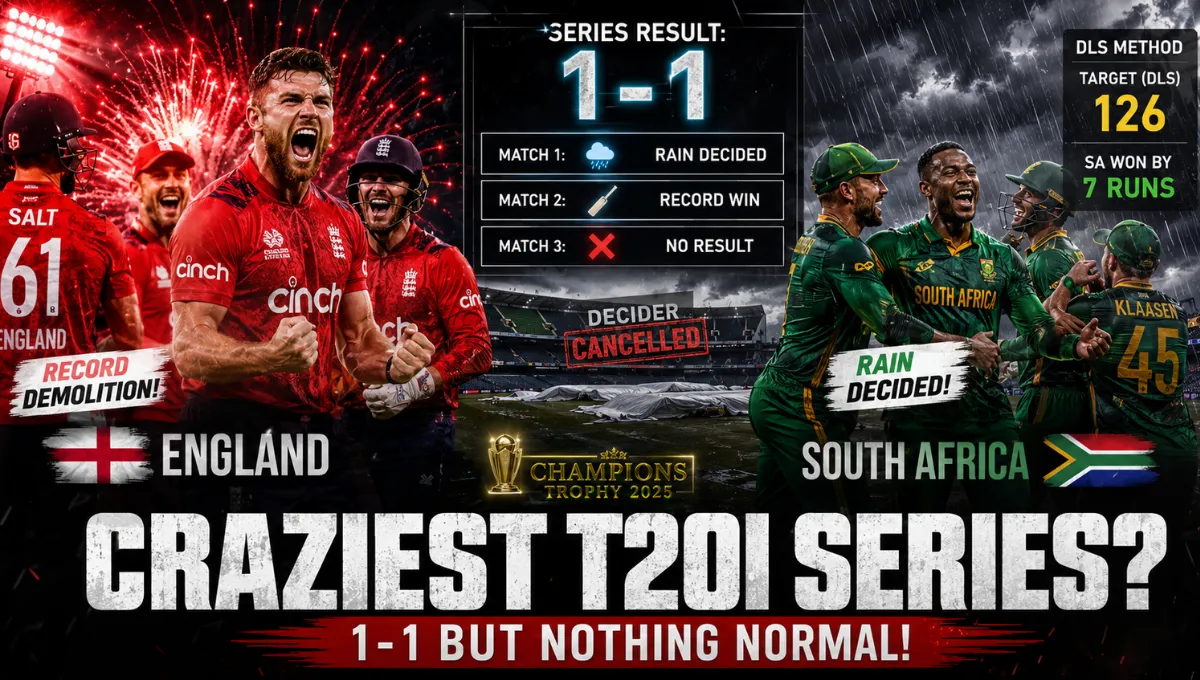
England and South Africa played out one of the strangest T20I series in recent memory in September 2025 a series where the final scoreline of 1-1 barely tells you anything real about what happened on the field. One match was decided by rain-adjusted math. One match was a record-breaking demolition. And the decider never happened at all add in the Champions Trophy 2025 group match from earlier that year, and you get a fuller, far more interesting picture of how these two teams actually stack up against each other.
Here’s the complete scorecard breakdown, match by match, with the moments that decided each result and the numbers most coverage glosses over.
Series Snapshot
South Africa toured England for a three-match T20I series in September 2025. South Africa won the rain-affected 1st T20I in Cardiff by 14 runs via the DLS method, England responded with a 146-run demolition in the 2nd T20I at Manchester, and the 3rd T20I decider at Trent Bridge, Nottingham was abandoned without a ball bowled due to rain. Six months earlier, in the ICC Champions Trophy 2025, South Africa had already beaten England by 7 wickets in Karachi.
What most people miss when they read the “1-1 draw” headline is that this wasn’t really a contest between two evenly matched sides it was two lopsided wins separated by a washout, plus a prior tournament humiliation that set the psychological backdrop for the whole series.
Champions Trophy 2025: The Match That Set the Tone
Before the T20I series even began, England and South Africa met in the ICC Champions Trophy 2025 group stage at the National Stadium, Karachi, on March 1, 2025. England batted first and were bowled out for 179 in 38.2 overs. Joe Root top-scored with 37 off 44 balls, and Jofra Archer added 25 off 31, but the innings never found real momentum.
England Innings: 179 all out (38.2 overs)
| Batter | Runs | Balls | Dismissal Over |
|---|---|---|---|
| Joe Root | 37 | 44 | Fell at 103-5 (17.3 ov) |
| Jofra Archer | 25 | 31 | Fell at 171-8 (34.5 ov) |
| Harry Brook | — | — | Fell at 99-4 (16.5 ov) |
Bowling: South Africa
| Bowler | Overs | Wickets | Runs | Economy |
|---|---|---|---|---|
| Marco Jansen | 7.0 | 3 | 39 | 5.57 |
| Wiaan Mulder | 7.2 | 3 | 25 | 3.41 |
South Africa chased down the target comfortably, finishing at 181 for 3 in just 29.1 overs, winning by 7 wickets with 125 balls still unused. Rassie van der Dussen anchored the chase with an unbeaten 72 off 87 balls, and Heinrich Klaasen added a rapid 64 off 56.
South Africa Innings: 181/3 (29.1 overs)
| Batter | Runs | Balls | Status |
|---|---|---|---|
| Rassie van der Dussen | 72 | 87 | Not out |
| Heinrich Klaasen | 64 | 56 | Out at 127-3 |
| David Miller | 7 | 2 | Not out, finished the match |
Read Also:- South Africa vs India Match Scorecard: T20 World Cup 2026
Here’s where most match reports stop short. They call this “another England ODI loss” and move on. The real story is that this was England’s seventh consecutive ODI defeat, tying their joint second-longest losing streak in the format’s history. That context matters enormously for understanding what came next, because it means England walked into the September T20I series carrying a genuine form crisis, not just a bad day against a tough opponent.
Turning point: A 127-run third-wicket partnership between van der Dussen and Klaasen, built steadily through the middle overs, turned a modest 180-run target into a formality well before the 30-over mark. Marco Jansen was named Player of the Match for his three-wicket haul that dismantled England’s innings early.
1st T20I (Cardiff): South Africa’s Rain-Rule Win
Rain hit Sophia Gardens before the toss, reducing the opener to nine overs a side. South Africa batted first and posted 97 for 5 in the shortened 7.5-over innings the match was cut even further by a second rain interruption during the South African innings. Aiden Markram made a quickfire 28 off 14 balls, and Donavon Ferreira finished unbeaten on 25 off just 11 deliveries, with Tristan Stubbs chipping in 13 off 6.
South Africa Innings: 97/5 (7.5 overs)
| Batter | Runs | Balls | Strike Rate |
|---|---|---|---|
| Aiden Markram | 28 | 14 | 200.00 |
| Donavon Ferreira | 25 | 11 | 227.27 |
| Tristan Stubbs | 13 | 6 | 216.67 |
| Ryan Rickelton | 0 | 1 | Out first ball |
Under DLS, England’s revised target became 69 off 5 overs. It sounds achievable on paper. It wasn’t. England were bowled out for 54 in exactly 5 overs, losing by 14 runs. Marco Jansen struck twice for 18 runs, and Corbin Bosch also picked up two wickets to trigger the collapse.
England Innings: 54/5 (5 overs, target 69)
| Wicket Fell | Score | Batter |
|---|---|---|
| 1st | 0 | Phil Salt, first ball |
| 2nd | 17 | Jacob Bethel |
| 3rd | 28 | Harry Brook |
| 4th | 43 | Jos Buttler |
| 5th | 43 | Tom Banton |
What people think happened here is that England simply batted poorly under pressure. The reality is more specific: they needed to score at nearly 14 runs per over from ball one, in a format where even elite batting lineups rarely sustain that rate for a full five-over burst. This wasn’t a batting collapse in the traditional sense it was a mathematically brutal chase set up by weather, not by anything England did wrong tactically.
Turning point: Phil Salt falling to the very first ball of England’s chase immediately destroyed any margin for error, and once Jansen struck again in the same over cluster, the asking rate spiralled beyond recovery.
2nd T20I (Manchester): Salt’s Record-Breaking Assault
If Cardiff was a story about DLS mathematics, Old Trafford was pure, uncomplicated brutality. England batted first and posted a staggering 304 for 2 in their full 20 overs. Phil Salt was the architect, smashing 141 off just 60 balls, while Harry Brook supported with 41 off 21.
England Innings: 304/2 (20 overs)
| Batter | Runs | Balls | Notes |
|---|---|---|---|
| Phil Salt | 141 | 60 | Career-best innings against South Africa |
| Harry Brook | 41 | 21 | Efficient support role |
South Africa’s chase never had a chance to breathe. They collapsed to 158 for 10 in just 16.1 overs, losing by 146 runs comfortably England’s biggest T20I win margin in this fixture’s recent history.
South Africa Innings: 158/10 (16.1 overs)
| Batter | Runs | Notes |
|---|---|---|
| Lizaad Williams | 0 | Not out at the end of the innings |
| Kagiso Rabada | 9 | Lower-order resistance |
Most people assume a total of 304 must mean the pitch offered nothing for bowlers, or that South Africa’s attack was simply poor that night. The reality is different: Phil Salt wasn’t exploiting bad bowling he was dismantling a full-strength South African attack that had looked sharp just days earlier in Cardiff. That’s the mark of an innings that would have hurt almost any bowling lineup in the world on that particular evening.
Turning point: The opening stand between Salt and Brook set an asking rate so far out of reach over 15 an over required from the start of South Africa’s reply that the chase mentality collapsed almost immediately, turning what should have been a tough pursuit into a batting surrender. A slightly bold take worth stating plainly: blaming South Africa’s bowlers for conceding 304 misses the point entirely. No total under 320 was realistically defensible against Salt in that form, and South Africa’s real failure that night was in the chase mentality, not the bowling effort.
3rd T20I (Nottingham): The Decider That Never Happened
Going into Trent Bridge on September 14, 2025, the series sat level at 1-1, setting up a genuine decider between two teams that had each delivered one statement performance. Instead, persistent rain across Nottingham forced umpires to abandon the match entirely without a ball bowled, and the toss itself never took place. The three-match series finished drawn 1-1, with both captains, Harry Brook and Aiden Markram, posing together with the trophy in what both sides described as an anticlimactic finish.
This is exactly where the “1-1 draw” framing becomes misleading if you don’t dig deeper. A genuine draw implies two closely matched sides splitting results evenly. Here, the two matches that were actually completed were decided by margins of 14 runs (via a weather-adjusted target) and 146 runs nothing close to parity. The series outcome, in the end, was determined as much by a rain system over the East Midlands as by anything either team produced with bat or ball.
Player Performance Breakdown (Series-Wide)
| Player | Team | Best Performance | Context |
|---|---|---|---|
| Phil Salt | England | 141 (60) in Manchester | Defined England’s only real statement win of the series |
| Harry Brook | England | 41 (21) in Manchester | Efficient support, also series co-captain |
| Aiden Markram | South Africa | 28 (14) in Cardiff | Best South African batting cameo of the T20I series |
| Donavon Ferreira | South Africa | 25* (11) in Cardiff | Finished South Africa’s low-scoring Cardiff innings |
| Rassie van der Dussen | South Africa | 72* in Champions Trophy | Anchored South Africa’s biggest win over England this cycle |
| Heinrich Klaasen | South Africa | 64 in Champions Trophy | Key middle-order partnership with van der Dussen |
| Marco Jansen | South Africa | 3/39 (CT), 2/18 (Cardiff) | South Africa’s most consistent performer across both formats |
Read Also:- Kerala Cricket Team vs Karnataka Cricket Team Match Scorecard
An original observation worth stating clearly: Marco Jansen is the one genuine constant across two completely different tournaments, two different formats, and two very different results. That kind of bowling consistency, more than any single headline batting innings, is the real thread connecting South Africa’s Champions Trophy dominance to their DLS win in Cardiff five months later. England’s story, in contrast, is entirely dependent on Phil Salt’s form on a given day remove his 141, and England don’t have a single completed win in this entire sample of matches against South Africa.
What This Series Reveals
England’s capacity to produce a 304-run total from a standing start in Manchester proves their T20I batting depth remains genuinely dangerous, regardless of the form slump that defined their Champions Trophy exit. South Africa’s bowling attack, with Jansen as the clear headline act, has now been the decisive factor in every completed contest against England across two different formats this cycle, which suggests their bowling depth is currently more dependable than their top-order batting under real chase pressure.
Going forward, any future England vs South Africa series should be watched primarily through one lens: can South Africa’s batting order finally match the consistency their bowlers have already delivered twice over.
Frequently Asked Questions (FAQs)
Q1. Who won the England vs South Africa T20I series 2025?
Ans. The three-match series finished drawn 1-1 after South Africa won the 1st T20I in Cardiff, England won the 2nd T20I in Manchester, and the 3rd T20I in Nottingham was abandoned due to rain.
Q2. What was the result of the England vs South Africa 1st T20I 2025?
Ans. South Africa won by 14 runs via the DLS method in a match reduced by rain to 9 overs a side, after England were bowled out for 54 chasing a revised target of 69.
Q3. How many runs did Phil Salt score against South Africa?
Ans. Phil Salt scored 141 off 60 balls in the 2nd T20I at Old Trafford, Manchester, anchoring England’s total of 304 for 2.
Q4. What happened in the England vs South Africa Champions Trophy 2025 match?
Ans. South Africa beat England by 7 wickets in Karachi, bowling England out for 179 and chasing the target down in 29.1 overs.
Q5. Why was the England vs South Africa 3rd T20I abandoned?
Ans. Persistent rain at Trent Bridge, Nottingham forced umpires to call off the match entirely without a ball bowled or a toss taking place.
Q6. Who was named Player of the Match in the Champions Trophy game between England and South Africa?
Ans. Marco Jansen was named Player of the Match for his three-wicket haul that dismantled England’s batting order.




Leave a Reply