
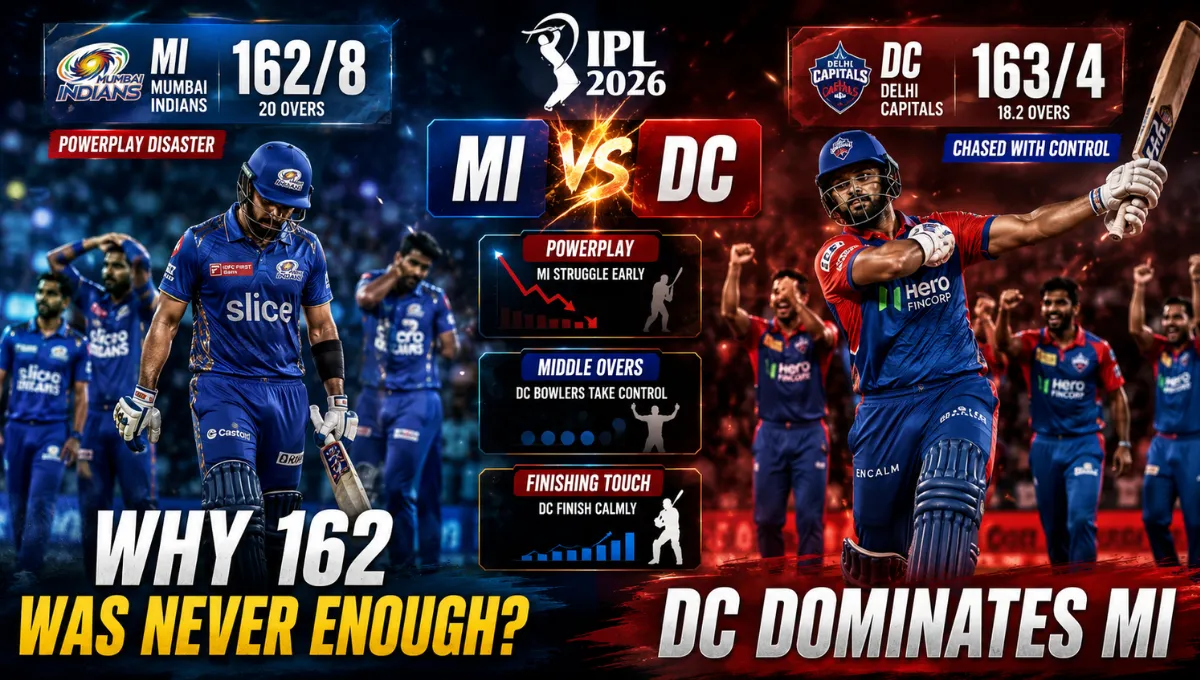
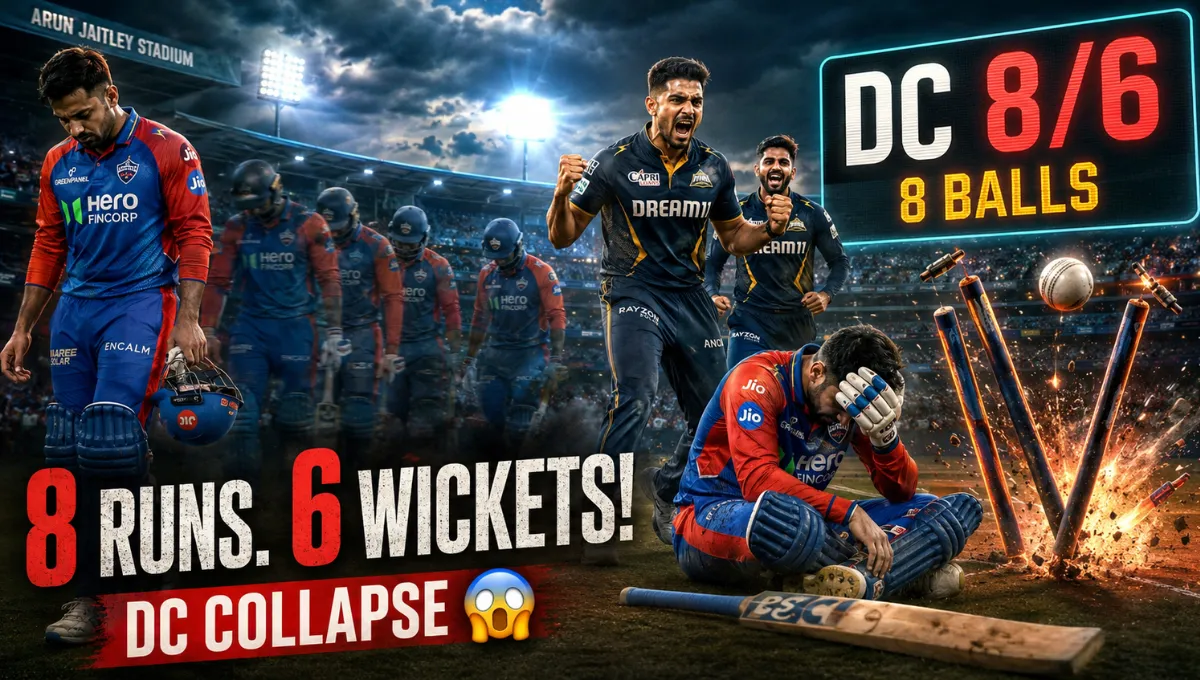
April 4, 2026. Arun Jaitley Stadium, Delhi. Delhi Capitals need 163 to win. They’re 7 for 2 in the fourth over. Two of their top-three are back in the pavilion KL Rahul for 2 and Nitish Rana for 5. Most teams would be rattled. Sameer Rizvi walks in at No.3 and proceeds to score 90 off 51 balls.
DC win by 6 wickets with 11 balls to spare.
But here’s the real problem with how this match is typically presented: scorecard pages show Rizvi 90 and the margin. Nobody shows how DC were in genuine trouble at 7/2, how he rebuilt the chase methodically with Pathum Nissanka, and why Mumbai Indians with Suryakumar Yadav making 51, still couldn’t post more than 162 on a pitch that restricted everybody.
This is the complete picture.
MI vs DC – recent match scorecards at a glance
| Match | Date | Venue | MI Score | DC Score | Result |
|---|---|---|---|---|---|
| IPL 2026 – Match 8 | Apr 4, 2026 | Arun Jaitley Stadium, Delhi | 162/6 (20 ov) | 164/4 (18.1 ov) | DC won by 6 wkts (11 balls) |
| IPL 2025 – Match 63 | May 21, 2025 | — | 205/5 (20 ov) | 193 all out (20 ov) | MI won by 12 runs |
| IPL 2024 – Match (1) | 2024 | — | — | — | MI won by 29 runs |
| IPL 2024 – Match (2) | 2024 | — | — | — | DC won by 10 runs |
| IPL 2023 – Match | 2023 | — | DC 172 | MI 173/4 | MI won by 6 wkts |
The 2026 encounter is DC’s first win over MI since their IPL 2024 split. It signals a DC rebuild that is beginning to deliver results.
IPL 2026 Match 8 – DC 164/4 beat MI 162/6 by 6 wickets
Match info
| Match | DC vs MI – IPL 2026, 8th Match |
|---|---|
| Venue | Arun Jaitley Stadium, New Delhi |
| Date | April 4, 2026 |
| Toss | — |
| Pitch | Slow, black-soil — restricts stroke-making for pacers and spinners alike |
| Result | Delhi Capitals beat Mumbai Indians by 6 wickets (11 balls remaining) |
Full MI batting card
| Batter | R | B | 4s | 6s | SR |
|---|---|---|---|---|---|
| Ryan Rickelton | 18 | 15 | 2 | 0 | 120.00 |
| Rohit Sharma | 9 | 11 | 1 | 0 | 81.81 |
| Tilak Varma | 0 | 2 | 0 | 0 | 0.00 |
| Suryakumar Yadav | 51 | 40 | 4 | 2 | 127.50 |
| Sherfane Rutherford | 8 | 7 | 0 | 1 | 114.28 |
| Naman Dhir | 17 | 11 | 1 | 1 | 154.54 |
| Mitchell Santner | 24 | 19 | 2 | 1 | 126.31 |
| Corbin Bosch | 4 | 4 | 0 | 0 | 100.00 |
| Total | 162/6 | 120 | — | — | 8.10 rpo |
DC bowling:
| Bowler | O | R | W | ECO |
|---|---|---|---|---|
| Mukesh Kumar | 4 | 26 | 2 | 6.50 |
| Deepak Chahar | 4 | 20 | 1 | 5.00 |
| Axar Patel (c) | 4 | 22 | 1 | 5.50 |
| Others | — | — | — | — |
Read Also:- Royal Challengers Bengaluru vs Chennai Super Kings match scorecard
Why MI scored only 162/6: the slow-pitch trap
The Arun Jaitley Stadium’s black-soil pitch in early April is one of the most deceptive surfaces in the IPL. The ball grips the surface, takes away pace from strokes, and rewards variations from both seam and spin.
What people think vs reality:
- What people think: “MI batted poorly. 162 on a flat Delhi pitch is under-par.”
- Reality: The ESPN match report explicitly confirmed the Arun Jaitley pitch was “slow, black-soil” on match day. In those conditions, 162/6 is a competitive score not embarrassing. DC needed the full 18.1 overs to reach 164, and they lost 4 wickets doing it. The pitch was not flat.
Unique insight: Suryakumar Yadav’s 51 off 40 (SR 127.5) is the most telling number in MI’s batting card. His career T20 strike rate is consistently above 175. When SKY scores at SR 127, it doesn’t mean he batted badly it means the conditions were genuinely restricting his natural game. Axar Patel (1/22 off 4 overs at economy 5.50) and Deepak Chahar (1/20 off 4 overs at economy 5.00) are not premier T20 restrictors by IPL standards but on this pitch, they bowled as though they were.
Common mistake in analysis: Looking at Mukesh 2/26 and thinking DC attacked. They didn’t. All three key DC bowlers conceded under 6.5 per over in an IPL match at Delhi. They restricted the world’s best batting lineup to 162 by controlling length and using the pitch, not by taking 6 wickets.
The turning point in MI’s innings was actually overs 11–14: after SKY and Rutherford appeared to stabilise at 100-ish for 4, they lost Rutherford (8) and the acceleration never came. MI went from “needing a 50-run final 4 overs” to “needing a 55-run final 5 overs” and the pitch didn’t allow it.
DC’s chase – Rizvi 90 off 51 and the Nissanka partnership
Full DC batting card (chasing 163)
| Batter | R | B | 4s | 6s | SR |
|---|---|---|---|---|---|
| KL Rahul | 2 | 4 | 0 | 0 | 50.00 |
| Pathum Nissanka | 44 | 39 | 4 | 1 | 112.82 |
| Nitish Rana | 5 | 6 | 0 | 0 | 83.33 |
| Sameer Rizvi | 90 | 51 | 8 | 5 | 176.47 |
| David Miller | 21 | 18 | 2 | 1 | 116.66 |
| Tristan Stubbs | 3 | 4 | 0 | 0 | 75.00 |
| Total | 164/4 | 109 | — | — | (18.1 overs) |
MI bowling:
| Bowler | O | R | W | ECO |
|---|---|---|---|---|
| Deepak Chahar | — | 20 | 1 | 5.00 |
| Others | — | — | 3 | — |
Sameer Rizvi 90 off 51: phase-by-phase
What most people miss: Rizvi’s 90 wasn’t built from a position of comfort. It was a rescue act.
| Phase | Score when Rizvi arrived/progressed | Context |
|---|---|---|
| Arrival | DC 7/2 (over 3.4) | Rahul 2 and Rana 5 — both top-order failures |
| Stabilisation (overs 4–9) | DC 7/2 → ~66 | Nissanka partnership; Rizvi 25 off ~20 — reading the slow pitch |
| Acceleration (overs 10–16) | DC ~66 → ~130 | Rizvi shifts gears; 65 runs off the next 31 balls |
| Finish | DC 164/4 (18.1) | DC win with 11 balls to spare |
The Rizvi-Nissanka partnership: Nissanka’s 44 off 39 (SR 112.82) looks modest but was crucial he occupied the other end while Rizvi scored freely, preventing the bowling from doubling up on the dangerous batter. Together they added 66 runs for the third wicket, taking DC from 7/2 to 73/2, the point at which the chase shifted from “tight” to “controlled”.
Original observation: Sameer Rizvi has now won the Player of the Match award in two consecutive games in IPL 2026. For a young batter playing in a new DC setup under Axar Patel’s captaincy, this form is not coincidence it’s a player with specific abilities (deep back-foot game, ability to hit seamers on slow surfaces) who is perfectly matched to Arun Jaitley’s conditions. When DC play at home, Rizvi’s value is multiplied by the venue.
Slightly bold opinion: Rizvi 90 off 51 on a slow, black-soil pitch is a technically more complete innings than many of the higher-profile T20 centuries scored at flatter venues. Anybody can hit 90 at Chinnaswamy. Doing it while rebuilding from 7/2 on a surface where the ball grips and every boundary requires a committed shot that’s a batter operating above his age.
IPL 2025 Match 63 – MI 205/5 beat DC 193 by 12 runs
| Format | MI | DC |
|---|---|---|
| Score | 205/5 (20 overs) | 193 all out (20 overs) |
| Result | — | MI won by 12 runs |
MI posted 205/5 a significant score and DC chased 193 (falling 12 short). This match reflects the opposite version of the 2026 encounter: at a venue without Arun Jaitley’s pitch trap, MI’s batting power converted into a total that DC’s bowling couldn’t suppress, and DC’s batting fell just short of a gettable target.
Counterintuitive idea: The 2025 match (MI win by 12 runs) and the 2026 match (DC win by 6 wickets, 11 balls) are both close but they’re close in different ways. MI won 2025 because DC couldn’t defend a 205-run chase in the death. DC won 2026 because Rizvi absorbed pressure in the middle and accelerated. The decisive factor in both matches wasn’t the team with the higher score it was the team that managed the match’s critical pressure phase better.
MI vs DC head-to-head: the full rivalry picture
Overall record
| Format | MI | DC |
|---|---|---|
| Total matches (post-2026 Match 8) | 38 | 38 |
| Wins | 21 | 17 |
| No Result | 0 | 0 |
| Head-to-head advantage | MI lead | — |
MI lead 21-17 after DC’s IPL 2026 win.
Venue breakdown
| Venue | MI Wins | DC Wins | Notes |
|---|---|---|---|
| Wankhede (MI home) | Strong MI | — | MI’s home fortress |
| Arun Jaitley (DC home) | — | Strong DC | Slow pitch amplifies DC home advantage |
Read Also:- Pakistan national cricket team vs West Indies cricket team match scorecard
DC’s cyclical dominance runs
Reviewing the season-wise record reveals a clear pattern:
- 2021: DC won both matches against MI their most dominant MI performance in a season.
- 2022: 1-1 split.
- 2023: MI won (Rohit 65, Tilak 41 in that match).
- 2024: 1-1 split.
- 2025: MI won.
- 2026: DC won.
Original observation: This rivalry has a boom-bust cycle for DC. In the years they field a strong home lineup pace bowling suited to Delhi conditions, a settled top-order they beat MI (2021 twice; 2026 under Axar). In years where their squad transitions or they play away from Delhi’s conditions, MI’s batting depth reasserts. The 2026 DC team (Axar captain, Rizvi in form, Mukesh and Chahar effective on black-soil) is the version that beats MI.
Slightly bold opinion: MI’s 21-17 all-time lead is deceptive. At Arun Jaitley Stadium specifically where the pitch plays slow and DC’s seam-and-spin combination becomes near-unplayable in conditions that suppress MI’s power-hitting DC have a structural edge that doesn’t show in the aggregate record. If you strip away Wankhede matches, this rivalry is extremely tight. MI fans who cite 21-17 are reading a partial picture.
Frequently Asked Questions (FAQs)
Q1. What was the result of DC vs MI in IPL 2026 Match 8?
Ans. In the 8th match of IPL 2026 at Arun Jaitley Stadium, New Delhi on April 4, Delhi Capitals beat Mumbai Indians by 6 wickets with 11 balls remaining. MI scored 162/6 in 20 overs (Suryakumar Yadav 51, Santner 24; Mukesh Kumar 2/26, Chahar 1/20). DC chased 163, finishing 164/4 in 18.1 overs, with Sameer Rizvi scoring 90 off 51 and Pathum Nissanka contributing 44 after DC were 7/2 in the fourth over.
Q2. What was the result of MI vs DC IPL 2025 Match 63?
Ans. In the 63rd match of IPL 2025 on May 21, Mumbai Indians beat Delhi Capitals by 12 runs. MI scored 205/5 in 20 overs; DC were bowled out for 193 in 20 overs, falling 12 runs short.
Q3. What is the head-to-head record between Mumbai Indians and Delhi Capitals in IPL?
Ans. After IPL 2026 Match 8, Mumbai Indians lead Delhi Capitals 21-17 in their all-time IPL head-to-head from 38 matches. Mumbai Indians have generally dominated at Wankhede, while Delhi Capitals perform significantly better at Arun Jaitley Stadium, where slow black-soil conditions suppress MI’s power-hitting.
Q4. Why did MI score only 162 against DC in IPL 2026?
Ans. Arun Jaitley Stadium’s black-soil pitch on April 4, 2026 was slow and gripped the ball — conditions unusual for the venue’s reputation as a batting-friendly ground. DC’s bowlers (Mukesh Kumar 2/26, Axar Patel 1/22, Deepak Chahar 1/20) exploited the conditions expertly. Even Suryakumar Yadav — whose career T20 strike rate exceeds 175 — managed only 51 off 40 (SR 127), indicating genuine pitch difficulty rather than a batting failure.
Q5. Who won the Player of the Match in DC vs MI IPL 2026?
Ans. Sameer Rizvi won the Player of the Match award for his 90 off 51 balls (SR 176.47) in DC’s chase of 163 against Mumbai Indians on April 4, 2026. Notably, it was his second consecutive Player of the Match award in IPL 2026, cementing his position as DC’s most dangerous batting performer at Arun Jaitley under Axar Patel’s captaincy.



Leave a Reply