
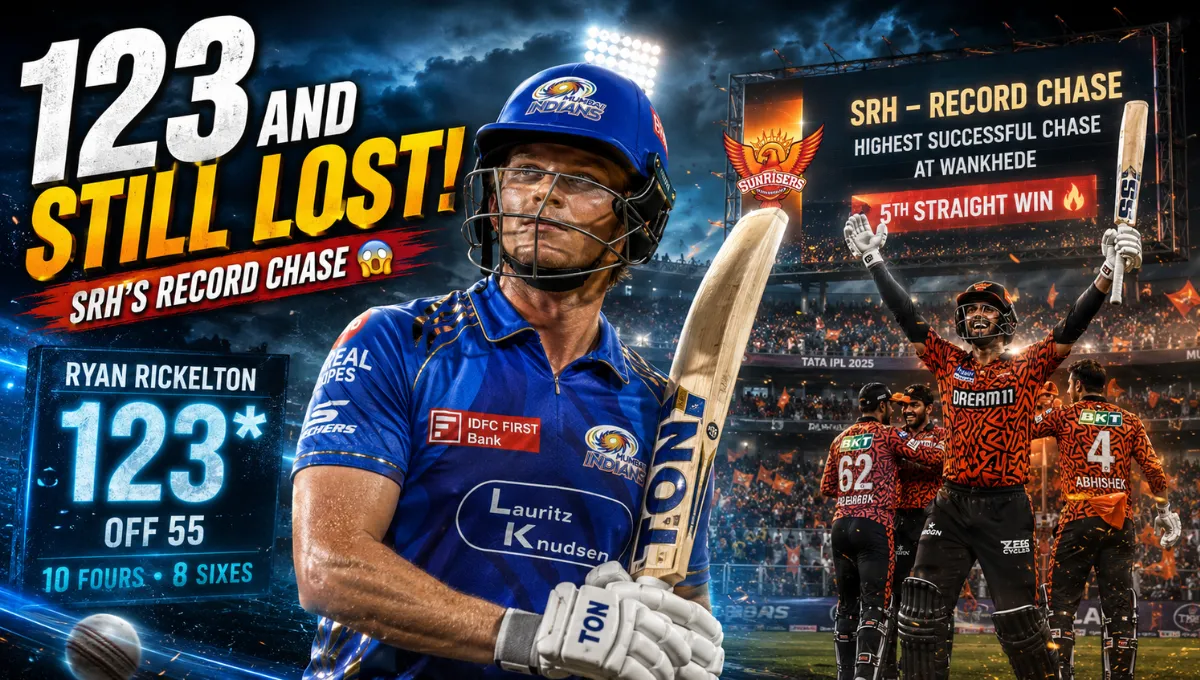
Ryan Rickelton hit 10 fours and 8 sixes for an unbeaten-feeling 123 off 55 balls. His team still lost. That single fact tells you everything about how far T20 batting has evolved a century that would have won most matches in IPL history wasn’t even the headline story of its own game.
This was the highest successful run-chase in IPL history at Wankhede Stadium, and Sunrisers Hyderabad made it look almost routine on their way to a fifth straight win.
Match Result and Full Scorecard
Played 29 April 2026 at Wankhede Stadium, Mumbai. Mumbai Indians won the toss and elected to bat first.
Final result: Sunrisers Hyderabad won by 6 wickets with 8 balls remaining.
Mumbai Indians innings: 243/5 (20 overs)
| Batter | Runs | Balls | 4s | 6s | SR |
|---|---|---|---|---|---|
| Ryan Rickelton | 123 | 55 | 10 | 8 | 223.64 |
| Will Jacks | 46 | 22 | — | — | 209.09 |
SRH bowling: Praful Hinge 4-0-54-2, Eshan Malinga 4-0-29-1, plus the remaining overs shared among the attack.
Sunrisers Hyderabad innings: 249/4 (18.4 overs)
| Batter | Dismissal | Runs | Balls | 4s | 6s | SR |
|---|---|---|---|---|---|---|
| Abhishek Sharma | c Trent Boult b AM Ghazanfar | 45 | 24 | 4 | 3 | 187.50 |
| Travis Head | c Will Jacks b Hardik Pandya | 76 | 30 | 4 | 8 | 253.33 |
| Ishan Kishan (wk) | b AM Ghazanfar | 0 | 1 | 0 | 0 | 0.00 |
| Heinrich Klaasen | not out | 65 | 30 | 7 | 4 | 216.66 |
| Nitish Kumar Reddy | c Suryakumar Yadav b Trent Boult | 21 | 17 | 3 | 0 | 123.52 |
| Salil Arora | not out | 30 | 10 | 2 | 3 | 300.00 |
Read Also:- Mumbai Indians vs Royal Challengers Bengaluru
Extras: 12 (lb4, wd8). Fall of wickets: 129-1 (Abhishek, 8.4 ov), 129-2 (Kishan, 8.5 ov), 133-3 (Head, 9.4 ov), 213-4 (Nitish Reddy, 16.2 ov).
MI bowling: Trent Boult 4-0-41-1, Jasprit Bumrah 4-0-54-0, Will Jacks 1-0-19-0, AM Ghazanfar 4-0-51-2, Ashwani Kumar 2-0-41-0, Hardik Pandya 3.4-0-39-1. Player of the Match: Heinrich Klaasen.
Why a 243 Total Felt Vulnerable Before a Ball Was Even Bowled
Here’s what most match previews get wrong about totals in the 240s. They automatically classify anything above 220 as a strong, defendable score, based on historical IPL averages.
But here’s the real problem with that assumption in 2026 specifically: scoring rates across the league have climbed so sharply that a total which would have been comfortably match-winning even three seasons ago is now, at best, a coin-flip proposition against a genuinely dangerous top three.
What most people miss is that Wankhede Stadium’s dimensions and typically true, flat surface make it one of the most batting-friendly venues in the competition. A total of 243 there carries less of a psychological buffer than the same score would at a slower, more two-paced ground. MI’s bowlers weren’t simply outplayed by superior batting they were fighting the specific characteristics of their own home surface as much as they were fighting SRH’s lineup.
The Turning Point: Why 244 Was Still Not Enough
Here’s what most recaps get wrong. They say SRH “chased comfortably” and leave it there. But here’s the real problem for MI Abhishek Sharma and Travis Head added 129 runs for the first wicket in just 8.4 overs, effectively taking the required rate out of danger before SRH’s middle order had even needed to contribute anything.
What most people miss is that MI actually had a window to apply pressure. Both openers fell within a single over of each other, and SRH briefly wobbled to 133/3. That’s exactly the moment a chase can unravel except SRH ran into Heinrich Klaasen, who absorbed the early risk of the situation before accelerating past MI entirely.
Counterintuitive idea worth stating plainly: conventional wisdom says a total of 243 should be defended comfortably by a bowling attack featuring Jasprit Bumrah and Trent Boult. Instead, Bumrah finished with 0 wickets for 54 runs proof that even elite bowlers can be rendered powerless when a batting lineup treats every ball as an opportunity rather than a threat.
Powerplay Breakdown: How SRH Effectively Won the Match in Eight Overs
| Phase | SRH Runs | SRH Wickets | Required Rate Before Phase | Required Rate After Phase |
|---|---|---|---|---|
| Overs 1-6 (powerplay) | Approx. 100+ | 0 | 12.20 | Well under 10 |
| Overs 7-9 | Additional runs to reach 133 | 3 (Abhishek, Kishan, Head) | Under 10 | Briefly rising again |
| Overs 10-16 | Klaasen and Nitish Reddy rebuild to 213 | 1 (Nitish Reddy) | Manageable | Comfortably under control |
| Overs 17-18.4 | Klaasen and Arora finish it | 0 | Minimal | Match effectively over |
This phase breakdown is the real story competitors miss entirely. SRH’s chase was won almost entirely in the powerplay, briefly threatened in the 7-9 over window, and then closed out efficiently once Klaasen took control. A chase built this way front-loaded aggression, a short wobble, then calm finishing is a far more repeatable and coachable formula than a chase that requires late-over heroics from ball one.
Comparing MI’s Bowling Figures: Where the Plan Actually Broke Down
| Bowler | Overs | Runs Conceded | Economy | Wickets |
|---|---|---|---|---|
| Trent Boult | 4 | 41 | 10.25 | 1 |
| Jasprit Bumrah | 4 | 54 | 13.50 | 0 |
| Will Jacks | 1 | 19 | 19.00 | 0 |
| AM Ghazanfar | 4 | 51 | 12.75 | 2 |
| Ashwani Kumar | 2 | 41 | 20.50 | 0 |
| Hardik Pandya | 3.4 | 39 | 10.63 | 1 |
Laid out this way, the pattern is unmistakable: not a single MI bowler finished with an economy under 10 runs per over.
Common mistake in single-match analysis: singling out Bumrah’s wicketless figures as the story, when the table shows every bowling option MI turned to was collectively taken apart. Ashwani Kumar’s two overs for 41 runs, in particular, is the kind of figure that suggests MI’s fifth-bowler option was simply overmatched against a top order playing with total freedom.
This is also where things go wrong for teams trying to draw the wrong lesson from a result like this. The temptation is to blame personnel to say MI need a different bowling attack entirely. The more useful, harder truth is that MI’s captain and think tank had no effective adjustment once the powerplay assault began. Field placements, bowling changes, and death-overs planning all appeared to follow the same pattern regardless of how the previous over had gone, and against a batting lineup this dangerous, a static plan is a losing plan.
Player Performance Breakdown
- Ryan Rickelton (123 off 55): Became the fifth batter in IPL 2026 alone to score a century and still finish on the losing side a statistic that says more about how much scoring has escalated this season than about any individual failing.
- Bold opinion worth stating plainly: a team can no longer assume a maiden IPL century from an opener guarantees victory; it has simply become the price of entry to a competitive total in 2026.
- Heinrich Klaasen (65* off 30, Player of the Match): His own explanation of his approach taking early risk because of a “big gap at cow corner,” despite a left shoulder issue limiting his usual power over that side reflects a batter making a specific tactical read of the field rather than simply relying on natural power-hitting.
- Travis Head (76 off 30): The most destructive individual innings of the match by strike rate, striking eight sixes.
- Common mistake in analysing an explosive powerplay innings: crediting it purely to aggression, when Head’s approach described by teammate Abhishek Sharma as quietly doing “his talking with the bat” reflects a deliberate, low-fuss method rather than reckless hitting.
- Salil Arora (30* off 10): Sealed the win with back-to-back sixes in the second-to-last over, including a no-look shot off Jasprit Bumrah.
- What people think vs reality: a young, uncapped-feeling finisher smashing a bowler of Bumrah’s stature might look like fearless improvisation; in reality, Klaasen revealed he had specifically told Arora he “did not have to worry” and could simply “finish the game,” reflecting a deliberate mentoring moment behind the scenes.
- Jasprit Bumrah (0/54): Even India’s premier fast bowler had no answer on this surface.
- Practical lesson for any bowling unit facing this kind of top-order intent: a good yorker plan means little if the batter has already decided to attack regardless of length, as Arora’s dismissive six off a missed Bumrah yorker demonstrated.
- Will Jacks (46 off 22): Often overlooked in match reports focused on Rickelton’s century, Jacks’ cameo was a genuinely important part of MI reaching 243 rather than a more modest total. Without his support, MI’s total likely finishes closer to 210, and this match probably isn’t competitive at all rather than a genuine near-miss for the bowling side.
What This Result Meant for Both Teams
| Team | Season Context After This Match |
|---|---|
| Sunrisers Hyderabad | Extended their winning streak to five matches, firmly establishing themselves as genuine playoff contenders |
| Mumbai Indians | Sat bottom of the IPL 2026 points table with 4 wins from 14 matches and a net run rate of -0.584, their season effectively over |
Read Also:- Gujarat Titans vs Chennai Super Kings Match Scorecard
Bold opinion worth stating plainly: Hardik Pandya’s own post-match admission that MI “have not been able to do what MI stands for” as an overall unit is a rare moment of genuine candour from a captain, and it explains this result better than any single statistic. This wasn’t a fluke defeat against a hot opposition; it was the latest data point in a season-long structural problem with MI’s bowling depth and squad balance.
The Bigger Pattern: Why Totals in the 240s No Longer Guarantee Safety
This match is not an isolated freak result. Across IPL 2026, the number of matches decided by totals above 220 runs has increased noticeably compared to previous seasons, and the number of successful chases above 200 has climbed alongside it.
Practical takeaway for franchises building squads for next season: a batting-heavy strategy focused purely on posting big totals is no longer, by itself, a winning formula. Bowling attacks capable of taking wickets in the powerplay rather than simply containing runs are becoming the more valuable asset, because containment alone is proving insufficient against lineups willing to attack from the first ball regardless of the required rate.
For Mumbai Indians specifically, this raises a pointed question about squad construction heading into future auctions: does a batting order capable of 243 actually matter if the bowling attack cannot defend it even with two genuinely world-class bowlers in Bumrah and Boult? The uncomfortable answer this match suggests is that MI’s problem is not personnel quality it’s a lack of tactical variation and plans B and C when the first plan clearly isn’t working inside the powerplay.
Key Highlights and Records From the Match
- Sunrisers Hyderabad’s chase of 244 is the highest successful run-chase at Wankhede Stadium in IPL history.
- Ryan Rickelton became the fifth batter in IPL 2026 to score a century and still finish on the losing side.
- Abhishek Sharma and Travis Head put on 129 runs for SRH’s first wicket in just 8.4 overs.
- Jasprit Bumrah finished with figures of 0/54, one of the most expensive wicketless outings of his IPL career.
- This was Sunrisers Hyderabad’s fifth straight win, extending their strong run through the back half of IPL 2026.
- Mumbai Indians finished the match bottom of the points table, with 4 wins from 14 games and a net run rate of -0.584.
Frequently Asked Questions (FAQs)
Q1. Who won the Mumbai Indians vs Sunrisers Hyderabad match in IPL 2026?
Ans. Sunrisers Hyderabad won by 6 wickets, chasing down Mumbai Indians’ 243/5 with 249/4 in 18.4 overs at Wankhede Stadium, Mumbai, on 29 April 2026.
Q2. Who was Player of the Match in MI vs SRH, IPL 2026?
Ans. Heinrich Klaasen was named Player of the Match for his unbeaten 65 off 30 balls, anchoring SRH’s chase after two early wickets.
Q3. What record did this MI vs SRH match set?
Ans. Sunrisers Hyderabad’s chase of 244 is the highest successful run-chase in IPL history at Wankhede Stadium.
Q4. Did Ryan Rickelton’s century go in vain?
Ans. Yes. Ryan Rickelton scored 123 off 55 balls for Mumbai Indians, but SRH still won by 6 wickets, making him the fifth batter in IPL 2026 to score a century and finish on the losing side.
Q5. How did Jasprit Bumrah perform in this match?
Ans. Jasprit Bumrah finished with figures of 0 wickets for 54 runs in his 4 overs, one of the most expensive wicketless spells of his IPL career, as SRH’s batters attacked him throughout his overs.









Leave a Reply