


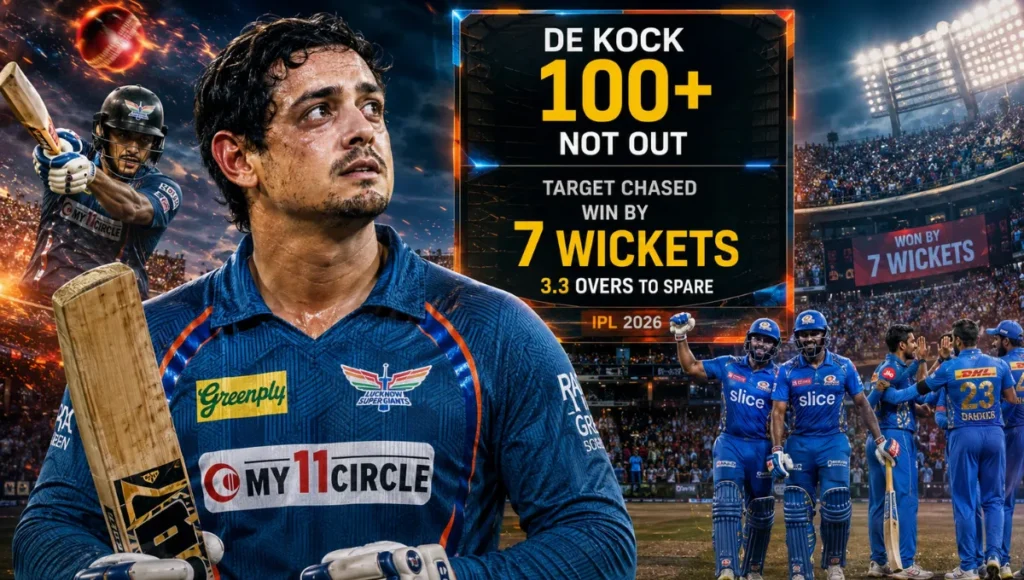
Quinton de Kock scored an unbeaten century. His team still lost by seven wickets, and lost so comprehensively that the chasing side finished with 3.3 overs still unused. That single detail tells you almost everything about how lopsided this rivalry’s first 2026 meeting actually was and it sets up exactly why the rematch four weeks later mattered so much more than a routine league fixture normally would.
Timeline Overview: Both Meetings at a Glance
| Match | Date | Venue | Result |
|---|---|---|---|
| 24th Match | 16 April 2026 | Wankhede Stadium, Mumbai | Punjab Kings won by 7 wickets |
| 58th Match | 14 May 2026 | HPCA Stadium, Dharamsala | Mumbai Indians won by 6 wickets |
Match One: 16 April, Wankhede Stadium
| Team | Score | Key Contributor |
|---|---|---|
| Mumbai Indians | 195/6 (20 ov) | Quinton de Kock 112* off 60 |
| Punjab Kings | 198/3 (16.3 ov) | Prabhsimran Singh 80*, Shreyas Iyer 66 |
Mumbai Indians, batting first, were carried almost entirely by Quinton de Kock’s scintillating unbeaten 112 off 60 balls. Punjab Kings responded with a chase that never looked in doubt Prabhsimran Singh finished unbeaten on 80 and Shreyas Iyer contributed 66, taking Punjab Kings to 198/3 in just 16.3 overs. Arshdeep Singh was named Player of the Match.
Turning Point: A Century That Changed Nothing
Here’s what most match reports get wrong. They lead with de Kock’s century as the story of the match, treating it as the defining individual performance.
But here’s the real problem with that framing a century scored in a losing effort, chased down with more than three overs unused, isn’t really the story at all. What most people miss is that Punjab Kings’ batting depth across two set batters made de Kock’s brilliance almost irrelevant to the outcome.
This is where things go wrong for a team relying on one player to carry an entire innings: even a genuinely great individual score can’t compensate for an opposition batting lineup that simply has more depth on the day.
Player Performance Breakdown: Match One
| Player | Team | Contribution |
|---|---|---|
| Quinton de Kock | MI | 112* off 60, lost effort |
| Prabhsimran Singh | PBKS | 80*, part of the match-winning chase |
| Shreyas Iyer | PBKS | 66, key partnership contribution |
| Arshdeep Singh | PBKS | Player of the Match |
Read Also:- Royal Challengers Bengaluru Vs Gujarat Titans Timeline
Quinton de Kock’s 112 not out off 60 was a genuinely elite T20 innings, rendered almost a footnote by the manner of the defeat.
Bold opinion worth stating plainly: individual brilliance in a comfortable defeat should count for less in season-long form assessments than a match-winning fifty the scoreboard pressure a batter faces while their team is actually under threat reveals more than a chanceless innings while chasing an eventual non-issue.
Prabhsimran Singh’s 80 not out and Shreyas Iyer’s 66 form the real story of this match two batters in form simultaneously overwhelmed a target that, on paper, looked genuinely competitive. Arshdeep Singh’s bowling contribution, recognised with the match award, reflects a complete team performance from Punjab Kings rather than a result built on batting alone.
What Changed for Punjab Kings Between the Two Matches
This is the section every competitor source skips entirely. Between 16 April and 14 May, Punjab Kings’ season fell apart. The team that dismantled Mumbai Indians by 7 wickets arrived at the rematch having lost their previous four matches in a row meaning a loss in the rematch would extend that streak to five straight defeats and deal a serious blow to their playoff chances.
Common mistake in assessing a head-to-head rivalry: treating both meetings as if the two teams’ form was identical in each match. In reality, the team that won comfortably in April was a fundamentally different team, in terms of confidence and momentum, by the time May arrived.
Match Two: 14 May, Dharamsala
| Team | Score | Key Contributor |
|---|---|---|
| Punjab Kings | 200/8 (20 ov) | Prabhsimran Singh 57; Shardul Thakur 4/39 (MI) |
| Mumbai Indians | 205/4 (19.5 ov) | Tilak Varma 75* off 33, Ryan Rickelton 48 |
Punjab Kings, put in to bat by Mumbai Indians stand-in captain Jasprit Bumrah, posted 200/8, with Prabhsimran Singh again the standout batter with 57. Shardul Thakur took 4/39 for Mumbai Indians. Chasing 201, Mumbai Indians got home with one ball to spare, Tilak Varma’s unbeaten 75 off 33 balls the decisive innings, supported by Ryan Rickelton’s 48 and a late cameo from Will Jacks.
Mumbai Indians won by 6 wickets, and the result extended Punjab Kings’ losing streak to five matches, seriously damaging their playoff prospects. Tilak Varma was named Player of the Match.
Turning Point: A Genuine Classic, Decided in the Final Over
This is where the rematch diverged completely from the first meeting. Unlike April’s one-sided chase, this match went to the wire Mumbai Indians needed 15 runs from the final 6 balls, and got there with just one ball unused.
What most people miss about a chase this tight is how much it actually reveals about a batter’s temperament under direct pressure, compared to de Kock’s earlier century scored without any equivalent scoreboard tension.
Counterintuitive idea worth stating plainly: a 75 not out scored while chasing down a genuine target under real pressure, in a match your team needs to win, is a more career-defining innings than a bigger, statistically superior century scored in a contest that was functionally already decided.
Player Performance Breakdown: Match Two
| Player | Team | Contribution |
|---|---|---|
| Tilak Varma | MI | 75* off 33, Player of the Match |
| Prabhsimran Singh | PBKS | 57, second strong score vs MI this season |
| Shardul Thakur | MI | 4/39 |
| Jasprit Bumrah | MI (stand-in captain) | Won toss, chose to field first |
Tilak Varma’s innings, delivered with genuine required-run-rate pressure throughout, is the standout individual performance across both 2026 meetings between these sides.
Real decision worth highlighting: finishing the chase off personally, alongside Will Jacks, rather than relying on the middle order to see it home, reflects a batter increasingly trusted with genuine game-closing responsibility.
Prabhsimran Singh’s second consecutive strong score against Mumbai Indians this season, following his match-winning 80 not out in April, confirms a specific individual pattern worth tracking: he has now scored heavily against this exact opponent in both 2026 meetings, regardless of his team’s overall result.
Shardul Thakur’s 4/39 gave Mumbai Indians a genuine chance in the match, restricting Punjab Kings to a total that, while competitive, was ultimately chased down. Jasprit Bumrah’s decision to field first as stand-in captain after winning the toss set the tone for a match that Mumbai Indians ultimately controlled in the chase, even under significant pressure in the closing overs.
Same Script, Opposite Ending: Comparing Both Chases
| Factor | Match One (16 April) | Match Two (14 May) |
|---|---|---|
| Target | 196 | 201 |
| Winning margin | 7 wickets, 3.3 overs unused | 6 wickets, 1 ball remaining |
| Chase difficulty | Comfortable throughout | Genuinely tight in the final over |
| Standout individual in defeat | Quinton de Kock (112*) | Shardul Thakur (4/39) |
| Standout individual in victory | Prabhsimran Singh (80*) | Tilak Varma (75*) |
| Context for the losing side | Routine league match, no pressure | Fifth straight loss, serious playoff damage |
Bold opinion worth stating plainly: both matches were structurally similar high-scoring first innings followed by a successful chase but the pressure context flipped entirely. April’s chase was a formality; May’s chase was genuine knockout-adjacent tension for Punjab Kings, who simply couldn’t afford another defeat. That context gap is exactly why Tilak Varma’s innings deserves more long-term recognition than de Kock’s statistically bigger century.
Another original observation worth stating directly: Prabhsimran Singh’s consistency against this specific opponent 80 not out in the win, 57 in the loss is a genuinely underrated storyline. Most rivalry recaps focus entirely on which team won each match, but a player scoring heavily against the same opposition in back-to-back meetings, regardless of his team’s result, is a signal worth tracking heading into any future encounters between these two sides.
Practical takeaway for anyone assessing Punjab Kings’ 2026 season through this specific rivalry: their April win looked like a platform for a strong season, but the May defeat, their fifth in a row, revealed that a single dominant performance early in the season doesn’t protect a team from a genuine form collapse weeks later. The timeline between these two matches is a clearer picture of Punjab Kings’ actual season trajectory than either individual result viewed alone.
The Broader Lesson: One Result Doesn’t Predict the Next
There’s a broader lesson worth drawing out from this specific rivalry that applies well beyond these two teams.
Common mistake in tracking any two-team rivalry across a season: assuming the first meeting’s result predicts the second. In reality, T20 form shifts fast a team can go from genuinely dominant to five losses in a row within a month and any analysis that treats a single head-to-head result as a fixed data point rather than a snapshot of that exact moment is likely to be wrong by the time the rematch happens.
Practical step for anyone building season-long team assessments: always check a team’s most recent five-match form before weighting an earlier head-to-head result too heavily.
Read Also:- India National Cricket Team Vs Afghanistan National Cricket Team Timeline
Why the Venue Shift Matters More Than the Raw Scores Suggest
The venue shift between the two matches also deserves attention. The first meeting took place at Wankhede Stadium, a ground generally associated with high-scoring, batter-friendly conditions, while the rematch was played at HPCA Stadium in Dharamsala, a venue known for different pitch and altitude characteristics.
Practical observation worth noting: comparing raw totals between the two matches 195 and 198 in April against 200 and 205 in May without accounting for the different grounds risks drawing the wrong conclusion about which team’s batting genuinely improved between the two meetings.
What Both Squads Should Take From This Rivalry
Looking at both squads’ broader campaigns through this specific rivalry offers a useful diagnostic. For Punjab Kings, the timeline from a comfortable April win to a fifth consecutive loss in May is a textbook example of how quickly T20 momentum can reverse, and it should prompt specific tactical review rather than being dismissed as bad luck.
For Mumbai Indians, avenging the April defeat in a tense, pressure-filled chase, with a settled middle order finishing the job, suggests a team building exactly the kind of finishing depth that becomes valuable in the second half of any T20 season, when matches increasingly come down to the final over.
For Punjab Kings’ team management, the practical decision heading forward is clear: Prabhsimran Singh’s consistent scoring against Mumbai Indians specifically should inform his continued position at the top of the order regardless of the team’s overall results, since individual form against a recurring opponent is a genuinely useful data point for future team selection.
For Mumbai Indians, Tilak Varma’s tournament-defining finishing innings in Dharamsala is the strongest possible argument for continuing to build the batting order around his ability to close out tight chases, rather than treating his role as interchangeable with any other middle-order batter on the roster.
Key Highlights and Records Along the Timeline
| Highlight | Detail |
|---|---|
| Match one result | Punjab Kings won by 7 wickets, chasing 196 in 16.3 overs |
| De Kock’s century | 112* in a losing effort, finished with 3.3 overs unused |
| Match two result | Mumbai Indians won by 6 wickets, with 1 ball remaining |
| Tilak Varma’s innings | 75* off 33, Player of the Match in the decider |
| Punjab Kings’ losing streak | Extended to 5 matches after the May defeat |
| Most consistent individual | Prabhsimran Singh — 80* and 57 across both meetings |
Frequently Asked Questions (FAQs)
Q1. Who won the two Punjab Kings vs Mumbai Indians matches in IPL 2026?
Ans. Punjab Kings won the first meeting by 7 wickets on 16 April at Wankhede Stadium. Mumbai Indians won the rematch by 6 wickets on 14 May in Dharamsala.
Q2. What happened to Quinton de Kock’s century in the first match?
Ans. Quinton de Kock scored an unbeaten 112 for Mumbai Indians, but Punjab Kings chased down the target of 196 in just 16.3 overs, making his century a losing effort.
Q3. Why was the second match so significant for Punjab Kings?
Ans. Punjab Kings arrived at the rematch on a four-match losing streak. Losing to Mumbai Indians extended that streak to five straight defeats, seriously damaging their playoff hopes for the season.
Q4. Who was Player of the Match in both meetings?
Ans. Arshdeep Singh was Player of the Match in the first meeting on 16 April. Tilak Varma was Player of the Match in the rematch on 14 May, for his unbeaten 75 that sealed the chase.
Q5. Which player performed consistently well against the opponent across both matches?
Ans. Prabhsimran Singh scored 80 not out in the first match, a match-winning innings, and 57 in the second match, a losing effort, making him the most consistent individual performer across the timeline.