
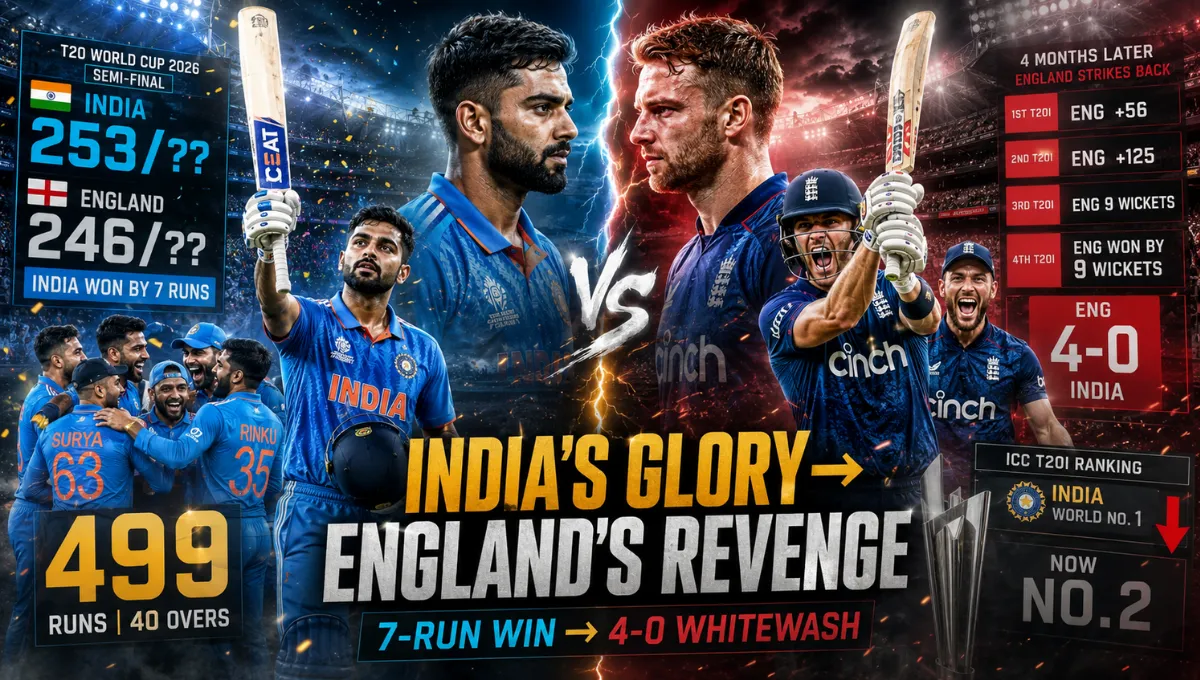
England Cricket Team Vs India National Cricket Team Stats cover head-to-head results, wins, losses, draws, and individual records across Tests, ODIs, and T20Is. India scored 253 in a T20 World Cup semi-final. England scored 246 in reply. Between them, that’s 499 runs in 40 overs the most ever seen in a men’s T20 World Cup match. India won by 7 runs. Four months later, the same two teams met again, and England won by 56 runs, then 125 runs, then 9 wickets, on their way to a 4-0 whitewash that stripped India of their world No.1 T20I ranking.
Read those two results side by side and you get the real story behind England vs India in 2026. Not one dominant team, but two teams who each had their moment, separated by just a few months.
Quick Stats Snapshot: Two Results, One Contradiction
| Event | Date | Result |
|---|---|---|
| T20 World Cup 2026, 2nd Semi-Final | 5 March 2026 | India won by 7 runs |
| T20I series (5 matches) | 1-11 July 2026 | England won 4-0 (1 no result) |
| ODI series (3 matches) | 14-19 July 2026 | England won 2-1 |
India won the match that mattered most in March. England won almost everything that mattered in July.
The T20 World Cup Semi-Final: A 499-Run Classic
Played 5 March 2026 at Wankhede Stadium, Mumbai. England won the toss and chose to field first.
Final result: India won by 7 runs, advancing to their second consecutive T20 World Cup final.
India innings: 253/7 (20 overs)
| Batter | Runs | Balls | Note |
|---|---|---|---|
| Sanju Samson | 89 | 42 | Player of the Match, his second defining knock in as many matches |
| Shivam Dube | 43 | — | Crucial support in the middle overs |
| Ishan Kishan | 39 | — | Contributed to India’s record knockout total |
England bowling: Will Jacks 2/40, Adil Rashid 2/41, plus the rest of the attack unable to prevent India’s highest-ever total in a T20 World Cup knockout match.
England innings: 246/7 (20 overs)
| Batter | Runs | Balls | Note |
|---|---|---|---|
| Jacob Bethell | 105 | 48 | Run out in the final over attempting to complete the chase |
| Sam Curran | — | — | Provided support in the middle overs |
Read Also:- Sunrisers Hyderabad vs Kolkata Knight Riders Match Scorecard
India bowling: Hardik Pandya 2/38, plus Jasprit Bumrah’s death-overs execution that ultimately closed out the win.
Turning Point: Bumrah’s Death-Overs Execution
Here’s what most recaps get wrong. They say India “held their nerve” and leave it there. But here’s the real problem for England Jacob Bethell’s 105 off 48 balls had genuinely put the chase ahead of the required rate for long stretches, and it took a combination of Hardik Pandya, Bumrah, and Axar Patel taking timely wickets in the closing overs to prevent what would have been one of the great T20 World Cup semi-final upsets.
What most people miss about the final numbers: England needed just 8 runs from the final over and could not get there, finishing on 246/7 after 22 runs came in that last over alone proof of how close this match actually was, right down to the very last ball.
England Cricket Team Vs India National Cricket Team Stats Player Performance Breakdown
- Sanju Samson (89 off 42, Player of the Match): His second defining knock in as many matches at the tournament, building on his earlier record-breaking performance against West Indies.
- Bold opinion worth stating plainly: a batter delivering back-to-back match-defining T20 World Cup innings against different opponents, in different match situations, is exactly the kind of big-tournament temperament selectors dream of finding.
- Jacob Bethell (105 off 48, on the losing side):
- Counterintuitive idea worth stating plainly: a century in a losing semi-final is often filed away as a footnote. Bethell’s innings deserves more than that it’s the reason this match produced the most runs ever seen in a men’s T20 World Cup game, and it announced him as a genuine white-ball talent months before England’s bilateral dominance made his name a regular headline.
- Jasprit Bumrah: Described afterward as delivering “targeted magnificence” in the closing stages, his death-overs execution is the clearest example of experience mattering more than raw pace when a match is this tightly poised.
The Bilateral Reversal: England’s 4-0 T20I Whitewash
Played across five venues in England, 1-11 July 2026.
Final result: England won the series 4-0, with the opening match washed out by rain.
| Match | Venue | Result |
|---|---|---|
| 1st T20I, 1 July | Chester-le-Street | No result (rain), India 189/7 |
| 2nd T20I, 4 July | Manchester | England won by 4 wickets |
| 3rd T20I, 7 July | Nottingham | England won by 125 runs |
| 4th T20I, 9 July | Bristol | England won by 9 wickets |
| 5th T20I, 11 July | Southampton | England won by 56 runs |
The Buttler-Brook Stand That Changed the Rankings
This is where things go wrong for reading a bilateral series as a routine formality: the 5th T20I decider wasn’t just about sealing a 4-0 result. Jos Buttler and Harry Brook England’s captains past and present put on 233 runs in just 103 balls, a new record second-wicket partnership, propelling England to 257/3. That single stand did more than win one match; it took England to the top of the ICC’s T20I rankings, displacing the reigning world champions.
Match-by-match results
Buttler finished with 131 off 64 balls, and Brook was unbeaten on 95 off 45. India’s reply of 201/8, built on Ishan Kishan’s 56 and Tilak Varma’s 53, was a genuinely competitive total against most attacks it simply wasn’t enough against a batting pair playing with that level of freedom.
Bold opinion worth stating plainly: England’s 2nd T20I win, chasing 191 through Jacob Bethell’s unbeaten 76, is arguably a more important data point than the 125-run demolition in the 3rd T20I. A tight chase completed under pressure reveals more about a team’s actual depth than a one-sided blowout does and Bethell backing up his World Cup semi-final century with another match-winning innings months later confirms this was never a fluke.
The ODI Series: A Closer Contest
| Match | Venue | Result |
|---|---|---|
| 1st ODI, 14 July | Birmingham | India won by 6 wickets |
| 2nd ODI, 16 July | Cardiff | England won by 4 wickets |
| 3rd ODI, 19 July | Lord’s | England won by 27 runs |
England won the series 2-1. India’s win in the opener, chasing 259 to reach 262/4, showed real quality but England’s response, including Joe Root’s 99 not out in the Cardiff chase and a 387/3 total at Lord’s led by Root’s 74 and Buttler’s 41, was enough to close out the series.
Common mistake in reading this ODI series: treating it as a continuation of the T20I whitewash. India actually won the 50-over opener convincingly, and the series was genuinely competitive throughout a reminder that dominance in one format doesn’t automatically transfer to another, even within the same tour.
Historical Head-to-Head Context
Before this year’s contrasting results, the two sides’ most recent Test meeting the 2025 Anderson-Tendulkar Trophy had ended in an extraordinary 2-2 draw across five matches, with the deciding fifth Test at The Oval won by India by just 6 runs after Mohammed Siraj took three of the last four wickets on the final morning.
What people think vs reality: fans often assume a rivalry this competitive in Tests should translate into similarly tight white-ball cricket. The 2026 results prove that assumption wrong the same two teams capable of a 2-2 Test series decided by 6 runs also produced a 499-run T20 World Cup classic decided by 7, and then a lopsided 4-0 T20I whitewash just months later. Format specialism, not overall team strength, decides these margins.
What Changed for India Between March and July
| Factor | March (World Cup semi-final) | July (bilateral series) |
|---|---|---|
| Context | Knockout tournament, maximum focus and preparation | Bilateral tour following a long season, different squad management priorities |
| Personnel | Full-strength tournament squad | Some rotation and different conditions (English pitches vs a neutral tournament venue) |
| England’s approach | Reactive, chasing a record total | Proactive, playing with freedom after building momentum through the series |
| Key difference-maker | Bumrah’s death-overs execution for India | Buttler-Brook’s record stand for England |
Read Also:- Mumbai Indians vs Sunrisers Hyderabad Match Scorecard
Bold opinion worth stating plainly: India’s dip in form between March and July isn’t evidence of a team in decline it’s evidence of how differently international teams approach a World Cup knockout match versus a bilateral series played months later on unfamiliar conditions. The margin between these two results is less about ability and more about which team’s specific match-ups clicked on the day, a pattern that repeats constantly in modern international cricket regardless of overall squad quality.
Key Highlights and Records
- India beat England by 7 runs in the T20 World Cup 2026 semi-final, a match that produced 499 combined runs the most in men’s T20 World Cup history.
- Sanju Samson’s 89 and Jacob Bethell’s 105 were the two standout individual innings of the semi-final, with Bethell’s century coming in a losing effort.
- India’s 253/7 was the highest total ever recorded in a T20 World Cup knockout match at the time.
- England won the bilateral T20I series 4-0, with Jos Buttler and Harry Brook’s 233-run stand in the decider setting a new record for England’s second wicket.
- England’s 5th T20I win took them to the top of the ICC’s T20I team rankings, displacing India as world champions.
- England won the ODI series 2-1, despite India winning the opening match by 6 wickets.
Frequently Asked Questions (FAQs)
Q1. Who won the India vs England T20 World Cup 2026 semi-final?
Ans. India won by 7 runs, posting 253/7 and restricting England to 246/7 at Wankhede Stadium, Mumbai, on 5 March 2026. The match produced 499 combined runs, the most in men’s T20 World Cup history.
Q2. Who was Player of the Match in the England vs India T20 World Cup semi-final?
Ans. Sanju Samson was named Player of the Match for his 89 off 42 balls, his second defining knock in as many matches at the tournament.
Q3. What was the result of the England vs India T20I series in 2026?
Ans. England won the five-match T20I series 4-0, with the opening match washed out by rain. The decider saw Jos Buttler and Harry Brook add a record 233 runs for England’s second wicket.
Q4. Did England overtake India in the T20I world rankings in 2026?
Ans. Yes. England’s 4-0 series win, sealed by their 5th T20I victory, took them to the top of the ICC’s T20I team rankings, displacing India.
Q5. Who won the England vs India ODI series in 2026?
Ans. England won the three-match ODI series 2-1. India won the opening match by 6 wickets, but England won the next two, at Cardiff and Lord’s.








Leave a Reply