
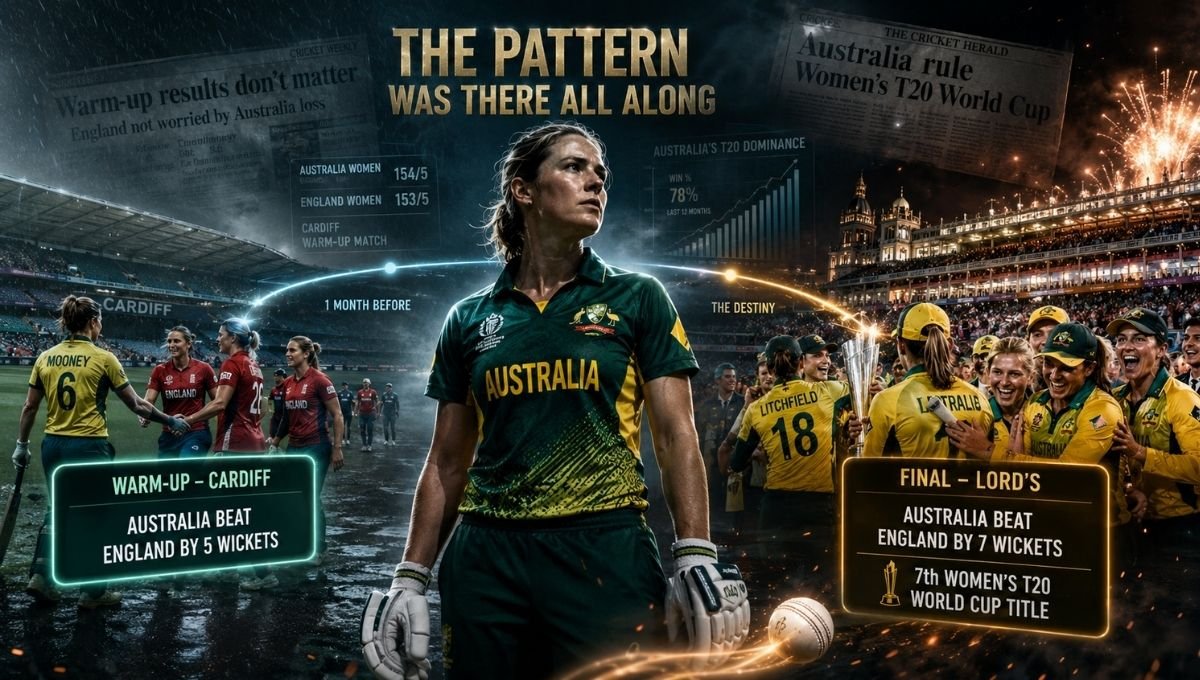
England Women’s National Cricket Team Vs Australia Women’s National Cricket Team Match Scorecard A month before the final, Australia beat England by 5 wickets in a warm-up match at Cardiff. Nobody thought much of it at the time warm-up results rarely mean anything. Then, at Lord’s, in front of a sold-out crowd, Australia beat England again, by 7 wickets, to win a record seventh Women’s T20 World Cup title.
The pattern had been there all along.
Quick Snapshot: Two Matches, One Pattern
| Match | Date | Venue | Result |
|---|---|---|---|
| Warm-up match | 8 June 2026 | Sophia Gardens, Cardiff | Australia won by 5 wickets |
| T20 World Cup Final | 5 July 2026 | Lord’s, London | Australia won by 7 wickets |
Australia beat England twice in the space of a month, in remarkably similar fashion restricting England’s total, then chasing it down comfortably through a middle-order partnership.
Why Connecting These Two Matches Changes the Story
Most coverage of the World Cup final treats it as an isolated, standalone event, separate from anything that came before it in the tournament build-up. That’s a missed opportunity.
The warm-up match, played barely a month earlier, used almost the exact same template Australia would later execute on the biggest stage: bowl first, restrict England to a total in the 150s, then chase it down through a middle-order pairing hitting their straps at the right moment. Reading the two matches together turns the final’s result from a surprising upset story into the logical conclusion of a pattern that had already been established.
The Warm-Up Match: An Early Warning Sign
Played 8 June 2026 at Sophia Gardens, Cardiff. Australia won the toss and chose to field. Final result: Australia Women won by 5 wickets.
England innings: 157/6 (20 overs)
| Batter | Runs | Balls | Note |
|---|---|---|---|
| Alice Capsey | 45 | 36 | Top-order anchor |
| Freya Kemp | 41 | 27 | Middle-overs acceleration |
| Danielle Gibson | 27* | 16 | Unbeaten finishing cameo |
Australia innings: 158/5 (18.2 overs)
| Batter | Runs | Balls | Note |
|---|---|---|---|
| Beth Mooney | 43 | 26 | Set the tone in the chase |
| Ellyse Perry | 64 | 44 | Top scorer, anchored the run chase |
Here’s what most recaps get wrong about a warm-up result. They treat it as meaningless preparation, disconnected from what follows. But here’s the real problem with that view the exact template Australia used in this warm-up (restrict, then chase through two in-form middle-order batters) is almost identical to what they executed in the final itself, just with different individual names carrying the load.
What people think vs reality: warm-up matches are widely assumed to reveal little about tournament form, since teams often experiment with personnel and tactics. In this case, the warm-up turned out to be an unusually accurate preview of exactly how the two sides would eventually meet again on the biggest stage, right down to the specific batting roles that decided both results.
The Final Scorecard: Australia’s Record Seventh Title
Played 5 July 2026 at Lord’s Cricket Ground, London, in front of a sold-out crowd. Australia won the toss and elected to field first.
Final result: Australia Women won by 7 wickets with 17 balls remaining.
England Women innings: 150/4 (20 overs)
| Batter | Dismissal | Runs | Balls | 4s | 6s | SR |
|---|---|---|---|---|---|---|
| Amy Jones (wk) | c Voll b Hamilton | 6 | 6 | 1 | 0 | 100.00 |
| Danni Wyatt-Hodge | c Mooney b Sutherland | 8 | 9 | 1 | 0 | 88.89 |
| Nat Sciver-Brunt (c) | not out | 58 | 53 | 5 | 0 | 109.43 |
| Alice Capsey | b Molineux | 23 | 20 | 2 | 1 | 115.00 |
| Heather Knight | lbw b Garth | 2 | 6 | 0 | 0 | 33.33 |
| Freya Kemp | not out | 44 | 28 | 4 | 1 | 157.14 |
Extras: 9 (lb4, w3, nb2). Sciver-Brunt and Kemp added an unbeaten 80 runs together to close out the innings.
Australia bowling
| Bowler | Overs | Runs | Wickets |
|---|---|---|---|
| Lucy Hamilton | 3 | 19 | 1 |
| Kim Garth | 4 | 20 | 1 |
| Sophie Molineux | 4 | — | 1 |
| Annabel Sutherland | 4 | — | 1 |
Australia Women innings: 153/3 (17.1 overs)
| Batter | Dismissal | Runs | Balls | 4s | 6s | SR |
|---|---|---|---|---|---|---|
| Georgia Voll | b Bell | 9 | 6 | 2 | 0 | 150.00 |
| Beth Mooney (wk) | lbw b Ecclestone | 64 | 49 | 10 | 0 | 130.61 |
| Phoebe Litchfield | c/b Charlie Dean | 48 | 35 | 6 | 2 | 137.14 |
England bowling
| Bowler | Overs | Runs | Wickets |
|---|---|---|---|
| Lauren Bell | — | 22 | 1 |
| Sophie Ecclestone | — | 24 | 1 |
| Charlie Dean | — | 28 | 1 |
Read Also:- England Cricket Team Vs India National Cricket Team Stats
Player of the Match and Player of the Tournament: Beth Mooney.
Turning Point: The Mooney-Litchfield Century Stand
Here’s what most recaps get wrong. They call this “a comfortable chase” and move on. But here’s the real problem with that framing Australia lost Georgia Voll cheaply inside the first over, and the chase could easily have stalled from there against a target that was, at the time, the highest successful chase ever attempted in a Women’s T20 World Cup final.
What most people miss is exactly how decisively Mooney and Litchfield answered that early setback. Their exactly 100-run partnership for the second wicket didn’t just steady the innings it took the game away from England entirely, reducing what should have been a tense finish into a match completed with 17 balls still unused.
How the Chase Actually Unfolded in Phases
| Phase | Australia’s Position | Required Rate |
|---|---|---|
| After Voll’s dismissal (1st over) | 9/1 | Rising slightly, but manageable |
| Halfway point of the chase | Well past 70/1, Mooney-Litchfield in control | Dropped below 6 per over |
| Final overs | 153/3, match already won | Effectively zero |
Voll’s dismissal in the first over could have forced Mooney into caution, but instead she and Litchfield attacked from the very next ball, treating the early wicket as an isolated event rather than a sign to slow down.
Practical lesson for any top order facing an early setback in a run chase: the correct response, demonstrated perfectly here, is not to retreat into caution but to trust the plan and continue playing with intent, provided the batters coming in have the composure to execute it.
England Women’s National Cricket Team Vs Australia Women’s National Cricket Team Match Scorecard Player Performance Breakdown
- Beth Mooney (64 off 49, Player of the Match and Player of the Tournament): This was her third fifty-plus score across multiple T20 World Cup finals, and it completed a historic individual double becoming the first player, men’s or women’s game, to win Player of the Match in a final and Player of the Tournament more than once each.
- Bold opinion worth stating plainly: a player capable of consistently performing on the single biggest stage in the format, across multiple tournament cycles, deserves to be spoken about as one of the format’s genuine all-time greats, not just a very good current player.
- Phoebe Litchfield (48 off 35): Her own description of the partnership “throw the first punch” and get the required rate down to six as fast as possible reveals a deliberate, shared game plan with Mooney rather than two individuals simply batting well independently.
- Nat Sciver-Brunt (58* off 53, England captain): Her own honest post-match reflection admitting England were “outplayed” by “a class Australian side that used all of their experience” is a rare moment of a losing captain crediting the opponent directly rather than making excuses.
- Counterintuitive idea worth stating plainly: an unbeaten 58 in a losing final is often filed away as insufficient; in reality, without her innings, England’s total falls well short of even being competitive.
- Freya Kemp (44* off 28): Her unbeaten stand with Sciver-Brunt, worth 80 runs, was the difference between England posting a genuinely defendable total and folding to a substantially lower score.
- Common mistake in reading England’s innings: crediting the captain alone for the recovery, when Kemp’s support was just as structurally important.
- Sophie Molineux (Australia captain): Winning the World Cup in her very first tournament as captain, she credited the calmness of senior players like Ellyse Perry for helping the group “stay calm and use our brains” under pressure a specific leadership philosophy that paid off in this exact final.
What England Got Right and Still Lost
| What England Did Right | Why It Still Wasn’t Enough |
|---|---|
| Nat Sciver-Brunt’s calm, unbeaten 58 anchored the innings | The overall total of 150 was still short of what a fast-scoring Australian top order could comfortably chase |
| Freya Kemp’s 44* provided genuine late acceleration | The 80-run stand came too late to push the total into a truly match-winning range |
| England restricted Australia’s top order with early wickets in the powerplay | Losing Georgia Voll cheaply barely dented Australia’s chase once Mooney and Litchfield combined |
Bold opinion worth stating plainly: England’s batting performance in this final was genuinely good 150 from a team that lost three early wickets shows real recovery quality. The result wasn’t decided by an England collapse. It was decided by an Australian middle order operating at a level England simply couldn’t match on the day, which is a harder problem to solve than fixing a batting fragility would have been.
What This Result Means for Both Programs Going Forward
For Australia, this title extends a level of sustained dominance that is genuinely rare in international sport seven titles across seven editions of a tournament format is not a cycle of success, it’s closer to an institutional advantage built through recruitment, coaching depth, and a culture of performing under maximum pressure.
Practical takeaway for any cricket board studying Australia’s model: their success is not attributable to one generation of exceptional players alone, evidenced by the fact that Mooney’s title-winning teammates have changed significantly across her multiple final-winning performances since 2020.
For England, the practical question is less about panic and more about precision. Losing a final by seven wickets after posting a competitive 150 is not evidence of a program in crisis it’s evidence of facing an opponent operating at the very peak of the format. The specific area England’s coaching staff should prioritise is middle-overs batting depth beyond Sciver-Brunt and Kemp, so that a similar recovery doesn’t have to rely so heavily on just two players finding form on the same day.
Why Beth Mooney’s Consistency Deserves Deeper Analysis
Winning a single T20 World Cup final is a career highlight for most players. Doing it multiple times, across different Australian squads with different supporting casts, points to something more specific than good form on the day. Mooney’s ability to deliver in finals in particular as opposed to strong performances scattered across a tournament’s group stage suggests a genuine temperament advantage under maximum pressure, separate from raw technical skill.
Common mistake in analysing repeat-final performers: attributing their success purely to experience, as if simply having played in more finals automatically makes a player better in the next one. That explanation doesn’t hold up under scrutiny, since plenty of experienced players have struggled precisely in the biggest moments.
What’s more likely is a specific mental skill set the ability to treat a World Cup final with the same process-driven approach as a routine bilateral match and Mooney’s results suggest she has that skill in unusually high supply.
Read Also:- Sunrisers Hyderabad vs Kolkata Knight Riders Match Scorecard
The Case for Taking Warm-Up Matches More Seriously
This final and its preceding warm-up together make a strong case for treating pre-tournament fixtures as more than disposable practice. Commentary and coverage routinely dismiss warm-up results as unreliable predictors, citing squad rotation and experimental tactics as reasons to discount them. Yet in this instance, the warm-up match’s result, method, and even some of the specific batting roles carried through almost unchanged into the final itself.
Practical decision for broadcasters and analysts covering future tournaments: rather than treating warm-up fixtures as background noise, cross-referencing them against the eventual knockout stage results could reveal genuinely useful predictive patterns, particularly when the same two teams meet again later in the same tournament. This final is a clear data point suggesting that dismissal of warm-up form as meaningless is, at minimum, an oversimplification worth reconsidering.
Key Highlights and Records From the Final
| Highlight | Detail |
|---|---|
| Title count | Australia’s seventh Women’s T20 World Cup title (2010, 2012, 2014, 2018, 2020, 2023, 2026) |
| Individual milestone | Beth Mooney: first player ever with two final Player of the Match awards and two Player of the Tournament awards |
| Chase record | 151 — second-highest successful target in Women’s T20 World Cup knockout history, highest ever in a final |
| Speed record | 17.1 overs — fastest 150-plus successful chase in Women’s T20 World Cup history |
| Home record | England’s only defeat in 12 Women’s T20 World Cup matches on home soil |
| Winning streak | Australia’s 10th consecutive T20I win |
Frequently Asked Questions (FAQs)
Q1. Who won the England Women vs Australia Women T20 World Cup 2026 final?
Ans. Australia Women won by 7 wickets, chasing down England’s 150/4 with 153/3 in 17.1 overs at Lord’s on 5 July 2026.
Q2. Who was Player of the Match in the Women’s T20 World Cup 2026 final?
Ans. Beth Mooney was named Player of the Match for her 64 off 49 balls, also winning Player of the Tournament — a historic double she had previously achieved in 2020 and 2023.
Q3. What record did Australia set by winning this final?
Ans. Australia won their seventh Women’s T20 World Cup title, extending their record as the most successful team in the tournament’s history.
Q4. How did Australia chase down England’s total so quickly?
Ans. Beth Mooney and Phoebe Litchfield added exactly 100 runs for the second wicket after Georgia Voll fell early, taking the required rate out of the equation and completing the chase in 17.1 overs — the fastest 150-plus chase in Women’s T20 World Cup history.
Q5. Did the warm-up match between these two teams predict the final result?
Ans. In hindsight, yes. Australia beat England by 5 wickets in a warm-up match at Cardiff a month before the final, using a similar template of restricting England’s total before chasing it down through a strong middle-order partnership.












Leave a Reply