
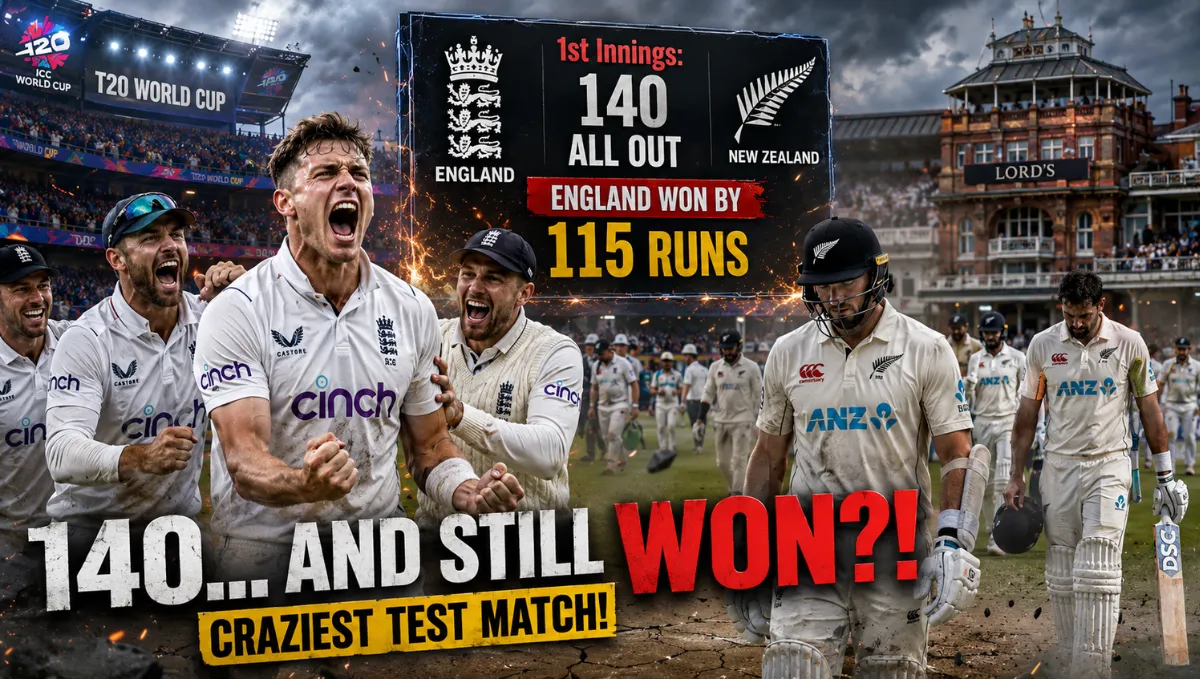
Picture a Test match where the first innings total is just 140 runs barely more than a good T20 score spread across a full day and the team that scored it still wins by 115 runs. That actually happened at Lord’s in June 2026, and it set the tone for one of the strangest England vs New Zealand contests in recent memory. Two Tests produced two completely different stories, and a T20 World Cup match sandwiched in between revealed just how differently these two teams operate depending on the format.
Here’s the complete breakdown, match by match, with the moments that actually decided each result.
Series Snapshot
England won the 1st Test at Lord’s by 115 runs despite being bowled out for just 140 in their first innings, before New Zealand hit back hard, winning the 2nd Test at The Oval by 253 runs to level the series 1-1. What most people miss when they see “115-run win” and “253-run win” side by side is that both results were built almost entirely on bowling brilliance, not batting dominance. This has been a series won and lost by fast bowlers, not batters.
1st Test (Lord’s): England Win the Low-Scoring Chaos
England batted first and were dismissed for just 140 in 39.4 overs. Harry Brook top-scored with 56, while Kyle Jamieson took 5 for 62 and Nathan Smith claimed 3 for 38. It was a day of pure seam and swing, reminiscent of the famous 2022 Lord’s Test between these same two sides, where 17 wickets fell in a single chaotic day.
England 1st Innings: 140 all out (39.4 overs)
| Batter | Runs | Notes |
|---|---|---|
| Harry Brook | 56 | Top scorer in a difficult total |
| Ben Duckett | — | Fell early in the innings |
Bowling: New Zealand
| Bowler | Wickets | Runs |
|---|---|---|
| Kyle Jamieson | 5 | 62 |
| Nathan Smith | 3 | 38 |
New Zealand’s reply was even worse. They collapsed to just 113 all out in 29.5 overs, handing England a first-innings lead despite England’s own modest total. Ollie Robinson was the standout performer with the ball, earning him Player of the Match.
New Zealand 1st Innings: 113 all out (29.5 overs)
| Total | Overs | Run Rate |
|---|---|---|
| 113/10 | 29.5 | 3.79 |
This is where things go wrong for casual readers trying to make sense of this match. Most people assume a 27-run first-innings lead in a low-scoring game means the contest stays tight throughout. The reality is completely different. England used that slender advantage as a psychological platform, batting far more assertively in their second innings once the pressure of batting first on a tricky pitch had passed.
England set New Zealand 254 to win, and despite Glenn Phillips fighting to an unbeaten 31 overnight, New Zealand folded to 138 all out, handing England a 115-run victory.
Final Scorecard: 1st Test, Lord’s
| Team | 1st Innings | 2nd Innings | Result |
|---|---|---|---|
| England | 140 | 226 | Won by 115 runs |
| New Zealand | 113 | 138 | Lost |
Read Also:- Delhi Cricket Team vs Gujarat Cricket Club Match Scorecard
Turning point: New Zealand’s failure to build any partnership past 61 for 6 on the opening day, despite bowling England out cheaply themselves, meant they never converted their own strong bowling performance into a genuine psychological advantage. What people think happened here is that New Zealand’s bowlers effectively won the match for their side by restricting England to 140. The reality is New Zealand’s own batting failures in the same conditions cancelled that advantage out completely.
2nd Test (The Oval): Matt Henry’s 11-Wicket Demolition
If Lord’s was about chaos, The Oval was about one bowler taking total control of a match. New Zealand batted first and posted a commanding 391 in 96.2 overs. Henry Nicholls scored a century, stepping in for the retired Kane Williamson, and Rachin Ravindra added 76, the pair sharing a defining 161-run partnership. England replied with 291 in 84 overs, conceding a first-innings lead of exactly 100 runs a deficit no team had overcome at The Oval in 124 years.
New Zealand 1st Innings: 391 (96.2 overs)
| Batter | Runs | Balls |
|---|---|---|
| Henry Nicholls | 121 | 171 |
| Rachin Ravindra | 76 | 99 |
New Zealand’s second innings added another 362 runs in 87.1 overs, setting England an enormous 463 to win. That target was always a long shot, but what happened next turned a difficult chase into a rout. England resumed day five at 182 for 5, apparently digging in for a draw, only for Matt Henry to produce one of the most destructive spells in recent Test history four wickets for no runs in just 12 balls. England collapsed from 182 for 5 to 192 for 9 within that single spell, and were bowled out for 209, losing by 253 runs.
England 2nd Innings: 209 all out (58.1 overs)
| Batter | Runs | Balls |
|---|---|---|
| Joe Root | 77 | 145 |
| Harry Brook | 58 | 54 |
Matt Henry’s Match Figures
| Innings | Wickets | Runs Conceded |
|---|---|---|
| 1st innings | 5 | 80 |
| 2nd innings | 6 | 29 |
| Match total | 11 | 109 |
Final Scorecard: 2nd Test, The Oval
| Team | 1st Innings | 2nd Innings | Result |
|---|---|---|---|
| England | 291 | 209 | Lost by 253 runs |
| New Zealand | 391 | 362 | Won |
What most people think happened here is that England simply batted poorly under a huge target. The reality is far more specific: they were cruising at 182 for 5, in genuine position to save the match, when Matt Henry produced a spell that would have destroyed almost any batting order in world cricket. Four wickets without conceding a run in twelve balls isn’t a normal collapse it’s a bowler operating on a different level entirely, dismissing Root and Brook within three balls of each other to seal the match.
Turning point: Henry’s four-wickets-in-12-balls burst on the final morning instantly ended any realistic hope of England saving the match, turning a genuinely competitive position into a 253-run defeat within 48 minutes of play. A slightly bold take worth stating directly: judging this match purely by England’s second-innings collapse misses the real story. New Zealand’s bowling attack, led by Henry, was simply operating on a different plane that morning, and no batting adjustment on England’s part would have changed the outcome once he found that rhythm.
T20 World Cup Super Eights: England’s Format Switch
Just weeks after this Test series wrapped up, England and New Zealand met again, this time in the ICC Men’s T20 World Cup 2025-26 Super Eights, Group 2, in Colombo. New Zealand batted first and posted 159 for 7 in their 20 overs, with Tim Seifert top-scoring with 35 off 25 balls. England’s bowlers, led by Will Jacks with 2 for 23, kept things under control throughout.
New Zealand Innings: 159/7 (20 overs)
| Batter | Runs | Balls |
|---|---|---|
| Tim Seifert | 35 | 25 |
Chasing 160, England suffered an early top-order collapse but recovered thanks to Will Jacks’ quickfire unbeaten 32 off 18 balls, chasing the target down with four wickets and three balls to spare. Jacks was named Player of the Match, and the win meant England finished the Super Eights stage undefeated, topping Group 2.
England Innings: 161/6 (19.3 overs)
| Batter | Runs | Balls | Notes |
|---|---|---|---|
| Will Jacks | 32 | 18 | Not out, sealed the win |
| Rehan Ahmed | 19 | 7 | Late acceleration |
Here’s a genuinely counterintuitive angle that gets missed in most coverage: the same England side that collapsed twice under sustained seam pressure in Test cricket looked completely calm chasing under T20 pressure just weeks later. That’s not a contradiction. It reveals something specific about squad identity England’s current top order struggles against patient, disciplined seam bowling in Test conditions, but thrives on the controlled aggression that T20 cricket demands. That’s an actionable insight about team strengths, not just a coincidence of form.
Player Performance Breakdown (Series-Wide)
| Player | Team | Best Performance | Context |
|---|---|---|---|
| Matt Henry | New Zealand | 11 wickets for 109 runs, 2nd Test | Series-defining performance, arguably the standout individual display of the year |
| Henry Nicholls | New Zealand | 121 at The Oval | Century in place of retired Kane Williamson |
| Rachin Ravindra | New Zealand | 76 at The Oval | Key 161-run stand with Nicholls |
| Harry Brook | England | 56 (Lord’s), 58 (The Oval) | Most consistent England batter across both Tests |
| Joe Root | England | 77 at The Oval | Fought hardest during the final-innings collapse |
| Ollie Robinson | England | Player of the Match, 1st Test | Central to England’s Lord’s bowling effort |
| Will Jacks | England | 32* (18) in T20 World Cup | Player of the Match, sealed England’s Super Eights sweep |
Read Also:- India National Cricket Team Vs England Cricket Team Match Scorecard
An original observation worth stating plainly: Matt Henry’s 11-wicket match haul at The Oval deserves to be viewed as one of the defining individual bowling performances of the cricket year, not just a good day with the ball. Taking 6 for 29 in a second innings, including a spell of four wickets in twelve balls to force a result from what looked like a safe position for the opposition, is genuinely rare in modern Test cricket.
What This Series Reveals
England’s Test batting order carries a specific vulnerability against high-quality, patient seam bowling in home conditions, exposed twice by New Zealand’s attack despite England having won the series opener. New Zealand’s bowling depth, with Matt Henry as the headline act, is currently a genuine match winning weapon independent of their own batting form, which explains how they leveled the series despite England posting a healthy 291 in the first innings at The Oval.
Going forward, the series outcome depends less on which team’s batting lineup performs on a given day, and more on whether England’s top order can finally solve the seam-bowling puzzle that has troubled them twice already in this contest.
Frequently Asked Questions (FAQs)
Q1. Who won the England vs New Zealand Test series 2026?
Ans. The series was level at 1-1 after two Tests, with England winning the 1st Test at Lord’s by 115 runs and New Zealand winning the 2nd Test at The Oval by 253 runs.
Q2. How did England win the 1st Test despite scoring only 140 in their first innings?
Ans. England used a slender first-innings lead after bowling New Zealand out for 113, then set New Zealand 254 to win in the second innings, which proved too much as New Zealand collapsed to 138 all out.
Q3. What were Matt Henry’s bowling figures in the 2nd Test?
Ans. Matt Henry took 11 wickets for 109 runs across both innings, including a second-innings spell of 6 for 29 that featured four wickets in just 12 balls.
Q4. Who won the England vs New Zealand T20 World Cup Super Eights match?
Ans. England beat New Zealand by 4 wickets, chasing down 160 with three balls to spare, powered by Will Jacks’ unbeaten 32.
Q5. Who scored a century for New Zealand at The Oval?
Ans. Henry Nicholls scored 121 off 171 balls in New Zealand’s first innings at The Oval.










Leave a Reply