
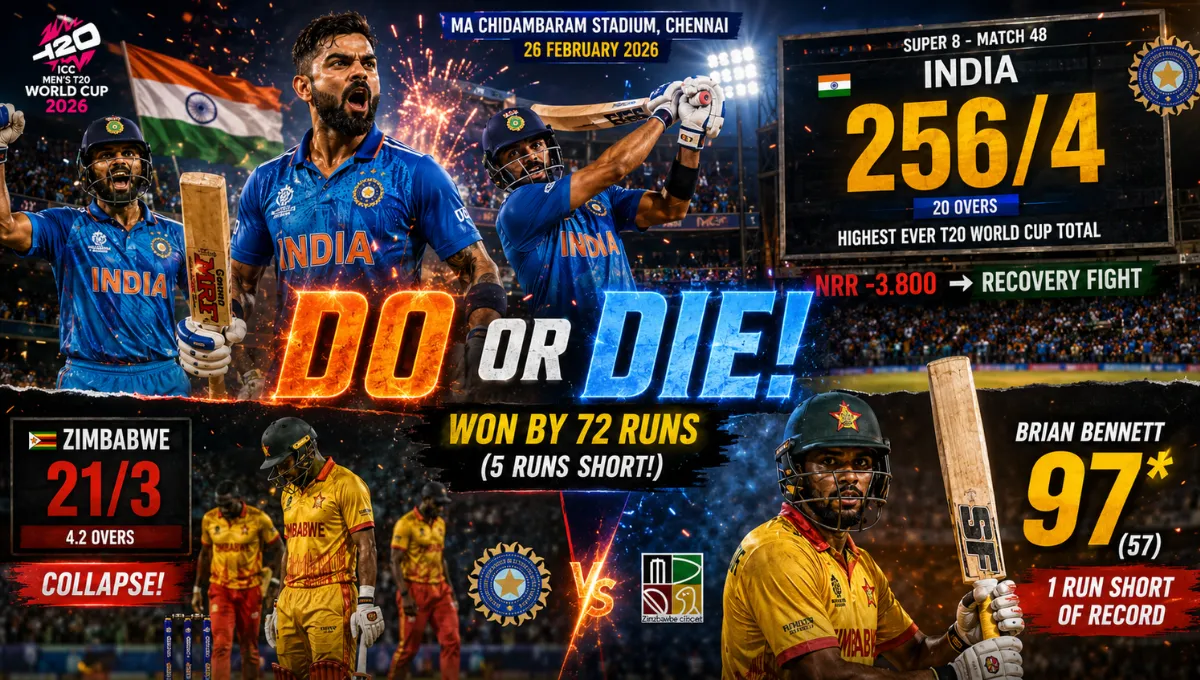
Four days earlier, India had just been beaten by 76 runs against South Africa in the same T20 World Cup 2026 Super 8 stage. Their tournament defense was suddenly in genuine danger. Then, at MA Chidambaram Stadium, Chennai, on February 26, 2026, India didn’t just bounce back. They posted 256/4, The highest T20 World Cup total in their history.
Zimbabwe, chasing 257, should have folded quietly. Instead, Brian Bennett walked out and played one of the greatest “nearly” innings in T20 World Cup history 97 not out, denied strike in the final over while chasing what would have been an all-time classic century.
Here’s the real problem with how this match gets covered: every scorecard site reports “India won by 72 runs” as if this was a comfortable, forgettable victory. It wasn’t. Buried inside the numbers is a genuinely historic batting performance from the losing side, a record-breaking bowling over, and a bounce-back story most reports don’t even mention.
This is the complete breakdown.
India vs Zimbabwe Super 8: full scorecard at a glance
| Match | 48th Match, Super 8 Group 1, ICC Men’s T20 World Cup 2026 |
|---|---|
| Venue | MA Chidambaram Stadium, Chennai |
| Date | February 26, 2026 |
| Result | India won by 72 runs |
| Team | Total | Overs |
|---|---|---|
| India | 256/4 | 20 (RR: 12.8) |
| Zimbabwe | 184/6 | 20 |
India’s 256/4 stands as their highest-ever total in T20 World Cup history.
India’s innings: how 256/4 became India’s highest-ever T20 World Cup total
Full India batting card
| Batter | Runs | Balls | Notes |
|---|---|---|---|
| Abhishek Sharma | 55 | 30 | Set the tone early |
| Ishan Kishan | 15 | — | Contributed in the powerplay |
| Hardik Pandya | 50 | 23 | One of the fastest fifties of the tournament |
| Tilak Varma | — | — | Contributed through the middle overs |
| Total | 256/4 (20 overs) | RR 12.8 |
Read Also:- Lucknow Super Giants Vs Gujarat Titans Match Scorecard
Zimbabwe’s bowling figures included Sikandar Raza (1/29 off 3), Blessing Muzarabani (1/43 off 4), and Varun… no, that’s India’s bowling. For Zimbabwe: Sikandar Raza 1/29, Blessing Muzarabani 1/43.
The bounce-back after a heavy defeat to South Africa
What people think vs reality:
- What people think: A high T20 total against a weaker opponent like Zimbabwe is routine and expected.
- Reality: India walked into this match having just lost by 76 runs to South Africa their tournament survival genuinely at stake. Posting their highest-ever T20 World Cup total immediately after that kind of defeat is a significant psychological response, not a routine performance against a lesser side.
Unique insight: Captain Suryakumar Yadav specifically addressed this context post-match, noting the team “aimed to put the past behind us” and didn’t dwell on the earlier defeat, instead reviewing a video analyst’s presentation on all batters and bowlers reflecting on their year. That’s a deliberate psychological reset, not an accident and it directly produced contributions from batters “up to number seven,” according to Suryakumar himself.
Original observation: Hardik Pandya’s 23-ball fifty deserves specific attention beyond the raw number. Pandya himself explained post-match that he had to “reassess” his approach mid-innings after realizing he was “trying to hit too hard,” shifting instead to timing the ball for sixes. That in-innings adjustment recognizing a flawed approach and correcting it in real time during a T20 innings is a rare, coachable skill that separates good T20 batters from elite ones.
What India needs to do now
- Build on this specific “reset mentality” approach for future high-pressure matches Suryakumar’s explicit strategy of reviewing season-long data rather than dwelling on the previous game is a repeatable process worth institutionalizing.
- Continue giving Pandya license to bat through the innings rather than purely as a finisher his mid-innings tactical adjustment shows genuine batting maturity beyond raw power hitting.
Zimbabwe’s chase: Brian Bennett’s great “nearly” innings
Full Zimbabwe batting card
| Batter | Runs | Balls | Notes |
|---|---|---|---|
| Tadiwanashe Marumani | 20 | — | Struggled initially in the chaseicc- |
| Brian Bennett | 97* | 59 | Denied strike in the final over |
| Sikandar Raza (c) | 31 | 21 | Built momentum alongside Bennett |
| Total | 184/6 (20 overs) | — | Lost by 72 runs |
Bowling for India: Arshdeep Singh 3/24 (4 overs), Varun Chakaravarthy 1/35.
Why 184/6 was closer to a heist than the scoreline suggests
Common mistake in analysis: A 72-run margin looks comprehensive on paper, leading most reports to describe this as India cruising to victory. The reality inside the scorecard is very different: Brian Bennett scored 97 not out off just 59 balls, and was statistically denied the chance to complete what would have been a historic century because he lost the strike in the final over.
Unique insight: Bennett’s 97* is the second-highest individual score by any batter against India in T20 World Cup history, behind only Chris Gayle’s 98* in 2010. That single fact transforms how this match should be remembered not as a routine Indian win, but as a genuine near-miss of one of the great individual innings in tournament history, delivered by a Zimbabwean batter under maximum pressure.
Slightly bold opinion: Zimbabwe’s cricket board should treat Bennett’s innings as proof their next generation of batting talent can compete individually with the very best teams in the world, even while the broader team structure still lacks the depth to convert individual brilliance into competitive team totals. This performance deserves more celebration in Zimbabwean cricket coverage than it’s currently receiving.
Real-world example: Sikandar Raza’s own post-match comments back this up he specifically praised his batters for playing “excellently” and managing the powerplay “smartly,” contrasting it with a previous match against a 250-run target where there was “urgency” in the batting order. Raza’s own captaincy assessment confirms Zimbabwe’s batting genuinely improved match-on-match, even in defeat.
What Zimbabwe needs to do now
- Build specific end-of-innings strike-rotation training Bennett being denied strike in the final over, right when he needed it most for his century, is a basic tactical failure that better partner communication could easily fix in future matches.
- Continue backing Bennett in the top three of the batting order this innings proves he can anchor a chase against elite bowling attacks under maximum tournament pressure.
Record-book breakdown: where this match ranks in T20 World Cup history
| Record | Detail |
|---|---|
| India’s highest T20 World Cup total | 256/4 — a new India record |
| Second-highest individual score vs India in T20 WC history | Brian Bennett’s 97* (behind Gayle’s 98* in 2010) |
| Most runs conceded by a bowler in 2 overs, T20 WC history | Shivam Dube — 46 runs |
| Second-highest match aggregate in T20 WC history | 440 runs (behind 459 in SA vs Eng, Wankhede 2016) |
| Sixes hit in the match | 28 total (India 17, Zimbabwe 11) — third-highest ever in a T20 WC match |
Read Also:- Punjab Kings vs Lucknow Super Giants Match Scorecard
The bowling figure nobody’s talking about: Shivam Dube’s expensive over
What most people miss: Buried inside India’s record-breaking win is a genuinely concerning statistic for their bowling attack: Shivam Dube conceded 46 runs in just two overs the most ever by any bowler in T20 World Cup history. A team can afford this kind of expensive spell when their batting posts 256, but this exact bowling vulnerability could cost India dearly against a team with more batting firepower than Zimbabwe in the knockout stages.
Counterintuitive idea: India’s own captain Suryakumar Yadav acknowledged this directly, admitting post-match that the team “could have been a bit more precise with our bowling” and that they needed to “sharpen” their approach specifically ahead of facing West Indies. This isn’t outside analysis it’s India’s own leadership flagging a genuine concern immediately after a 72-run win, which tells you how seriously it should be taken.
What India’s bowling unit needs to do now
Review Dube’s specific over-by-over bowling plans before the West Indies match a bowler conceding a T20 World Cup record of 46 runs in two overs needs either a tactical role adjustment (bowling earlier when batters are less set) or reduced overs in future high-stakes matches.
What this win means: the virtual quarter-final stakes
Unique insight: This victory did more than keep India’s campaign alive, It set up what was described as a “virtual quarter-final” against West Indies, while officially eliminating Zimbabwe from Super 8 contention. South Africa had already qualified from the group, while West Indies needed to beat India or hope for no result to progress, meaning India had to win to advance.
Original observation: The stakes framing here matters enormously for understanding why India’s batting approach was so aggressive throughout this innings. This wasn’t just about beating Zimbabwe comfortably it was about building a net-run-rate cushion and match-winning momentum heading into a genuine knockout-equivalent fixture against West Indies days later.
What fans tracking India’s tournament run should do now
Track India’s bowling changes specifically against West Indies given Suryakumar’s own admission about bowling precision needing improvement, any personnel or tactical shift in that match will confirm whether India’s team management acted on the lessons from this game.
Frequently Asked Questions (FAQs)
Q1. What was the result of the India vs Zimbabwe T20 World Cup 2026 Super 8 match?
Ans. India beat Zimbabwe by 72 runs in the Super 8 stage of the ICC Men’s T20 World Cup 2026 at MA Chidambaram Stadium, Chennai, on February 26, 2026. India scored 256/4, their highest-ever T20 World Cup total, while Zimbabwe finished at 184/6.
Q2. Who scored the most runs for India in the match against Zimbabwe?
Ans. Abhishek Sharma scored 55 off 30 balls, and Hardik Pandya scored a rapid 50 off just 23 balls, powering India to 256/4, their highest total in T20 World Cup history.
Q3. How close did Brian Bennett come to scoring a century against India?
Ans. Brian Bennett finished unbeaten on 97 off 59 balls, denied strike in the final over of Zimbabwe’s chase. His innings is the second-highest individual score by any batter against India in T20 World Cup history, behind only Chris Gayle’s 98 not out in 2010.
Q4. What records were set or approached in the India vs Zimbabwe 2026 match?
Ans. The match produced the second-highest aggregate run total (440) in T20 World Cup history, behind South Africa vs England’s 459 at Wankhede in 2016. Shivam Dube conceded 46 runs in two overs, the most ever by a bowler in a T20 World Cup match, and 28 sixes were hit combined — the third-highest ever in the format.
Q5. What did India’s win over Zimbabwe mean for their T20 World Cup 2026 campaign?
Ans. The win kept India alive in the Super 8 stage after a heavy 76-run defeat to South Africa in their previous match. It set up a “virtual quarter-final” against West Indies, while Zimbabwe was eliminated from the tournament.











Leave a Reply